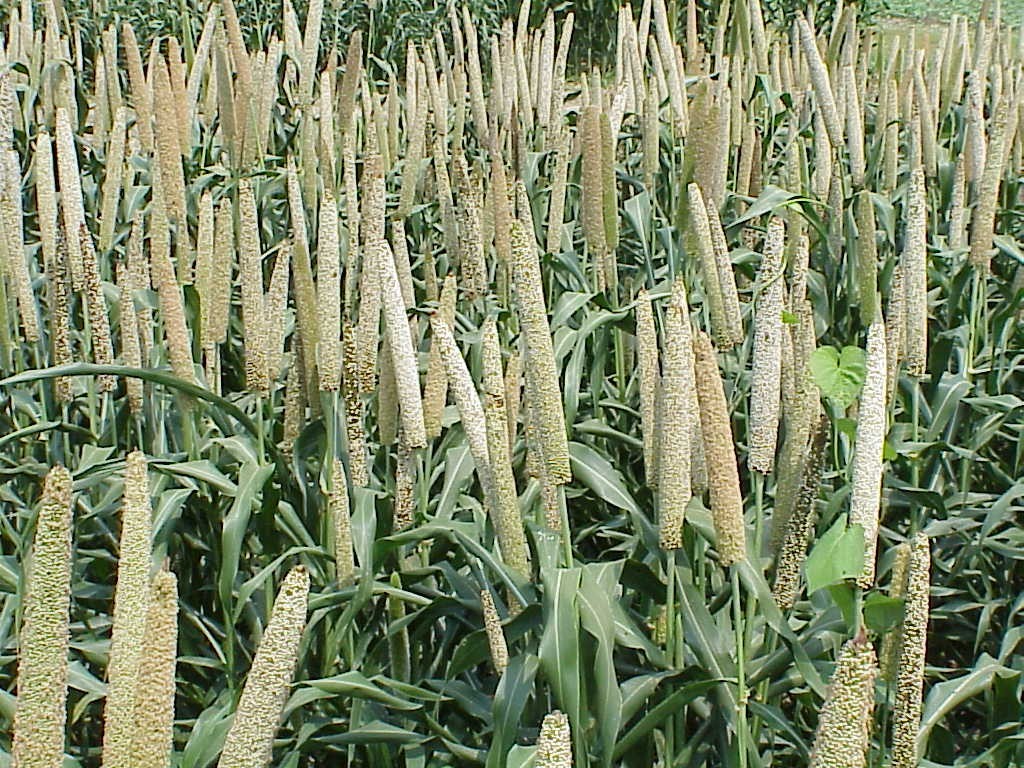
This image, entitled “Pearl millet” is in the public domain in the United States because it is a work prepared by an officer or employee of the United States Federal Government as part of that person’s official duties under the terms of Title 17, Chapter 1, Section 105 of the US Code.
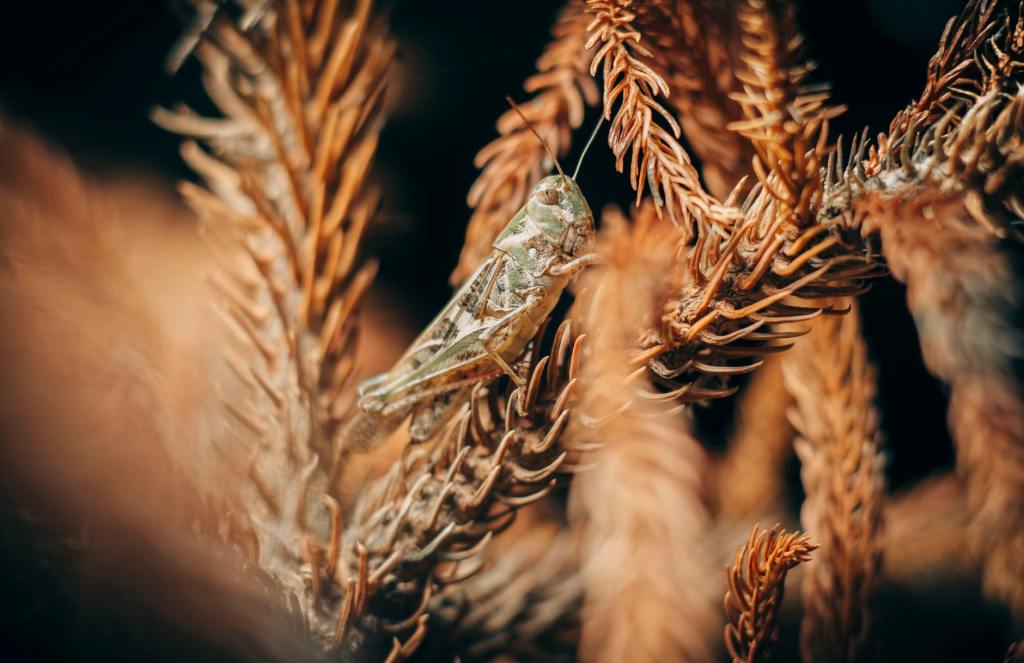
Amongst the numerous Bushisms attributed to George W Bush, 43rd President of the USA, he memorably said that humans and fish can co-exist peacefully (Ben Robke). That may be so, but the relationship between humans and insects is not always so peaceful. A situation that’s less than harmonious is when herbivorous insects target the same food sources as humans. Take, for instance, locusts.
Locusts, “various species of short-horned grasshoppers in the family Acrididae that have a swarming phase” (quoted from here) are a major pest of crops. Famously, “Locust swarms devastate crops and cause major agricultural damage, which can lead to famine and starvation. Locusts occur in many parts of the world, but today locusts are most destructive in subsistence farming regions of Africa” (quoted from here). Attempts to control locust swarms – and the danger to human crops posed by locusts more generally – are major agricultural pre-occupations wherever these hungry herbivores are found (Christina Panopoulou & Antonios Tsagkarakis, 2025). And the areas affected by locusts are extremely widespread,. For example “The range of the migratory locust (Locusta migratoria) is wider than that of any other acridid. It is found in grasslands throughout Africa, most of Eurasia south of the taiga, the East Indies, tropical Australia, and New Zealand” (quoted from here). Good news, then, that a step forward in locust control has been proposed by Mamour Touré et al. (2026).
Touré et al. (2026) discovered that increasing the protein content of a crop targeted by the Senegalese grasshopper (Oedaleus senegalensis) “successfully decreased pest abundance and damage”. Furthermore, the treatment “increased millet* yield” (Touré et al., 2026) [Ed. – although this may be predictable on the basis that decreased insect damage and cereal consumption means more harvestable grain..?]
The intervention used on this occasion was to add commercial nitrogen fertilizer to the growing millet crop. A consequence of this was – maybe not too surprisingly – increases in yield from the millet. The enhanced protein content may also be a result of the added nitrogen. But why should protein-enriched plants result in a decrease in grasshopper abundance? One might predict that greater protein content would make the crop more attractive to a would-be herbivore because the seed contains more of an essential ‘food group’, protein. Maybe ordinarily, yes, but the swarming behaviour of these insects requires a carbohydrate-rich diet “to create fat stores that power population growth and long-distance migration” (Nidhi Sharma). In that regard, the higher-protein millet seeds – which means less room for carbohydrates in the seed – are of no benefit to the insects. But, they are of benefit to the human consumers.
Although Senegalese grasshopper are not locusts (but, they are described as locusts in the graphics in the paper’s results section, and in-text throughout the paper), they do exhibit swarming behaviour similar to locusts**. Anything that can reduce the impact of this insect on farmers’ crops is therefore helpful – and may have relevance to control of the devastation caused by locusts proper.
Another dimension to this problem is human behaviour. “Livestock overgrazing and intensive cropping can degrade land and cause soil erosion, creating nitrogen-poor soil that spawns carb [shorthand for ‘carbohydrate’]-heavy plants which support locust growth and help sustain swarms traveling long distances“ (Nidhi Sharma). Better management by Man of domesticated animals may be another way of controlling locust problems, which is part of a wider, more environmentally-sympathetic approach to land usage, one that works with nature rather than against it. And, could provide a solution that is, arguably, cheaper than the expense of buying and applying nitrogen fertilisers.
For more on this work, see Mikala Kass, Nidhi Sharma, here, here, and here.
* Disappointingly (from the plant-minded perspective of this blog, anyway), Touré et al. (2026) don’t specify the particular millet species involved. Just referring to ‘millet’ is not specific enough because – and quoted from here, “millets are a highly varied group of small-seeded grasses”, and “The different species of millets are not all closely related. All are members of the family Poaceae (the grasses), but they belong to different tribes and subfamilies”.
However, the image that accompanies the paper’s crop yield graphic looks like pearl millet, Cenchrus americanus, which “has been grown in Africa and the Indian subcontinent since prehistoric times. The center of diversity and suggested area of domestication for the crop is in the Sahel zone of West Africa” (quoted from here).
** And “In many parts of the Sahel, this species may cause greater year-on-year crop damage than better-known locusts, attacking crops such as the pearl millet” (quoted from here).
REFERENCES
Christina Panopoulou & Antonios Tsagkarakis, 2025. From surveillance to sustainable control: A global review of strategies for locust management. Agronomy 15: 2268; https://doi.org/10.3390/agronomy15102268
Mamour Touré et al., 2026. Soil amendments suppress migratory pests and enhance yields. Sci Rep 16: 646; https://doi.org/10.1038/s41598-025-27884-z


Leave a Reply