
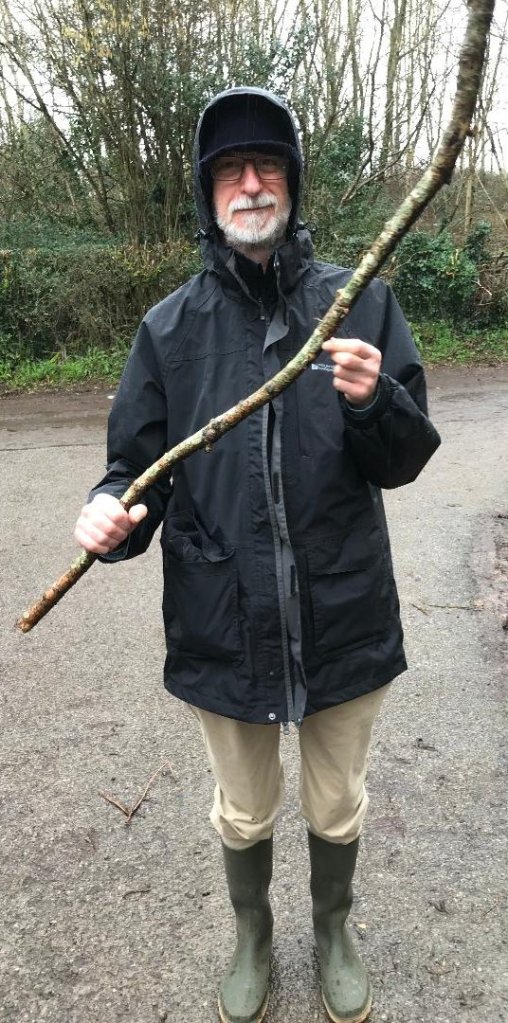
The author with a modern-day stick (from the Plasticene not the Pleistocene…), purely for illustration purposes.
What does every boy, wherever he may live in the world (and whatever his age…), do when he gets into a wooded area? He looks for and finds a stick*. And what does he do with that stick?
He uses it to have: imaginary sword fights with a less worthy knight or even battle a dragon to rescue a damsel in distress (Ryan Janise) (or maybe wields his lightsabre in a duel with an intergalactic foe); or to clear away vegetation as he hacks his way through a tropical jungle in search of El Dorado (Willie Drye); or which he waves around in a big circle in the air pretending it’s a giant sparkler and writing his name; or bashes it against the bark of a tree trunk to make some noise and beat out a warning to others; or poke it into an interesting-looking hole to see what curious creature may reside within; or to dig into the ground to see what interesting things can be unearthed [Ed. – arguably, there are more uses for a stick in the hands of the imaginative than, well, ‘you can shake a stick at’ (Pascal Tréguer) …].
However he uses it, he recognises in those imaginative actions a tool that can do amazing – and multiple – things (especially if the raw stick is subjected to further processing such as removing the bark..). And, in doing so he is re-enacting a story that’s part of an unbroken chain of connection between humanity and wood, one that’s at least 430,000 years old**. And how do we know how long this has been going on? Because of work by Annemieke Milks et al. (2026), which presents “Evidence for the earliest hominin use of wooden handheld tools found at Marathousa 1 (Greece)” [Ed. – by one interpretation of that statement, the authors are being more than a little modest because the find purports to be the earliest hominin use of wooden handheld tools anywhere on the planet, not just in that site in Greece], that’s how***.
What’s been unearthed?
Amongst dozens of pieces of wood – essentially sticks or fragments therefrom – recovered from a site in southern Greece known as ‘Marathousa 1’ (or MAR-1), two seemed worthy of much more detailed examination by Milks et al. (2026). Having subjected them to thorough study, Milks et al. (2026) concluded that they had been deliberately shaped. In other words they were artefacts crafted by the hand of humans, or our human ancestors. The larger item was a thin stick of alder (an unidentified species of Alnus) wood about 80 cm long (although now in four pieces). The other was a much shorter length of wood – approx. 6 cm long – from either a willow or a poplar tree (Salix sp., or Populus sp., respectively).
At first sight it seems reasonable to propose that the longer item – when put back in one piece – might have been a ‘digging stick’ (Suzanne J Nugent, 2006; Oriol López-Bultó et al., 2020), “utilized for digging in soils, primarily for plant extraction” (Milks et al., 2026). It is also conjectured that it may have been a multi-purpose tool, possibly also used as a ‘bark peeler’ (Dennis M Sandgathe & Brian Hayden, 2003), “to extract inner bark for consumption” (Milks et al., 2026).
However, noting that this item was found alongside bones of an elephant (a “large adult male straight-tusked elephant (Palaeoloxodon antiquus)” (Milks et al., 2026)) has led to the suggestion that the stick may (also) have been used to help process the animal’s carcass [Ed. – in the words of the researchers, “The tool … fits with other Pleistocene multifunctional sticks retrieved in association with butchered megafauna”. Although this suggestion was not made much more of in Milks et al. (2026), it is a notion that has been – unsurprisingly – enthusiastically pursued by some in the scicomm media, e.g., “Oldest wooden tools may have been used to butcher elephants” (Andrew Curry). If substantiated, that would make this relatively simple ‘stick’ quite a versatile – plant-uprooting, bark-peeling, carcass-processing – multi-purpose tool, indeed.
The likely use of the smaller item “found in the periphery of the main elephant bone accumulation, represents a new type of wooden artifact, whose function is as yet unclear” (Milks et al., 2026). By reference to “evidence of use of organic tools for working lithics [“small rock artifact”s (George (Rip) Rapp)] during the Lower Paleolithic … one possibility could be its use in retouching the small lithic tools at MAR-1” (Milks et al., 2026)****. In other words, this could be a wooden implement used in the care and maintenance of stone tools and implements*****. But, the researchers also mention use of willow (one of the species that this artefact may be made of) “is well documented from Holocene archaeological sites with functions including as wood splitting wedges, bows and arrows, handles, digging sticks, fishing technology, stakes, and vessels …” (Milks et al., 2026). But, “we don’t really know what it was for”, co-author Katerina Harvati is quoted as saying in the scicomm article about this work by Christian Thorsberg.
But, there are doubters…
Still, demonstrating that a length of wood is a tool isn’t easy. “Telling a rock from a stone tool is one thing******, but telling a wooden tool from a stick is a different proposition,” says Katerina Harvati, a paleoanthropologist at the University of Tübingen who led the research project (quoted from Andrew Curry). The problem of attributing artefactual status to these wooden objects is one of the reasons why not everyone is convinced by the work. For instance, Jarod Hutson, an archaeologist with the Smithsonian’s National Museum of Natural History who was not involved in the study, says “It’s difficult to get excited about these because they don’t strike you immediately as wooden tools …And we don’t know what they were used for” (quoted from the article by Christian Thorsberg).
Whilst one has some sympathy with that sentiment, we prefer to go with the view that Milks et al. (2026) have “built a compelling, forensic case to show these are wood tools … and not just random wooden detritus” (the words of Matt Pope, an archaeologist at University College London (UCL), who was not part of the new study, and quoted from the article by Andrew Curry).
Who were those workers with wood?
It should be noted that Milks et al. (2026) do not tell us which of our many human ancestors may have made the artefacts. Instead they just refer to ‘hominins’******* in their suitably cautiously-worded title and throughout the article.
However, other commentators upon that work were more than happy to try and identify those ancestral humans; e.g., “the stick might have been used by an early cousin of modern humans—perhaps an ancestor of Neanderthals (Lisa Hendry, Rebecca Wragg Sykes, Frank L’Engle Williams et al.), or Homo heidelbergensis (Fran Dorey, Henry McHenry), or another, as-yet-unidentified hominin…” (Andrew Curry); and “The items were likely used by early Neanderthals or a species known as Homo heidelbergensis” (Christian Thorsberg).
We may never know the identity of the woodworkers of Marathousa 1, but their handiwork is evidence of creativity and ingenuity, characteristics that one would certainly wish to claim for a human relative, however distant.
Sticks and stones…
Whilst it is said that ‘sticks and stones may break my bones’ (Gary Martin), it’s usually only the latter that we have archaeological evidence for. Why are there not more of these – wooden – tools in the archaeological record?******** Because stones, as minerals, tend to survive far longer in the earth than organic items such as sticks or other wooden objects, which decompose. However, and just occasionally, such organic artefacts are left in the right place, and time, to be preserved, as uncovered in Milks et al. (2026)’s work at Marathousa 1 (where “The site’s loose sediments and wet environment helped bury and preserve the 144 pieces of wood that archaeologists excavated at the site” (Christian Thorsberg)).
But, and disappointingly, this paucity of preservation of wooden artefacts is why, and as momentous a discovery as the ‘Greek stick’ tool discovery is, it is always likely to be ‘pipped at the post’ by more long-lasting, inorganic finds. Take for example, “This Hammer Created From an Elephant Bone 480,000 Years Ago May Be the Oldest Known Tool of Its Kind Ever Found in Europe” (Sarah Kuta). That quoted title relates to work by Simon A Parfitt & Silvia M Bello (2026). [Ed. – this preservation bias in favour of more durable artefacts is primarily the reason why we talk of The Stone Age – rather than the – and much more appropriate – Wood Age…].
Another reason for dearth of wooden artefacts in antiquity may relate to their flammability. Wooden objects are eminently combustible. So, maybe these ‘sticks’ were used to start and fuel fires once their usefulness as tools had been exploited. After all, human creation and use of fire dates back – at least – almost 400,000 years, according to research by Rob Davis et al. (2026)*********. And for more on the human fascination with fire, see Tom Hale’s piece.
So, what have we learned..?
From the all-important plants-and-people perspective (that we are so fond of in this blog), we finish with the words of Milks et al. (2026): “Despite their small number, they [the wooden tools from Marathousa 1] expand our knowledge of hominin plant-based technology both temporally and geographically, as well as in terms of repertoire and exploitation of plant species”. A view we here are very happy to stick with.
* It’s highly likely that some girls do this as well. I’m not saying that they don’t, or couldn’t (and the notion of connectivity between modern humans and our human ancestors works just as well with girls as boys). I’m just remarking on what seems to be more typical behaviour amongst boys, which appears to be an almost primeval, knee-jerk, Pavlovian response that’s more noticeable in those more simple souls… That’s my story, and I’m, err, sticking to it.
It has been said that ‘ontogeny recapitulates phylogeny’ – in which “development of the embryo of an animal, from fertilization to gestation or hatching (ontogeny), goes through stages resembling or representing successive adult stages in the evolution of the animal’s remote ancestors (phylogeny)” (quoted from here) (Esther Jackson, Casey Luskin). Here, we have more a case of ‘ethology (animal behaviour) (Michael A Steele) re-enacts ancestry’…
** Some readers may recall a news item about ancient wooden buildings in Zambia (Larry Barham et al., 2023). Dated to 476,000 years ago you might presume that their great antiquity makes them a more ancient use of wood than the stick story considered in this post. It does, but the Zambian wood use is distinguished from that from Greece because they “are not counted as wooden implements because they are structures” (Nicholas Thompson & Katerina Harvati). Nevertheless, as an older use of wood, the Zambian find appears to hold the record – at present. For more on the Zambian find, see Thompson & Harvati, Jan Dönges, Annemieke Milks, and Will Sullivan.
*** For more on the Marathousa 1 story, see Owen Jarus, Dario Radley, Tom Metcalfe, Enrico de Lazaro, Stephen Luntz, Andrew Curry, Guillermo Carvajal, Adithi Ramakrishnan, Christian Thorsberg, Michael Marshall, Jan Dönges, Abdul Moeed, Nicholas Thompson & Katerina Harvati (co-authors of the scientific article), Gary Manners, Emily Carter, Kaleena Fraga, here, here, and here.
**** For more on lithics and lithic tools, see here, here, here, here, and here.
***** Interestingly, if he might be allowed to float a train of thought on this notion, Mr P Cuttings has a proposition for the palaeoarchaeologists. If we accept that human ancestors used naturally sharp stones – ‘naturaliths’ [see here, here, here, and the research article by Metin I Eren et al. (2025)] – long before the technology to create lithic tools was developed – maybe as long ago as 3 million years (Alastair Key & Eleanor M Williams, 2026) – then it is possible that other tools may have been used to keep those edges sharp, etc. It is therefore conceivable that wooden implements – such as “Specimen 935/671-13” (Milks et al., 2026) [the short length of wood from Marathousa 1] – might also have been created and used for that purpose. But, being made of non-durable wooden material that readily decomposes in nature, we have no record of their existence – or, therefore, use. The point Mr Cuttings is making is that wooden implements for maintaining stone tools may be as old as – or even older – than the purposefully-crafted stone tools. Right, flight of fancy over.
****** For insights into how one can differentiate a rock from a stone tool, see the article by John K Murray.
******* What are hominins (Dennis R Dean, Mary Caperton Morton)? In modern usage, ‘hominins’ is the term used for “the group consisting of modern humans, extinct human species and all our immediate ancestors (including members of the genera Homo, Australopithecus, Paranthropus and Ardipithecus)” (quoted from here).
‘Hominins’ should be used carefully to distinguish it from the very similar term ‘hominids’, which embraces a much larger group of primates (Sarah Malmquist & Kristina Prescott), “consisting of all modern and extinct Great Apes (that is, modern humans, chimpanzees, gorillas and orang-utans plus all their immediate ancestors)” (quoted from here).
Somewhat annoyingly, the word ‘hominids’ used to refer to humans and their ancestors. The literature – which includes on-line resources – will have both usages of hominids [Ed. – unfortunately, checking the publication date of the item won’t necessarily help you to understand which meaning is intended because even today hominids is used incorrectly (Mary Caperton Morton)…]
******** Although use of the stick as a weapon is not something suggested by Milks et al. (2026), having now thought of it, isn’t it as likely that the stick tool was used to defend the elephant’s meat from carnivores to keep more of the carcass for the hominins, than using it specifically to butcher the animals? Its presence alongside the elephant may just indicate the site of demise of the stick-wielder who did not win the battle with the hungry carnivore..?
********* For more on that somewhat incendiary discovery, see Meghan Bartels, Nick Petrić Howe & Anne Marie Conlon, and Ségolène Vandevelde. And for insights into the so-called ‘burn selection hypothesis’ and how fire injury helped to shape human evolution, see Joshua Cuddihy et al. (2026), Andrew Paul, and Benjamin Taub.
REFERENCES
Larry Barham et al., 2023. Evidence for the earliest structural use of wood at least 476,000 years ago. Nature 622: 107–111; https://doi.org/10.1038/s41586-023-06557-9
Joshua Cuddihy et al., 2026. Burn selection: How fire injury shaped human evolution. BioEssays 48(2): e70109; https://doi.org/10.1002/bies.70109
Rob Davis et al., 2026. Earliest evidence of making fire. Nature 649: 631–637; https://doi.org/10.1038/s41586-025-09855-6
Metin I Eren et al., 2025. What can lithics tell us about hominin technology’s ‘primordial soup’? An origin of stone knapping via the emulation of Mother Nature. Archaeometry; doi: 10.1111/ARCM.13075
Alastair Key & Eleanor M Williams, 2026. A continuous record of early human stone tool production. Cambridge Prisms: Extinction 4: e1; doi: 10.1017/ext.2025.10009
Oriol López-Bultó et al., 2020. Tool mark analysis of Neolithic wooden digging sticks from La Draga (Banyoles, Spain). Quaternary International 569–570: 39-50; https://doi.org/10.1016/j.quaint.2020.06.045
Annemieke Milks et al., 2026. Evidence for the earliest hominin use of wooden handheld tools found at Marathousa 1 (Greece). PNAS 123(6): e2515479123; https://doi.org/10.1073/pnas.2515479123
Suzanne J Nugent, 2006. Applying use-wear and residue analyses to digging sticks. Memoirs of the Queensland Museum, Culture 4(1): 89–105; https://search.informit.org/doi/10.3316/informit.890092331962439
Simon A Parfitt & Silvia M Bello, 2026. The earliest elephant-bone tool from Europe: An unexpected raw material for precision knapping of Acheulean handaxes. Science Advances 12(4): eady1390; doi: 10.1126/sciadv.ady1390
Dennis M Sandgathe & Brian Hayden, 2003. Did Neanderthals eat inner bark? Antiquity 77(298): 709-718; doi: https://doi.org/10.1017/S0003598X00061652


Leave a Reply