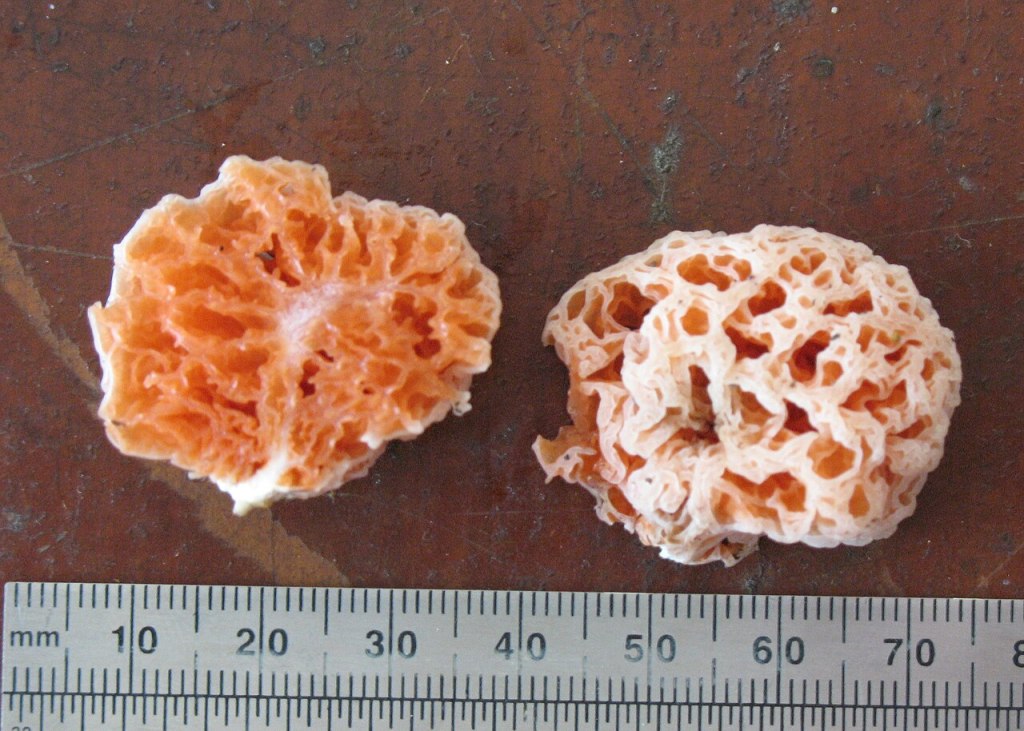
This image, entitled “Fruit bodies of the bolete fungus Spongiforma squarepantsii Desjardin, Peay & Bruns. Specimens collected in Lambir Hills”, and by Tom Bruns (pogon), is licensed used under the Creative Commons Attribution-Share Alike 3.0 Unported license.
Warning: This is the first of two posts that are a bit of a rant. However, whilst one of the matters raised may appear to be arcane and abstruse [see Part 2], the other is fundamental to science writing [and dealt with here, in Part 1 of the pair]. Both are important to Mr P Cuttings and his attempts to communicate science to a general audience in his blog.
One of the ambitions of the plantcuttings blog is to communicate scientific matters to a non-specialist audience. Part of doing that is to present scientific information properly. And to do that, it is necessary to follow certain conventions. That should also be a goal of all sites that aim to promote greater understanding of science amongst the general public. But, is that always the case? I’ve come across an issue in the scicomm – communication of science (Bruce V Lewenstein, 2022; Sarah Hubbart; Anika Gogia & Brittany Zhao – media that risks undermining that goal.
Rather surprisingly, this matter was found in a post on Phys.Org, a site dedicated for science, and powered by Science X Network [see here], “one of the largest online communities for science-minded people”. Phys.Org is “a credible Pro-Science source based on the publication of scientific information from credible universities and peer-reviewed journals and properly sourced original content. We also rate them High for factual reporting due to proper sourcing and a clean fact check record” (quoted from here). Phys.Org is also a site that I value highly as a source of very good scicomm reporting – and has provided inspiration for many of my own posts.
With those endorsements, what do readers make of this statement? “Alessandro Chiolerio et al, Bioelectrical synchronization of Picea abies during a solar eclipse, Royal Society Open Science (2025). DOI: 10.1098/rsos.241786“. These are the publication details for the science discussed in Phys.Org’s scicomm post entitled “Forest in sync: Spruce trees communicate during a solar eclipse”*.
What is wrong in this extract? First, and probably the most egregious error, is the way that the scientific name of the plant is shown. Second, there’s a problem regarding use of ‘et al’. [Ed. – since the latter issue is of secondary importance, it’s dealt with in Part 2 of this pair of posts]. First things first…
Setting out scientific names
Scientific names of organisms should be shown in italics (e.g., here, here, here, and Daniel Ruten) [Ed. – for more on scientific names, see here, here, and here]
In the Phys.Org excerpt, the scientific name of Norway (or European) spruce should therefore be shown as Picea abies (Christopher J Earle). Non-italicisation of a scientific name is indefensible for any organisation that purports to report science, and promotes very poor practice amongst readers.
This error is not made within the body of the Phys.Org post because that only mentions the tree’s common name. Unfortunately, simply referring to it as ‘spruce’ doesn’t distinguish it from the other 36 species of spruce (Christopher J Earle), which include dragon spruce, white spruce, and black spruce. Whilst it is always better to use a plant’s scientific name (for first mention at least) – to avoid doubt or ambiguity over which organism is meant – use of its common name may be defended on the grounds that scientific names may not be familiar to readers. Whilst I can understand that, use of a common name that is not specific enough to the particular spruce species in question – as done here – doesn’t help matters.
Can we make sense of this practice?
In trying to make sense of why Phys.Org has not italicised Picea abies on this occasion I wondered if the author of the post was merely being faithful to the way in which that scientific name was presented in the source used as the basis for the Phys.Org article – stated to be Southern Cross University. Checking the source site the journal article information there is displayed as: ”‘Bioelectrical synchronization of Picea abies during a solar eclipse’. Authors: Chiolerio A, Gagliano M, Pilia S, Pilia P, Vitiello G, Dehshibi M, Adamatzky A. Journal: Royal Society Open Science DOI: https://doi.org/10.1098/rsos.241786”. In other words, the scientific name of the tree is there shown correctly [Ed. – but that Southern Cross University source simply refers to ‘spruce’ trees in the body of the item…].
Maybe the writer of the Phys.Org item was just copying the layout of the scientific name from the journal’s site? No, the scientific name is correctly italicised there: “Bioelectrical synchronization of Picea abies during a solar eclipse”.
And this is not an isolated example. Further research for this post has revealed that the numerous scientific names mentioned are not italicised in the Phys.Org item entitled “Zombie fungi and ‘bloodstained’ orchids: Top plant and fungal species named new to science in 2025”. [Ed. – and has compounded the problem here by citing numerous scientific articles for that post, whose titles include scientific names, but which have been shown unitalicised, despite being correctly italicised in the article titles themselves…] Similarly, the binomial of the plant that is the source of arrow poison mentioned in the Phys.Org post entitled “60,000-year-old traces of world’s oldest arrow poison reveal early advanced hunting techniques”, edited by Stephanie Baum and reviewed by Robert Egan, is not italicised.
Why has Phys.Org done this?
Under the section known as ‘Editors’ Notes’ (e.g., here) – for all three of those highlighted Phys.Org articles – we are told that “This article has been reviewed according to Science X’s editorial process and policies [which page is actually entitled “Editorial standards”]. Editors have highlighted the following attributes while ensuring the content’s credibility: fact-checked; peer-reviewed publication; trusted source; proofread”. Amongst the list of the site’s editors, several have degrees in various biological sciences – e.g., Sadie Harley, BSc (Hons) in Life Sciences & Ecology; and Paul Arnold, BSc in Biology. The need for, and importance of, setting out scientific names correctly should therefore be known to the Phys.Org editorial team as a whole.
With that as background, I can only conclude that the reason that Phys.Org has chosen to show scientific names unitalicised must either be an editorial decision by that scicomm outlet, or a lapse in proof-reading the items before publication.
Maintaining standards in writing about science
Whatever the explanation, seeming to promote non-italicisation of scientific name is very poor practice, and could be seen as an example of dumbing-down in communicating science. All of us involved in, and concerned about, reporting and interpreting science for a non-specialist audience must lead by example – but that example needs to be a good one. [Ed. – on the other hand, it is nice to see the journal name italicised by Phys.Org.]
In fairness to Phys.Org, they do publicise their policy regarding “Clarifications, corrections and retractions”, which states that “Science X is committed to achieving the highest standards of accuracy and will never knowingly publish material that is inaccurate. While we may make mistakes, we will correct them”. Accordingly, Mr P Cuttings has contacted Phys.Org about this matter, but has yet to receive a reply.
Take-home message: plantcuttings.uk intends to continue to italicise scientific names (and to use et al. for cited publications which have more than two authors (see Part 2) for the foreseeable future as exemplifying best practice in this aspect of science writing, and communicating [Ed. – is the future really foreseeable? If it is, I will be asking you to choose my Euro Millions/National Lottery numbers…].
I’m so glad I got that off my chest. However, there’s a little more in part 2 of this pair of posts…
* The keen-eyed amongst you will recognise that this scientific work was written about in my July 2025 post about trees and solar eclipses**. In the spirit of ‘fessing-up’, I originally intended to deal with the ‘et al.’ matter in that post, but it was already rather a long item and so that particular matter was shelved ‘until another day’, which, it turns out, is next week. And it was only when writing that ‘et al’ post that I noticed the much bigger matter of incorrect representation of scientific names(!)
** For an update on ‘trees and solar eclipses’, see the detailed commentary of the study by Ariel Novoplansky & Hezi Yizhaq (2026), and the scicomm article by Andrew Paul (with the scientific name of the study organism properly italicised…).
REFERENCE
Bruce V Lewenstein, 2022. What is ‘‘science communication’’? JCOM 21(07): C02; https://doi.org/10.22323/2.21070302
Ariel Novoplansky & Hezi Yizhaq, 2026. Eclipse of reason: debunking speculative anticipatory behavior in trees. Trends in Plant Science; DOI: 10.1016/j.tplants.2025.12.001


Leave a Reply