
Tree day: A story of 24 hours and 24 arboreal lives, Meg Lowman, illustrated by Thibaud Hérem, 2025. The University of Chicago Press.
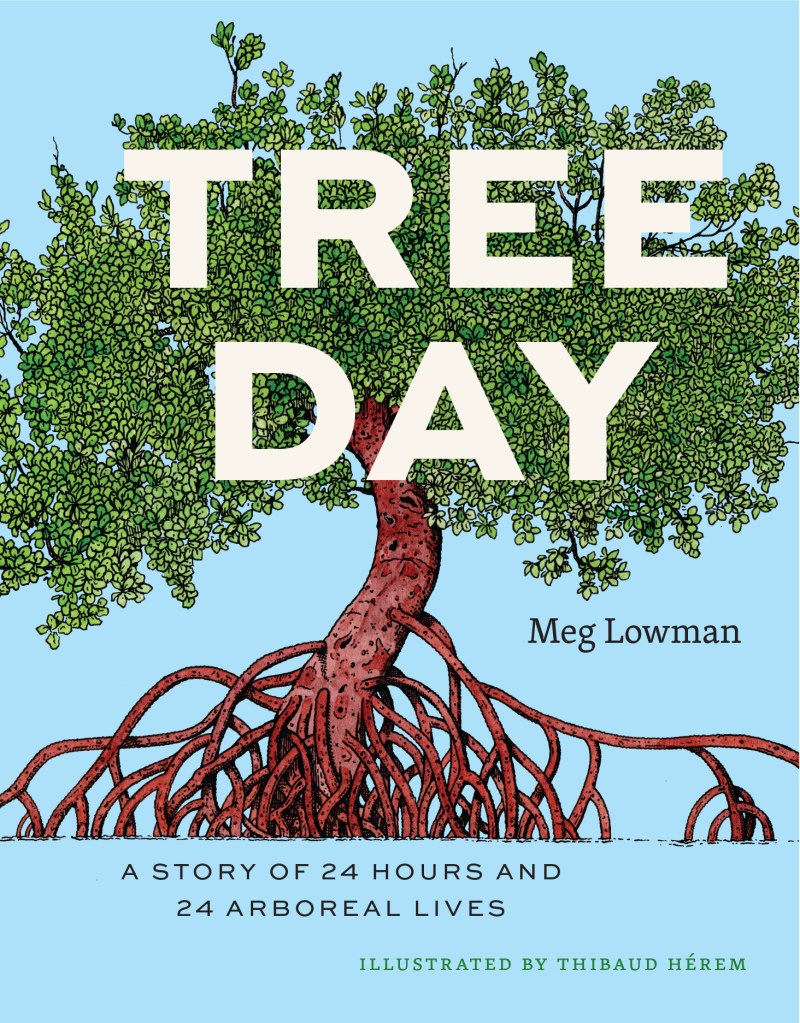
Tree day by Meg [Margaret] Lowman [which title is here appraised] is a charming book.
Overview
Tree day is written with clear appreciation for, and evident love of, trees. And that’s entirely understandable when one learns that the author – formally Dr Margaret Lowman*, but unofficially – and affectionately – known as ‘Canopy Meg’ (Marian Smith Holmes) – has spent many years dangling precariously from ropes amongst the tops of some of the tallest trees on the planet investigating numerous aspects of their biology and ecology.
Having spent almost a lifetime amongst the tree canopy she knows a thing or two about the ecology of that so-called ‘eighth continent’ (Paul Kennedy, Carlyn Kranking, Anna Salleh)**. Amongst which insights are that: “almost half of terrestrial biodiversity lives in the tops of tropical trees, and we never knew that before a handful of us started climbing trees; most insects prefer to eat leaves at night; leaves live a long time in the canopy (or at least some do); insect defoliation leads to the trees investing in defensive chemicals that in turn become medicines used by many cultures; and rain forest seedlings are not quick to regenerate” (quoted from here). Several of those nuggets of information – and many more besides! – are to be found amongst the tales of 24 trees in the book which therefore represents a really good introduction to tree biology – and especially tree canopy ecology.
It’s all about timing…
“This book is part of a series of natural history volumes in which chapters revolve around particular times of day, but the time of day is not always a defining factor for tree activities. I have therefore taken poetic license to approach these twenty-four hours with regard to not only the biology of trees but also the ecology of tree canopies” (p. xxv). “Sometimes, I have planned our visit to see a tree at a particularly fascinating time in its day, such as when a dragon’s blood tree [one of the few trees that Meg has not seen in its natural habitat] in Yemen attracts nighttime pollinators to its flowers. At other times, a personal memory connects a tree to a time—spending a cold, rainy night in the Scottish Highlands to study hairy birches” (pp. xii/xiii).
And it’s those personal insights that help to make Tree day such an interesting book: Meg has been there [except for Yemen], seen them, climbed them, studied them. For almost every tree Meg has a personal anecdote about her relationship or encounter with it – for example, “A weak bladder can often be a liability for a field biologist who needs to spend nights in the treetops. But sometimes the need to pee can lead to discovery. I never thought that a trip to the outhouse in the wee hours in the middle of a subtropical jungle would cement my love affair with a tree, but that is how I came to adore coachwood” (p. 21). And she cheerfully shares those experiences with her readers with writing that is full of flair and wit and – above all – love for these awe-inspiring trees and their intriguing ecologies, and respect for the indigenous peoples who live along side these wonderful products of the natural world.
As always with Earth day collections, one wonders how the featured plants were matched with times of the day/night. For Tree day it was simple, as the author tells us: “In this book, I will share my twenty-four favorite trees and explain what makes them extraordinary” (p. xv). Furthermore, “These twenty-four trees are my good friends—I have climbed, photographed, observed, and measured them. I have undertaken all kinds of research into their individual canopies and, more broadly, into the role of forests in the health of the planet” (p. xxiii). Which is fair enough.
Some more detail…
As standard, each of the 24 Chapters contains: a full-page black-and-white ink drawing of the featured tree by talented artist Thibaud Hérem (and a representation of a leaf elsewhere in the chapter)***; time of day; common name; scientific name; location (where plant is native – many may have been transplanted elsewhere in the world since their ‘discovery’…). Thereafter, the text provides information regarding basic information about the tree (e.g., height, flowers, leaves, stem, roots), its uses by people, its ecology, and usually insights into an aspect of its biology or physiology or conservation. Plus, an anecdote by Lowman that personalises her association with the tree. Frequently the plant family to which the tree belongs is mentioned [Ed. – it would be useful if this was stated for all trees, on the first text page].
The length of each chapter varies, from a whopping 11.2 pages for coastal redwood down to a diminutive 5.25 for African baobab (Adansonia digitata), and a mere 5 pages for red mangrove (Rhizophora mangle). All trees showcased are single species, apart from the chapters for Ficus spp., and Cecropia spp. In terms of taxonomic coverage, the majority are angiosperms [which includes two Eucalyptus spp. – New England peppermint, and ribbon gum], primarily dicots (Eric Bullard), but with two monocots (Frederick B Essig), dragon’s blood tree (Dracaena cinnabari), and cabbage palm (Sabal palmetto)****. Two gymnosperms (Gary E Dolph) are also featured, gingko (Ginkgo biloba), and the conifer, coastal redwood (Sequoia sempervirens). Geographically, trees featured are from North America, Central and South America, Asia, Africa, Australia, India, Europe, and Yemen.
Further Reading
After a general listing of 11 books – 5 of which are either authored or co-authored by Meg, and one that’s about Meg(!) – we have sources by chapter. Those chapter sources include 19 by Lowman (including her PhD Thesis) [Ed. – which only goes to show how much the author has contributed to the study of the subject matter of the book, and underlines her credentials for writing Tree day!], and are generally a mix of books and scientific articles. The number of items listed varies widely between trees, e.g., we have a maximum 8 sources for coastal redwood, and for fig, and 6 items re red stinkwood, but only one each for durian, and cocoa tree. The other tree chapters have between 2 and 4 stated sources.
Index
This consists ofn 14.25 pages of 2-columned entries, from ‘abscission’, to ‘Zahl, Paul’, via terms such as: Amazon (South America); arbornauts; biodiversity; Bourdain, Anthony [whose quote about eating durian is memorable!); cauliflory; citizen scientists; climate change; deciduous trees; droughts; ecology; Ethiopia, church forests; Fossey, Dian; frugivores; growth of trees; gymnosperms; herbivores; hydrology; Indigenous peoples; insects: in Antarctic beech; jungles; keystone species; koalas; ligno-tuber; logging; methylxanthine; monodominant species; Native Americans; natural capital; odors; owls; phloem (nutrient-transporting cells); pollination; rainforests; reforestation; science and church; successional species; tarantulas; trunks; umbrella species; Vermont (United States); “wet rain”; xylem (water-transporting cells); and Yemen.
Some over-simplification…?
Throughout the pages of Tree day author Lowman introduces us to lots of tree biology (with such terms as umbrella trees, cauliflory, vivipary, ligno-tubers), and to their ecology with mention of emergents, umbrella species, and monodominant species, and many of the interactions they have with animals, and humans. As far as I can tell, all technical terms are explained upon first mention in-text – which is always nice to see, and is considerate of the expected intelligent but largely non-specialist audience.
However, there were at least three places where attempts to convey some of the science of trees was over-simplified to the point that it was inaccurate, and probably misleading. First, “All tree trunks have a cambial layer, which is composed of water-transporting cells called xylem and nutrient-transporting cells called phloem” (p. 41) [the cambium is a meristematic tissue that’s solely concerned with making new cells, some of which go on to become components of the phloem, and the xylem, and some of which remain as cambial cells – to make more cambium, phloem and xylem cells.] Second, “A leaf represents one of nature’s most extraordinary factories, manufacturing sugars from sunlight” (p. 119) [certainly, energy within sunlight is converted into a chemical form within the products of photosynthesis such as sugars. But it isn’t sunlight that’s magical converted into sugars, we need water and carbon dioxide – and a lot of biophysics and biochemistry – to achieve that.]. And third, “These fungal partners absorb nutrients and moisture from the soil through their delicate, almost microscopic roots (known as hyphae),” (p. 129) [it’s rather inaccurate to call fungal hyphae roots].
More sources needed
Although not stated explicitly, the book’s Further Reading section presumably provides sources for at least some of the factual statements made within the text of Tree day. However, with no direct connection made between statements within the text and listed sources there is no easy way to tell which facts are supported by sources, and which are not.
Because of the author’s intimate knowledge of the biology and ecology of the trees about which she writes, it is likely that several of the factual statements are based on her own observations in the field/canopy. Although support for at least some of those facts may be found in the publications she’s authored or co-authored, and which are listed amongst a chapter’s Further Reading, there are several statements for which explicit evidence is required. For example, the rather grand claim that “Millions of plant and animal species depend on them [fig trees]” (p. 4), “since the production of green pigment, called chlorophyll, requires more energy” (p. 28), “Antarctic beech is one of over sixty thousand tree species on our planet” (p. 71), “Even worse, they’re part of a much longer history of ecological destruction, in which European colonists invaded Indigenous lands and cut down over 99 percent of their primary forest over two centuries” (p. 78).
The Epilogue is one section of the book which has no sources listed in Further Reading but contains several statements that need them: “During my lifetime, humans have burned, cleared, or destroyed an estimated 50 percent of the earth’s primary forests” (p. 191); and “the canopy houses an estimated 50 percent of land-based biodiversity” (p. 191).
In only one instance was the source of a fact alluded to in-text, “A study published in the Proceedings of the National Academy of Sciences estimated that at least 20 quadrillion ants populate planet Earth. (That’s 20 followed by fifteen zeros.) This corresponds to 2.5 million ants for every human!” (p. 114). Unfortunately, that PNAS paper was not listed amongst Further Reading.
A forest of fascinating facts…
Having readTree day, I now know several important tree facts, such as: The concept of umbrella species; that “The foliage of dragon’s blood trees has the rare ability to take water from the air and transport it downward into the soil” (p. 32); that tardigrades curl into a ball called a ‘tun’; the word ‘fetor’; the tree/fruit known as durian comes from ‘duria’, the Malay word for thorn; an intriguing origin story of chocolate; how many gingkos are in the urban American tree canopy; the economic value of a single gingko tree on the streets of New York city; the name of the most massive gingko tree in the world – and how old it is estimated to be; the name of the family whose “timber quality is what makes them the world’s most economically important tree family” (p. 167); the word ‘nativasive’; and a recipe for swamp cabbage salad (!).
In other words, Tree day provides much to inform, educate, and entertain its readers – regardless of how many books about trees they may already have read.
Summary
Tree day by Meg Lowman is a charming book, and is recommended reading for anybody interested in trees, and/or ecology, and/or plants-and-people. It’s also another fine addition to publisher University of Chicago Press’ Earth Day series, alongside other botanical titles Flower day by Sandra Knapp and Mushroom day by Alison Pouliot.
* And who has been variously described as a global pioneer in forest canopy ecology, an arbornaut, explorer of the treetops, the “mother of canopy research“, the “Einstein of the tree tops” (Sophie Cunningham), and “the scientist who discovered ‘the Eighth Continent’” (Daniel Nash)**.
** The origin of that name is explained by Lowman in Tree day, “This is why I coined the playful term “eighth continent” to describe treetops” (p. xx). This should not be confused with the official eighth continent of Zeelandia (Nick Mortimer), or Madagascar…
*** To see what we’re missing in the book’s monochrome illustrations, colour versions of some of Tree day’s trees can be seen on-line, here, and here.
**** Wisely, the book’s sub-title is A story of 24 hours and 24 arboreal lives. Importantly, that does not say 24 tree lives. Why is that distinction important? Surely, arboreal was used to avoid repetition of the word tree? Maybe.
But I think it was to acknowledge that two of the book’s so-called trees are monocots (Maria Morrow) – cabbage palm, and dragon’s blood tree. As a monocot, palms don’t have the secondary growth (Daniela Dutra Elliott & Paula Mejia Velasquez, Craig R Landgren & Bryan Ness, Maria Morrow) [Ed. – the kind that produces those nice annual growth rings beloved of dendrochronologists] that distinguishes a true tree from other plants that ‘pretend’ to be trees. On the other hand (Alisha, Gina Rancaño), and although a monocot, dragon’s blood tree is unusual in that it undergoes a version of secondary growth (Petr Maděra et al., 2020) – and “even has growth zones resembling tree rings found in dicot tree species”. Nevertheless, neither palms nor dragon’s blood trees are true trees – and really shouldn’t be included in Lowman’s book about trees.
They are, however, tree-like because they have what’s termed an arborescent growth form; i.e., they are woody ‘wannabees’. On that basis [and we should recognise and even encourage such arborescent aspiration] they can be considered amongst the other proper [i.e., dicot angiosperm and gymnosperm] trees – provided that important point of distinction is pointed out in the book [Ed. – in the case of cabbage palm, Lowman does so by telling us that “They are not technically trees but tall grasses” (p. 178). However, she appears silent on the non-true-tree nature of dragon’s blood tree…].
REFERENCE
Petr Maděra et al., 2020. What we know and what we do not know about dragon trees? Forests 11(2): 236; https://doi.org/10.3390/f11020236


Leave a Reply