
50 plants that changed the world by Stephen A Harris, 2025. Bodleian Library Publishing.
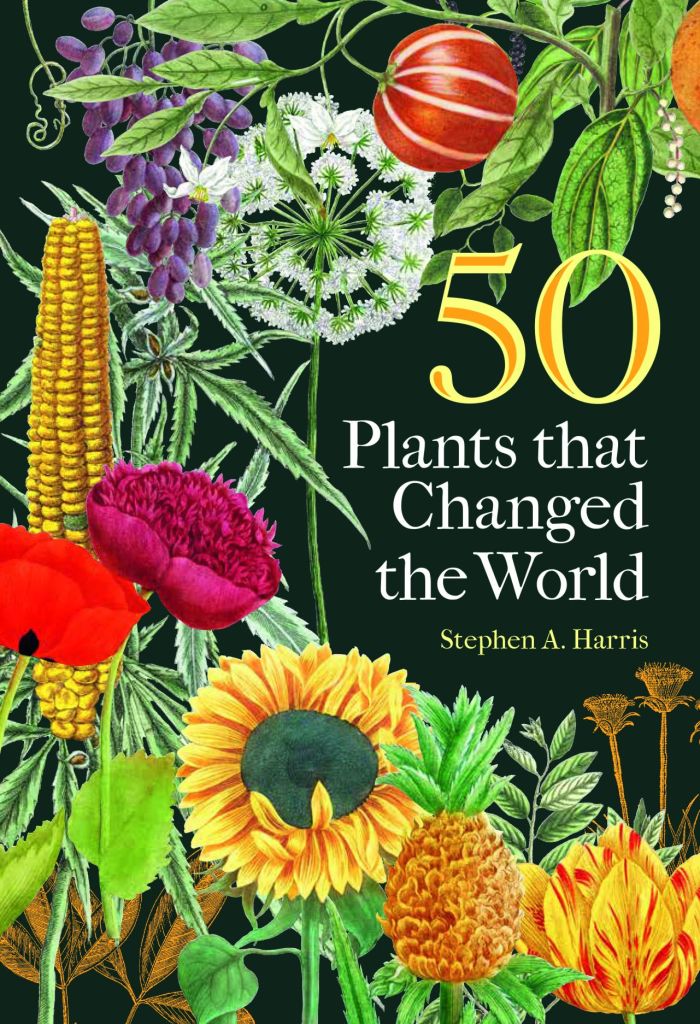
The greater part of the utility of plants to people is encapsulated in the concept of the “Four Fs of Ethnobotany” of ‘food, fibres, fuel, and pharmaceuticals’. But that quartet of uses does not encompass all of the ways in which plants – and their products – have been exploited by humanity. Nor does it indicate the profound nature of the changes that their use has brought to humankind. Fortunately, to remind us of that, we have books such as Stephen Harris’ 50 plants that changed the world [which tome is here appraised].
General
The book’s main text of 275 pages is split between an Introduction and 50 plant entries, and is completed with sections of Notes, Further Reading, and an Index. As you should expect from a botanical book by Harris [e.g. here, here, and here], 50 plants that changed the world is very well written throughout – with some nice phrasing (e.g., “…the fiscal waltz between the excise man and the smuggler…” (p. 117); “Can we afford to run our lives on the capital of prehistoric photosynthesis?” (p. 208); and “although Noah shows a complete indifference to the central role of plants in the lives of the animals he tried to save” (p. 269). Accompanying the words, the book is lavishly illustrated – with lots of beautiful pictures of the featured plants. [Ed. – And it has a built-in book mark, fixed to the book’s spine so you don’t lose it or your place(!)]
The contents in a bit more detail
In 13 pages of Introduction Harris sets the scene and provides necessary context for the rest of the book. Probably the two most important points in this section are comments about plant choice and the book’s focus. Recognising that “Globally, we exploit at least 35,000 different plant species” (p. 2), Harris acknowledges that the selection of 50 is down to his personal choice. And “In compiling these fifty plant profiles, a chronological approach is used *, where plants are arranged by when they first became influential in Western civilization” (p. 11). Important to note here is the book’s emphasis on the role of plants and their products in Western civilization **.
Without mentioning the phenomenon by name, Harris starts the Introduction by acknowledging the existence of plant blindness/plant awareness disparity (Jon Moses) with a reminder that plants and their products are everywhere and used by people every day – often without them realising or appreciating their plant origin. And, if we do give a thought to the impact of plants in our lives, “we are too often inclined to think of them in personal terms as accessories rather than main-stage players” (p. 1). Well, Harris’ book tries to redress the balance and presents stories associated with 50 plants that highlight their role(s) as main-stage players in the history of human affairs.
This section, and the book’s premise, is probably summed-up in Harris’ own words: “Plants, and plant products, are everywhere we look. Their effects on our lives continue to be profound, and often unpredictable” (p. 13). Read on…
Plant entries
Each of the 50 plant entries, which are effectively mini-essays, is illustrated – generally in colour, but only in black-and-white for coconut, papyrus, rubber, and soya – with full-page pictures. Illustrations are primarily sourced from two publications, Elizabeth Blackwell’s A curious herbal [https://archive.org/details/mobot31753002620836; https://www.rcpe.ac.uk/heritage/heritage-blog/elizabeth-blackwell-prison-plotting-and-curious-herbal] (Will Beharrell [https://www.linnean.org/news/2021/07/28/elizabeth-blackwells-curious-herbal]), and Johann Willhelm Weinmann’s Phytanthoza iconographia [https://www.biodiversitylibrary.org/bibliography/570; https://www.huh.harvard.edu/book/phytanthoza-iconographia-1737; https://www.stonegateprints.com/botanical/johann-w-weinmann/].
Each entry has a formulaic beginning: Title – a single English common name for the plant (e.g., barley); scientific name, with its Authority (e.g., Hordeum vulgare L.); Family to which it belongs (e.g., Poaceae), and a pithy sub-heading, e.g., Boon and bane (Opium Poppy), Of cabbages and kales (Brassicas), Hemp’s high life (Cannabis), and Ball games to condoms (Rubber) [some of which gives clues to the author’s sense of humour…].
Amongst the 50 plants featured (and which is at least 51 different ‘species’ because the entry entitled Reeds deals with species of Arundo and Phragmites, and some other entries deal with more than one species, e.g. Rose is concerned with species of the genus Rosa (although without explicitly naming any actual species by scientific name in-text), and Citrus mentions sweet oranges, lemons, limes, grapefruit, clementine, citron, and pomelo (all of which are different Citrus species)) [Ed. – which is probably why the book’s title includes the word ‘plants’ and not ‘species’…].
Of the 50 named plants 47 are angiosperms (or flowering plants), 2 are gymnosperms (Yew, and Pines), and one is a non-seed plant Lycopods [Why? Think: Coal…]. Within the angiosperms are 12 monocots, and 35 dicots. Nine grasses [e.g., barley, bread wheat, and rice] and three tree-like plants [coconut, banana, and oil palm] comprise the monocots. There are 9 trees [e.g., Olive, Oak, and Apple] and three bushes/shrubs [Tea, Coffee, Rose] amongst the dicots; the remainder are herbs (Samia Qureshi), such as Mandrake, Woad, Potato, and Carrot.
The average length of an entry is approx. 5 pages; the longest entry is 6 pages for White mulberry. Although Banana is longer – at 6.25 pages – that includes 3 pages of illustrations as compared to the more typical/usual single page. At 4 pages, Ragwort is the shortest entry.
Notes
Numbered 1 – 491 [which relate to in-text super-scripted numbers], these occupy approx. 30 pages and provide citation details for books or articles that are the evidence base for statements made in the book. Usually there’s a single source per Note, but occasionally multiples sources are provided (e.g., Notes 55, 82, 215, 256, 303, and 407). Occasionally, a Note will have some commentary by Harris (e.g., re Notes 233 and 238 on p. 290), but that is rare. There is some duplication of sources, e.g. some Notes that are different numbers refer to the identical source, e.g., Notes 21 and 27; 29 and 30; 178 and 181; and 481 and 482. Whilst that impacts upon the number of unique sources cited in the book, leaving the Note numbers as they are retains the numerical sequencing of the notes within the text [Ed. – although there’s no reason I can see why identical sources stated for consecutively-numbered Notes 29 and 30, or for 481 and 482 should have different numbers…].
An oddity that should be mentioned is Note number 470. Although this Note clearly exists in the Notes section (on p. 340), the super-scripted ‘470’ is missing from the text. It looks like it should be somewhere on p. 264 (the entry for Soya), between Notes 469 and 471. Interestingly, Note 470 is also missing from the text – p. 223 – in What have plants ever done for us?, which is the sort of oversight you’d expect to have been corrected in a subsequent edition/version of that title [for the relevance of this comment see Comparisons?].
Further reading
Is approx. three pages, almost exclusively of books, including several Reaktion Books’ Botanical Series titles, e.g., Peter Coles’ Mulberry, Cannabis by Chris Duvall, Stephen Harris’ Grasses, and Oak by Peter Young. Unfortunately, no guidance is provided as to the meaning or purpose of this collection; are they sources those used by Harris to provide facts for the book, or just a list that readers may like to explore to find out more about the 50 plants that changed history? An explicit statement about its purpose would be useful [see Statement about sources].
The Index is three, 2-columned pages, from ‘Accum, Frederick’ to ‘yew (Taxus)’. Primarily, it’s a listing of: plants [listed by common name (and generally with the genus of the plant’s scientific name shown in brackets – except for tomato where the full scientific name is shown, and plants such as bluegrass, beetroot, broccoli, and hemp where only the common name is indexed [I suspect in those cases that is because they are not headings of any of the 50 plant essays]); people [e.g., Linnaeus, Carolus; Ötzi; Poivre, Pierre; Polo, Marco; Theophrastus; and Wallace, Alfred Russel]; products [e.g., amber; cork; hemp; laudanum; longbow; paper; sugar (sucrose); tetrahydrocannabinol (THC); vitamin C], and topics [such as: agriculture; American Civil War; British East India Company; chemical synthesis; Columbian Exchange; crop origins; Doctrine of Signatures; domestication; drugs; Dutch East India Company; environmental effects; fertiIizer; genetically modified organisms; hybrida [maybe this should be ‘hybrids’?]; intoxication; medicine; model plant; Napoleonic Wars; plant breeding; religion; shipbuilding; slavery; spice trade; trade; and warfare].
Statement about sources
With 491 Notes providing sources for statements made in the book, you’d probably think that 50 plants that changed the world is sufficiently well-evidenced. Sadly, that is not the case. Yes, it is good to see so many sources provided, but there are large chunks of the text that provide many facts, but which are devoid of any indication of their sources.
For example, sources were not found for: “Ten thousand years ago the ice sheet that encased the northern hemisphere for ten millennia finally melted” (p. 3); “These skills will be essential if 9.7 billion people are to be fed by 2050” (p. 6) ; “The genus Allium comprises more than 700 species, distributed across the Old and New Worlds” (p. 60); The detailed anatomical information re giant reed stem on p. 103; “although the vast majority of global nutmeg production (c. 134,000 tonnes per year) comes from Indonesia, India and Guatemala” (p. 141); “teosinte seeds are specialized for dispersal through animals’ guts” (p. 193); and use of coconut water “as emergency blood transfusions” (p. 220). Furthermore, the first paragraph of the Cannabis entry contains many factual statements, but none of them are explicitly related to any source(s), and the four text pages for Rubber only have 4 references cited; many more are needed for the numerous facts shared in that plant entry.
It is possible that the missing sources will be found amongst the items listed in Further reading [although these items are listed in alphabetical order of author and hard to relate to specific items in the text…]. Maybe, but I do think it is an important part of the author’s contract with the reader to make such links explicit – if only to demonstrate that the necessary fact-checking has been undertaken to ensure that what is stated as fact is evidence-based [Ed. – such attention to detail also helps to establish – and enhance – the author’s academic credentials].
What’s there?
The coverage of 50 plants that changed the world ca be left to the book’s Press Release, which tells us that Harris’ most impressive consideration and catalogue of plant-and-people interactions “is a celebration of plants’ profound impact on trade, imperialism, politics, medicine, and even the course of wars”, and whose stories “span centuries, covering subjects as varied as the origins of paper and ink, the rise of global trade, the development of new chemicals and medicines, and the creation of life-changing technologies … how plants have changed landscapes, driven wars, and even fueled slavery, while also showing how they continue to shape our world today”. In so doing, Harris has charted the ways in which “fifty key plants have shaped the development of the Western world”. There is much here to interest everybody who has any interest in how plants and people have interacted over many millennia, and I’m prepared to bet that you will learn something that you didn’t already know***.
What’s not there..?
In reviewing a book one should focus on what’s there [except in the case of missing sources]. However, in a book that deals with obvious plant and people material it is not unreasonable to wonder if the author may have ‘missed a trick’ by not making mention of some additional – and appropriate – material or facts.
For example: in the quinine entry an opportunity to mention more modern malaria treatments such as artemisinin derived from the plant Artemisia annua was not taken; and in the rubber entry, Harris was silent on the involvement of Belgian monarch King Leopold II in the rubber plantation-related ill-treatment of the inhabitants in Africa’s Congo Free State, and no mention was made of American industrialist Henry Ford’s establishment of towns – such as Fordlândia – in the Amazon jungle “to supply Ford’s internal demand for rubber as well as to provide a better way of life for the Brazilians who lived and worked on the plantations”.
Yes, these facts could have been included, but there’s a limit to what you can pack in to 5 pages or so for each plant. And Harris has already crammed in about as much as one can in the space made available. So, what this comment really means is that there is always more to a plant’s people story to discover. And if 50 plants that changed the world inspires readers to want to discover more – about Harris’ 50 plants and others – then that’s a very good thing and a ‘job well done’ by Harris’ book.
A couple of amendments are needed
When an author deals with such an enormous range of topics it’s probably inevitable that some errors will occur because they can’t be expected to be an expert in everything. Two that I spotted – and which can easily be amended in future editions of the book – are the following****.
On p. 176 Harris tells us “When the potato fungal infection late blight arrived in Ireland in the mid-nineteenth century it caused devastation”. From a botanical correctness point of view, it needs to be stated that late blight of potato (Jean Ristaino et al., 2000) is not a fungal infection. It is caused by an oomycete (Amy Rossman & Mary Palm, 2002), which could be described as fungal-like (Lida Derevnina et al., 2016).
“The awkwardly named ‘Flavr Saver’ tomato was genetically modified to slow the ripening process while retaining its natural colour and flavour” (p. 183). I’ve never seen the name of the GM tomato shown in that way. All the sources I’ve found show it as Flavr Savr (or, more correctly, as Flavr Savr™) (e.g. here, Alex Philippidis, Michelle Fabio], here, here, and here), i.e., as shown in Harris’ cited source for this fact, Note No. 328, Martineau, B. (2001) First fruit: the creation of the Flavr Savr tomato and the birth of biotech food. McGraw-Hill Education, London.
Comparisons?
The most obvious comparison for Harris’ book is with Fifty Plants that changed the course of history by Bill Laws. Laws’ book is as erudite and insightful as Harris’ but has no sources stated within the text – one would have to wade through the list of further reading to track down any of those sources. So Harris fares better in that regard. There is also the equally-cerebral, but entirely evidence-devoid The History of the World in 100 Plants by Simon Barnes. And the lighter in tone and approach – but also entirely source-free – Chris Beardshaw’s 100 Plants That (almost) Changed The World.
However, the ‘elephant in the room’ (Bennett Kleinman), from a comparison point of view, is the 2015 publication What have plants ever done for us? by Stephen Harris (Michael McCarthy). Why? Because Harris’ 2025 title 50 plants that changed the world is a “new and updated edition of What have plants ever done for us?” [p. 17 of Bodleian Publishing’s Spring 2025 catalogue] – although just “a New Edition of What have Plants Ever Done for Us?”[on the publisher’s web page for the book here]. And that comparison is even more relevant because that 2015 title appears to have had the sub-title “Western Civilization in Fifty Plants” (Michael McCarthy; Stuart Gillespie).
I haven’t reviewed or read What have plants ever done for us? in any detail, but I can offer these comparisons. Containing the same number of Notes – 491 – as 50 plants that changed the world, what is new and/or updated in the 2025 book? Some of the more obvious ones are that the illustrations are almost all in glorious colour [whereas 2015’s pictures are solely black-and-white]; there are several additions to the list of further reading – all of the 15 publications dated 2015 or more-recently are new to the 2025 edition – e.g., Andrew Griebeler Botanical icons, Stephen Harris Sunflowers, Luke Keogh The Wardian case, Robert Spengler Fruit from the sands, Henry Oakeley (ed.) [shown as ‘Oakley’ in Harris’ book] Modern medicines from plants, and Kim Walker & Mark Nesbitt Just the tonic. And that is relevant because – I suspect – much of the not-explicitly-separately-sourced factual statements in the 2025 book come from such publications, and which therefore supports the view that information from the 2015 book has been added to.
One intriguing difference is that the 2015 book talks “about 50,000 different plant species” being exploited by people (p. 2). In the 2025 version that number is dramatically cut to “at least 35,000” (p. 2). One can only wonder why there is this pronounced difference, but it is noticeable that a source is cited for 2025’s figure but none is declared for the 50,000 value. The 2025 edition has 314 pages as opposed to 2015’s 264 page count, and the 2025 book is physically larger than 2015’s. If you don’t have the 2015 book, the 2025 version is certainly recommended. If you do have What have plants ever done for us?, then 50 plants that changed the world is likely to have new information and is a recommended read. But, the question remains: Why does a new edition of What have plants ever done for us? have a different title?
Summary
The insufficiency of explicit sources notwithstanding, 50 plants that changed the world by Stephen Harris is a great read, and a valuable resource which catalogues the debt that has been owed by people to plants for millennia. It is a most welcome addition to the plants-and-people genre of literature.
* That having been said, and with a comment like “Some, such as barley and wheat, were there at the birth of society” (p. 11), why aren’t barley and wheat chapters next to each other instead of being separated by 5 other plants? And, if a true chronological order is followed, why isn’t yew mentioned first since “A yew spear, apparently more than 200,000 years old, was recovered from Clacton, on the East Anglian coast of England” (p. 84)? Using spears to harm or kill other humans or animals would seem to be pretty influential.
** What is Western civilization? Although I’ve heard the phrase I wasn’t exactly sure what it meant, and thought it best to seek confirmation to avoid doubt. My researches tell me that: “Western civilization, western culture or the West is made up of European culturally derived societies (most notably in the Classical Roman heritage, Western Christianity (Catholicism and Protestantism), Democracy and Liberalism). This at least includes Western and Central Europe, English speaking North America, Australia and New Zealand” . For completeness, similar definitions will be found here [for Western world], here [for countries of the ‘Latin West’], here [for the Western World’], and William H McNeill, 1997.
Although Australia and New Zealand are included in this definition, there’s very little in 50 plants that changed the world about Australia and/or New Zealand. By contrast, North America – also include within Western civilization – gets a decent number of mentions (although there are almost as many references to central and South America combined – which regions are not part of the Western world…).
*** For instance, some of 50 plants that changed the world‘s fascinating facts [subject to appropriate validation, since they’re not all necessarily source-cited by Harris, see Statement about sources …] that I discovered were: The graminaceous etymological origin of the word ‘barn’; The identity of the two plant-derived medicines that English physician Thomas Sydenham considered were the most noble from the hands of God; How much hemp a warship needed; When bread wheat production overtook emmer production; Which legume was fed to slaves aboard ships during the middle passage; Why stir-fried garlic smells and tastes different from slow-cooked garlic; That the wetlands in southern Iraq known as the Mesopotamian marshes is the size of Wales; That limes have only about a quarter of the vitamin C content of lemons; That imports of Chinese silk to Rome drained it of the modern-day equivalent of about 3.5 tonnes of gold, each year; The name of the first European to describe having tried tobacco; and The identity of the plant that John Gerard called a pleasant and profitable reed.
**** I was also intrigued by this statement, “However, Arthur Conan Doyle’s Sherlock Holmes is more ambiguous; opium dens are the haunts of Holmes’s opponents but it is acceptable for him to take morphine in his own rooms” (p. 37). I’d always understood that it was cocaine that the fictional Victorian detective indulged in. Harris provides no source for the reference to Holmes and morphine, and I can’t recall my source. So, which is correct; is it morphine or cocaine?
Some internet searching revealed that “Sherlock Holmes, the most famous consulting detective in literature, used occasionally cocaine and morphine to escape, as he said, from “the dull routine of existence”” (Andrzej Diniejko), and “He sometimes uses morphine and sometimes cocaine”. Interestingly, J Thomas Dalby tells us that, “In The Sign of Four it is suggested that Holmes also abused morphine and Doyle [Arthur Conan Doyle, author of the Sherlock Holmes stories (Philip K Wilson)] may simply have forgotten to which drug he was referring. Doyle wrote very quickly, sometimes not even revising his draft, and in his memoirs admits that he has never been nervous about details and that his readers reprimanded him for his lapses.”
The answer it would seem is both morphine and cocaine.
REFERENCES
Lida Derevnina et al., 2016. Emerging oomycete threats to plants and animals. Phil. Trans. R. Soc. B 371: 20150459; http://dx.doi.org/10.1098/rstb.2015.0459
William H McNeill, 1997. What we mean by the west. Orbis 41(4): 513-524; https://doi.org/10.1016/S0030-4387(97)90002-8
Jean Ristaino et al., 2000. Late blight of potato and tomato. The Plant Health Instructor 01; 10.1094/PHI-I-2000-0724-01
Amy Y Rossman & Mary E Palm, 2002. Why are Phytophthora and other Oomycota not true Fungi? The Plant Health Instructor 02; 10.1094/PHI-I-2002-0225-01
Tags: science communication, plants-and-people, botany, plant biology, plant science, economic botany, Stephen Harris, 50 plants that changed the world, Elizabeth Blackwell, A curious herbal, What have plants ever done for us?, Western civilisation, oomycete, Sherlock Holmes, cocaine, morphine, condoms, agriculture, late blight of potato, Flavr Savr,

 Plant Cuttings
Leave a comment