
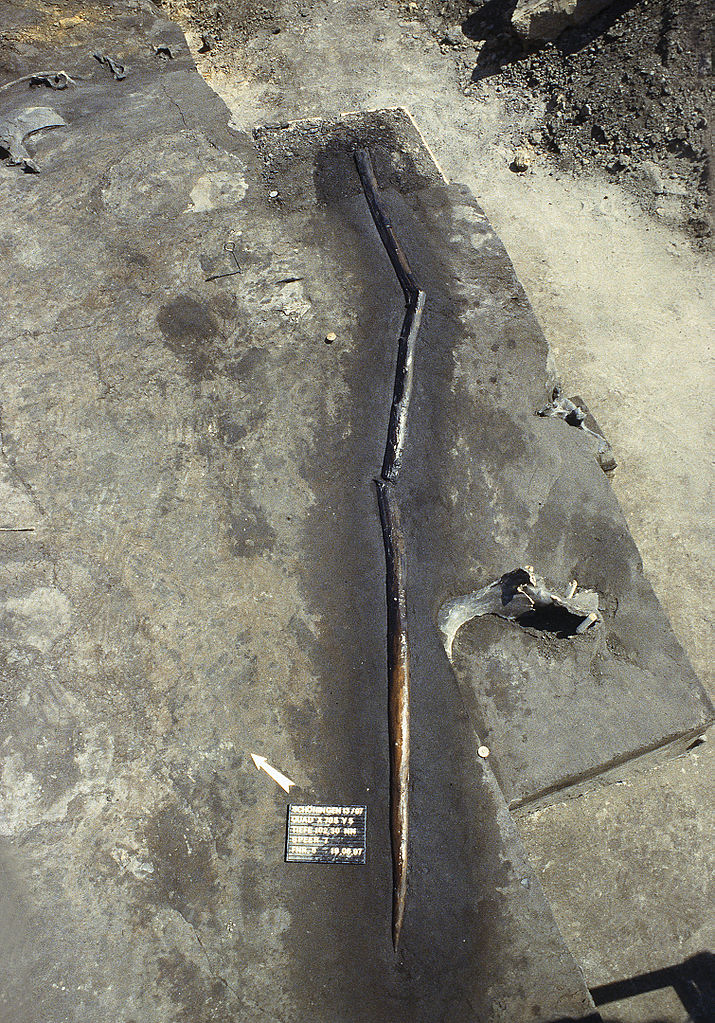
This image, of a spear in situ at the Schöningen site by P Pfarr (NLD, Niedersächsisches Landesamt für Denkmalpflege), is used under the Creative Commons Attribution-Share Alike 3.0 Germany license.
Time for a backwards glance
As we take our first, faltering steps into 2025, it has long been traditional to look back and reflect upon what’s gone before. Whilst we at Cuttings HQ are happy to go along with that, we won’t limit ourselves to a consideration of the post 12 months. We’re much more ambitious than that…
Is prehistory written in stone..?
A major preoccupation – for those who are preoccupied with such things – is what to call different periods of history or prehistory. For example, there has been a lot of debate about whether the modern age should be called the Anthropocene (John P Rafferty). And there are suggestions that we should be calling the present day the Plastic Age (Damin Carrington; Raffaelle Porta, 2021), or even the Plasticene (Kristen Minogue; Linsey Haram et al., 2020; Nelson Rangel-Buitrago et al., 2023). That’s all well and good: Debate is healthy, and we might expect discussion and disagreement about what to call the age we’re currently living in. But, what about times long gone by? Although they have names that may appear to be agreed and settled, are they correctly categorized? Are they ‘set in stone’ (Candace Osmond)? What, for example, about the so-called Stone Age?
The Stone Age, which extends from about 3.4 million (Debbie Kilroy), 3.3 million (Richard Pittioni & Robert J Braidwood, Katie Grace Carpenter), 3 million, 2.6 million (Caleb Strom) or 2.5 million (Cristian Violatti) years ago (or even as recent as 1.5 million years ago) until about 3,300 BCE (Cristian Violatti), 3,000 BCE (Caleb Strom), 2,500 BCE (Debbie Kilroy), 2,300 BCE, or 2,000 BCE, is so named because it is a “prehistoric cultural stage, or level of human development, characterized by the creation and use of stone tools” (Robert J Braidwood & Hallam L Movius). For most of us, we’re happy to accept that that period of human history was appropriately named ever since the term was popularised and promoted in the early 19th century by Danish scholar Christian J Thomsen (Josh Gross, Cristian Violatti), as part of his Three-Age System (Vasundhra) (which also included the Bronze and Iron Ages).
And finds of increasingly sophisticated stone tools and weapons (Vasundhra) – associated with evolution and development within the human species of the time – underline the validity of this period’s name and are recognised in its subdivision into an Old Stone Age [Palaeolithic (Cristian Violatti)], Middle Stone Age [Mesolithic (Cristian Violatti)], and New Stone Age [Neolithic (Richard Pittioni)], during which latter phase we see the rise of agriculture and farming (Cristian Violatti) in the phenomenon known as the Neolithic Revolution (Erin Blakemore). But how solid is the evidence for the name ‘stone age’?
Shaking those foundations of stone…
Whilst categorisation of this period of human history on the basis of tangible, physical artefacts of bone and stone is understandable, not everybody is happy with the focus on stone, and some dissent has been expressed for the name stone age. In particular, Yuval Noah Harari, in his book Sapiens: A brief history of humankind, proposes that the Stone Age should be renamed the Wood Age*,** “because most of the tools used by ancient hunter-gatherers were made of wood”. In support of that view he states that “archaeological evidence consists mainly of fossilised bones and stone tools. Artefacts made of more perishable materials – such as wood, bamboo or leather – survive only under unique conditions. The common impression that pre-agricultural humans lived in an age of stone is a misconception based on this archaeological bias” (from pp. 52/53 in the 2014 English version of the book viewable here).
Since the book’s publication there has been further promotion of the notion of a ‘wood age’ by James Dilley, and Shadreck Chirikure. And Stephen E Nash cites the naming of the period as the stone age as one of the – several – “Stone Age Myths We’ve Made Up”. Nevertheless, and notwithstanding these dissenting views, in the 13 years or so since Harari’s book was published, the Stone Age hasn’t been renamed. But, maybe the work of Dirk Leder et al. (2024) is about to change that. Maybe…
Is change afoot?
The impetus for renaming the Stone Age at this time comes from Leder et al. (2024)’s work*** on wooden artefacts found at the lakeshore site at Schöningen (Lower Saxony, Germany). The site is understandably famous**** for its assemblage of wooden spears, which are believed to have been crafted by Homo heidelbergensis (Fran Dorey, Henry McHenry, Barbara Helm Welker) – an ancient hominin (Beth Blaxland, Erin Wayman) ancestral to us modern humans, Homo sapiens (Ian Tattersall, Barbara Helm Welker) – and which are approx. 300,000 years old [more here, here, here, and Mark Milligan].
Although Leder et al. (2024) examined the spears, they also carried out a detailed investigation of a wide range of other wooden artefacts at the site. It was their in-depth study of both spears and non-spear objects that led them to a much better appreciation of the sophisticated wood-working skills and associated complex inter-personal intellectual attributes in human development necessary to create these objects. As stated in the paper’s statement of significance, “The study provides unique insights into Pleistocene woodworking techniques, tool design, use, re-working, and human behavior connected to wooden artifacts. Human evolution studies show increasing brain size and technological complexity that coincide with human group hunting over the last 2 Ma. Schöningen’s wooden hunting weapons exemplify the interplay of technological complexity, human behavior, and human evolution”.
For the purposes of this post, their study is aptly summarised in this quote from their Discussion: “Assuming that woodworking technologies have been present for as long as lithic and bone technologies have, the preservation of wooden tools clearly affects our understanding of technological complexity at any given time, meaning where wooden artifacts are not preserved, we might underestimate the cognitive abilities of prehistoric societies” (Leder et al., 2024). In other words, ignoring the wood component of prehistoric humanity’s development, because it is so rarely preserved, and instead concentrating on the hard artefacts that have survived – such as ‘stone’ tools and weapons, dangerously distorts our view of human evolution and development. Leder et al. (2024)’s work considerably extends the conclusions from Nicholas Conard et al. (2015)’s study entitled “Excavations at Schöningen and paradigm shifts in human evolution”, and underlines the importance of what Conard et al. termed the Schöningen effect.
Tellingly, although it is somewhat disappointing not to have seen this in the scientific paper itself, Leder is quoted as saying “The whole idea of a Stone Age might be wrong, maybe we should be talking about a Wood Age” [from the article by Andrew Curry]. Whether research on the spears of Schöningen will also now result in a ‘Leder effect’ in bringing about a name change to the Stone Age remains to be seen, but the gauntlet has been well and truly thrown down (Elizabeth Harrison). Will the powers that be accept the challenge, right the (pre)historical wrong, and rename the Stone Age?
But, why stop at stone..?
As you might expect, wood enthusiast extraordinaire John Perlin enthusiastically endorsed the concept of rebranding the Stone Age as the Wood Age in the 2022 third edition of his book, A forest journey (p. 31). But, and, as if that proposed nomenclatural revision isn’t bomb-shell enough, he wants to develop and extend wood-based history further. Consequently, he proposes that the Bronze Age and the Iron Age should more correctly be categorised as The Age of Charcoal (p. 31, A forest journey).
Why? Because separation of the metals from their ores (Marisa Alviar-Agnew) – in which the prized metals, such as iron and copper (for making the alloy known as bronze), occur in chemical combination with other elements – requires high temperature treatment (Mike Leahy), smelting. To achieve the necessary extraction of the metal, charcoal was the best fuel then available to facilitate this remarkable, almost ‘alchemical’, transformation (Lee Horne; Thomas Straka, 2017). And, charcoal is the produce of incomplete combustion/oxidation of … wood (Jason Crawford).
In the absence of any name changes…
The truth is, and regardless of what we might want to call various stages of human development, we’ve always had an important relationship with wood. Indeed, it is so deep and ingrained that we forget it exists at all. Maybe the best tribute we can pay the people-tree interrelationship is not to get hung up on names, but rejoice in the knowledge that we humans have a shared history with trees. And, let’s not forget that wood (and trees, and tree products) continue to play a major role in the life of humankind (e.g. see recent uses of wood), and will continue to do so into the future (see e.g. future uses of wood).
Human history isn’t written in stone. For much of human history it was not written at all, but it is writ large in the ancient and intimate relationship that exists – and that endures to this day – between people and plants, especially trees and their products. If it is recorded in anything, human history is largely written in wood.
But, why stop with wood and charcoal?
Why should we limit any nomenclatural revision to the Ages of Stone, Bronze, and Iron? Persuasively, Prof. Dean Falk has taken the idea of more-appropriate naming of past ages to its logical extreme and proposed the Botanic Age for the period of human history that precedes the Wood Age [formerly known as the Stone Age]. For more on this idea, see the video of her Leakey Foundation lecture here, and keep an eye out for her shortly-to-be-published book, The botanic age. And, for an admirably well-sourced and insightful piece about a “pre-Stone Age botanical period”, see Sophie Berdugo’s article.
And, to add the cherry to the icing on top of the cake, we should mention ‘Hayley’ who reminds us that we are living in “the everlasting Botanic Age”. Which makes things nice and simple, no Anthropocene or Plasticene, nor any Stone, Bronze, and Iron Ages, just one enduring Botanic Age that accompanies and encompasses the entirety of human evolution and development. This Botanist can live with that!*****
* A suggestion that I’ve managed to trace back almost 40 years to the paper by Aimé Bocquet & Michel Noël (1985) entitled “The Neolithic or Wood Age” (and which doesn’t appear to be cited in Harari’s book). Having got back to 1985 I’m keen to know how much farther back in time this suggestion goes: Do let me know of any older mentions of the Wood Age.
** And which idea is firmly embedded in the 2021 book of the same name – and sub-titled How one material shaped the whole of human history – by Roland Ennos, and enthusiastically endorsed and promoted by Sam Walters.
*** For more on Leder et al (2024)’s investigation, see here, Guillermo Caravajal, here, here, here, here, here, Arjun Sengupta, Evrim Yazgin, here, Franz Lidz, and Andrew Curry. For a succinct summary of the importance of Leder et al’s work – but which doesn’t mention them or their paper by name – and context, see “Redefining the Stone Age as ‘Wood Age’” here.
For more on the spears of Schöningen, see here, Arlette P Kouwenhoven, here, here, here, here, Werner Schoch et al. (2015), and John Hawks. There’s also a special issue of the Journal of Human Evolution devoted to the Schöningen site, accessible here.
For insights into the use of spears, such as those from Schöningen, in “confrontational scavenging and hunting”, see Annemieke Milks et al. (2016). For information on the paleoenvironment and possibilities of plant exploitation in the Middle Pleistocene of Schöningen (Germany), see Gerlinde Bigga et al. (2015). And, because who can resist a story about sabre-toothed cats, Mr P Cuttings is pleased to alert you to Jordi Serangeli et al. (2015)’s article entitled “The European saber-toothed cat (Homotherium latidens) found in the “Spear Horizon” at Schöningen (Germany)”.
**** In view of its importance to our understanding of human development, evolution, and history, the Schöningen site has been nominated for the UNESCO World Heritage List.
***** Whilst we’re thinking about name changes, and the importance of plants to humanity’s history, how about our species’ scientific name, Homo sapiens (which translates as ‘wise human’ (Fran Dorey). Maybe it’s time to change it to Homo botanicus? Surely, that’s the wise thing to do? Discuss…
REFERENCES
Gerlinde Bigga et al., 2015. Paleoenvironment and possibilities of plant exploitation in the Middle Pleistocene of Schöningen (Germany). Insights from botanical macro-remains and pollen. Journal of Human Evolution 89: 92-104; https://doi.org/10.1016/j.jhevol.2015.10.005
Aimé Bocquet & Michel Noël, 1985. The Neolithic or Wood Age. Endeavour 9(1): 34-41; https://doi.org/10.1016/0160-9327(85)90007-9
Nicholas J Conard et al., 2015. Excavations at Schöningen and paradigm shifts in human evolution. Journal of Human Evolution 89: 1-17; https://doi.org/10.1016/j.jhevol.2015.10.003
Linsey E Haram et al., 2020. A Plasticene Lexicon. Marine Pollution Bulletin 150: 110714; https://doi.org/10.1016/j.marpolbul.2019.110714
Dirk Leder et al., 2024. The wooden artifacts from Schöningen’s Spear Horizon and their place in human evolution. Proceedings of the National Academy of Sciences 121(15): e2320484121; doi: 10.1073/pnas.2320484121
Annemieke Milks et al., 2016. Early spears as thrusting weapons: Isolating force and impact velocities in human performance trials. Journal of Archaeological Science: Reports 10: 191-203; https://doi.org/10.1016/j.jasrep.2016.09.005
Raffaele Porta, 2021. Anthropocene, the plastic age and future perspectives. FEBS Open Bio 11: 948–953; https://doi.org/10.1002/2211-5463.13122
Nelson Rangel-Buitrago et al., 2023. Is Earth in a New Time Period: The Plasticene? Front. Young Minds 11: 1210561; doi: 10.3389/frym.2023.1210561
Werner H Schoch et al., 2015. New insights on the wooden weapons from the Paleolithic site of Schöningen. Journal of Human Evolution 89: 214-225; https://doi.org/10.1016/j.jhevol.2015.08.004
Jordi Serangeli et al., 2015. The European saber-toothed cat (Homotherium latidens) found in the “Spear Horizon” at Schöningen (Germany). Journal of Human Evolution 89: 172-180; https://doi.org/10.1016/j.jhevol.2015.08.005
Thomas Straka, 2017. Charcoal as a Fuel in the Ironmaking and Smelting Industries. Advances in Historical Studies 6: 56-64; doi: 10.4236/ahs.2017.61004


Leave a comment