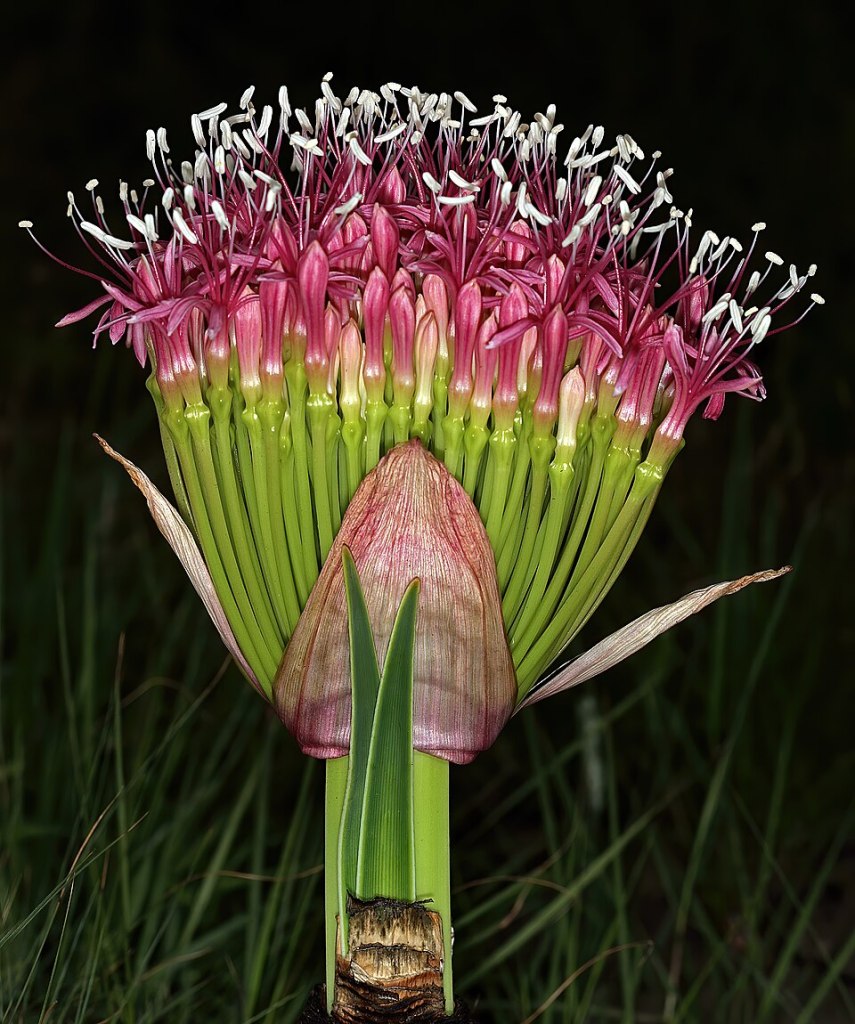
This image, entitled “Boophone disticha, inflorescence; recently burned grassland, Umtamvuna Nature Reserve, Amphitheatre, Port Edward, KwaZulu-Natal, South Africa” by SAplants is used under the Creative Commons Attribution-Share Alike 4.0 International license.
Let’s start this post with a question: What’s worse than being struck by an arrow?
Answer: Being hit with one that has a poisoned tip.
In fairness, that’s probably not a major pre-occupation for most of us today. But, if you lived – or, more likely, were a hunted animal-food species – in certain parts of the world, in olden times, it may have been a daily concern. Even then, prior to approx. 7,000 years ago (Justin Bradfield et al., 2024)*, that was assumed to be an unlikely occurrence.
Well, that was until the work by Sven Isaksson et al. (2026), who present evidence that extends the use of poisoned arrows back to 60,000 years ago**.
Examining artefacts from a rock shelter site in KwaZulu-Natal (a province of South Africa), Isaksson et al. (2026) identified the presence of toxic alkaloids (Erick Paul Gutiérrez-Grijalva et al., 2020) on small stone arrowheads. Those compounds*** – specifically buphandrine (1,2-didehydro-3α,7-dimethoxycrinan) and epibuphanisine (1,2-didehydro-3α-methoxycrinan) – “only originate from Amarylli daceae [Ed. – the amaryllis, or daffodil, family of flowering plants] indigenous to southern Africa” (Isaksson et al. (2026).
Consistent with the interpretation that these compounds were used as poisons (and that the small rock fragments [‘microliths’] were actually arrowheads), the team propose that their most likely plant source is Boophone disticha****, the exudate from the bulb of which plant is “associated with historically documented arrow poisons” (Isaksson et al. (2026) [Ed. – the deadly quality of the plant is evident in the name of the genus, which comes “from Greek; bouphonos; ‘killing cattle’”]. In support of this botanical source, Isaksson et al. (2026) identified presence of both buphandrine and epibuphanisine in modern-day bulb extracts from the plant.
Adding an extra dimension to their discovery, Isaksson et al. (2026) also found those same two alkaloids on arrows collected in the 18th century from the same sort of area as the site of the rock shelter in KwaZulu-Natal. Taken together this work strongly suggests use of toxins from Boophone disticha, which has a common name of ‘Gif-bol’ or ‘Kopseer-blom’ in Afrikaans and poison bulb in English, as an arrow poison 60,00 years ago [in the African Middle Stone Age, the same time as the European Middle Palaeolithic (Richard Sheposh)], potentially in an unbroken tradition until at least as recently as the 1770s. That implies thousands of generations of hunters preserving and passing-on that important ethnobotanical knowledge related to life-sustaining, “meat acquisition strategies” (Isaksson et al. (2026).
But there’s even more that can be inferred from this finding. Apparently, such poisoned arrows were not intended to kill the prey instantly (Isaksson et al., 2026)*****. Rather, the intention was for the poison to act slowly merely wounding the animal. This means that wounded prey “usually continue to run for several kilometers during which hunters will track them, sometimes for a day or more” (Isaksson et al. (2026)******. That being the case, “our study demonstrates that they [the hunters] had a knowledge system or procedural knowledge (48) enabling them to identify, extract and apply toxic plant exudates effectively. They must have also had the necessary understanding of prey ecology and behavior (ethology) to know that if shot into a prey animal, the delayed effect of poison would cause it to weaken after some time, contributing to the efficiency of attrition or persistence hunting [Ed. – for the meaning of this term see Jeff Hays]. Such out-of-sight, long-distance action is a convincing proxy for complex cognition that requires response inhibition enabled through enhanced working memory” (Isaksson et al. (2026). In other words, this seemingly straightforward discovery of plant-poisoned arrowheads provides remarkable insights – if the inferences are correct – into the mind and mind-set of Palaeolithic – Stone Age – people.
The importance of this discovery can be summed-up in the researchers’ own words: “Thus, apart from providing the first evidence of hunting with poisoned arrows during the late-Pleistocene (W Hilton Johnson) in southern Africa, our findings contribute to the understanding of human adaptation and technobehavioral complexity during a phase of rapid, cumulative innovation in the region” (Isaksson et al., 2026). Now, you don’t get much more of a ‘plants-and-people’ story than that.
For more on this cutting edge work, see scicomm articles by Marlize Lombard [one of the three scientists behind the discovery], Min Chen, Abigail Eisenstadt, Selva Vargas Reátegui, Tom Metcalfe, Anastasia Scott, Enrico de Lazaro, Stephanie Baum, Dario Radley, Andrew Paul, Guillermo Carvajal, Christian Thorsberg, Ashley Strickland, Anders Högberg, Tatang Mulyana Sinaga, Nicola Jones, Brianna Barbu, Rebecca McPhee, Ada McVean, Sophie Berdugo, Mark Milligan, Carly Cassella, Ricky Ferreira, James Woodford, Andrea Margolis, here, here, here, here, here, here, and here.
And, for more on arrow poisons generally – not all of which are necessarily of plant origin – see Ralph Cheney (1926, 1931), here, James P Smith Jr (2022), Shreya Dasgupta, Kurt Hoelzl, here, here, here, here, and here.
* Although a much more recent discovery than that discussed in the body of this post, the work by Bradfield et al. (2024) is of note because the arrow poison they found was a mix of compounds from at least two different plant species – and, maybe, from a third – indicating a multi-plant recipe (see also here). That contrasts with the single plant source proposed by Isaksson et al. (2026).
** And arrowheads may themselves be at least as old as 80,000 years (Sonja Anderson).
*** If the molecules are sufficiently well preserved to be chemically identifiable 60,000 years after being applied to the arrowheads, might they also still be pharmacologically active in 2026? If they are, not only could they potentially poison prey animals, they could also endanger the life of any humans that come in to contact with them. Now that does add an extra element of ‘excitement’ – a euphemism (Laura Payne) here for risk of serious injury or death(!) – to this sort of palaeoarchaeological work. I do hope those involved wear suitable protective clothing. [Ed. – do I sense a botanically-befuddling plot idea for a murder mystery..? In any event, it would be interesting to see the wording of the risk assessment for those working with ancient arrowheads.]
**** “The researchers cannot determine whether other plants containing similar plant toxins might have been used, though only Boophone disticha [sic.] bulb exudate has authenticated historical use as arrow poison” (quoted from here).
***** Not knowing enough about the background to, or evidence for, this view, it does seem odd to me not to want to kill a prey animal as quickly as possible. Doing so would avoid the need to track it for a long time – expending energy and risking personal injury, etc. – before securing the prized meat. Unless a consideration is the fact that larger doses of the poison would be needed to kill the animal more quickly, which might mean more chance of humans who eat the meat receiving a dangerous dose of the poison..? That could be risky. After all, we are told that “buphanine (another toxic alkaloid found in Boophone disticha [(WJ du Plooy et al., 2001)] … produces effects similar to scopolamine, triggering hallucinations, coma, or death. … Human exposure produces severe symptoms: nausea, coma, muscle weakness, accelerated heart rate, difficult breathing, and lung fluid accumulation. Dosage determines outcomes—small amounts offer medicinal benefits, while larger quantities kill” (quoted from here).
****** One thing not addressed in the report by Isaksson et al. (2026) is the risk to humans from poisoning their prey. The toxic compounds used to incapacitate the hunted mammal will also have an effect on mammalian human beings [“In humans, symptoms include nausea, coma, muscular flaccidity, visual impairment, stertorous breathing, respiratory paralysis, feeble or increased pulse, dyspnea, and hyperemia and edema of the lungs” (Isaksson et al. (2026)]. How, therefore, can meat – or any other body parts – from such an animal be safely consumed?
One suggestion is to avoid eating anything from, or close to, the point of entry for the arrowhead (e.g., kleedawson). Unfortunately, that is unlikely to help here because the poisons used are circulated throughout the blood system of the animal. In other words, all parts of the prey are likely to be ‘poisoned’. Maybe the toxic compounds are destroyed by cooking (Armando Cardona) (assuming we have evidence that those hunters cooked their meat)? Maybe.
But one of the best suggestions I’ve seen relates to the amount of toxin applied to the arrowhead to incapacitate the animal compared to the concentration of that compound when it has spread throughout the animal’s tissues. This notion – which relies on the concept of LD50 [median lethal dose] – is admirably and concisely explained by Huey Tlatoani.
REFERENCES
Justin Bradfield et al., 2024. A 7,000-year-old multi-component arrow poison from Kruger Cave, South Africa. iScience 27(12): 11143; https://doi.org/10.1016/j.isci.2024.111438
WJ du Plooy et al., 2001. Poisoning with Boophane disticha: a forensic case. Hum Exp Toxicol. 20(5): 277-278; doi: 10.1191/096032701678227749
Ralph H Cheney, 1926. The ancient and modern use of plant arrow poisons. The Scientific Monthly 23(6): 552–555; http://www.jstor.org/stable/7676
Ralph H Cheney, 1931. Geographic and taxonomic distribution of American plant arrow poisons. American Journal of Botany 18(2): 136–145; https://doi.org/10.2307/2435938
Erick Paul Gutiérrez-Grijalva et al., 2020. Plant alkaloids: Structures and bioactive properties, pp. 85-117. In: Mallappa Kumara Swamy (ed) Plant-derived Bioactives. Springer, Singapore. https://doi.org/10.1007/978-981-15-2361-8_5
Sven Isaksson et al., 2026. Direct evidence for poison use on microlithic arrowheads in Southern Africa at 60,000 years ago. Science Advances 12(2): eadz3281; doi: 10.1126/sciadv.adz3281
James P Smith Jr, 2022. Purposeful use of poisonous plants. Botanical Studies 105; https://digitalcommons.humboldt.edu/botany_jps/105
 Plant Cuttings
Leave a comment