
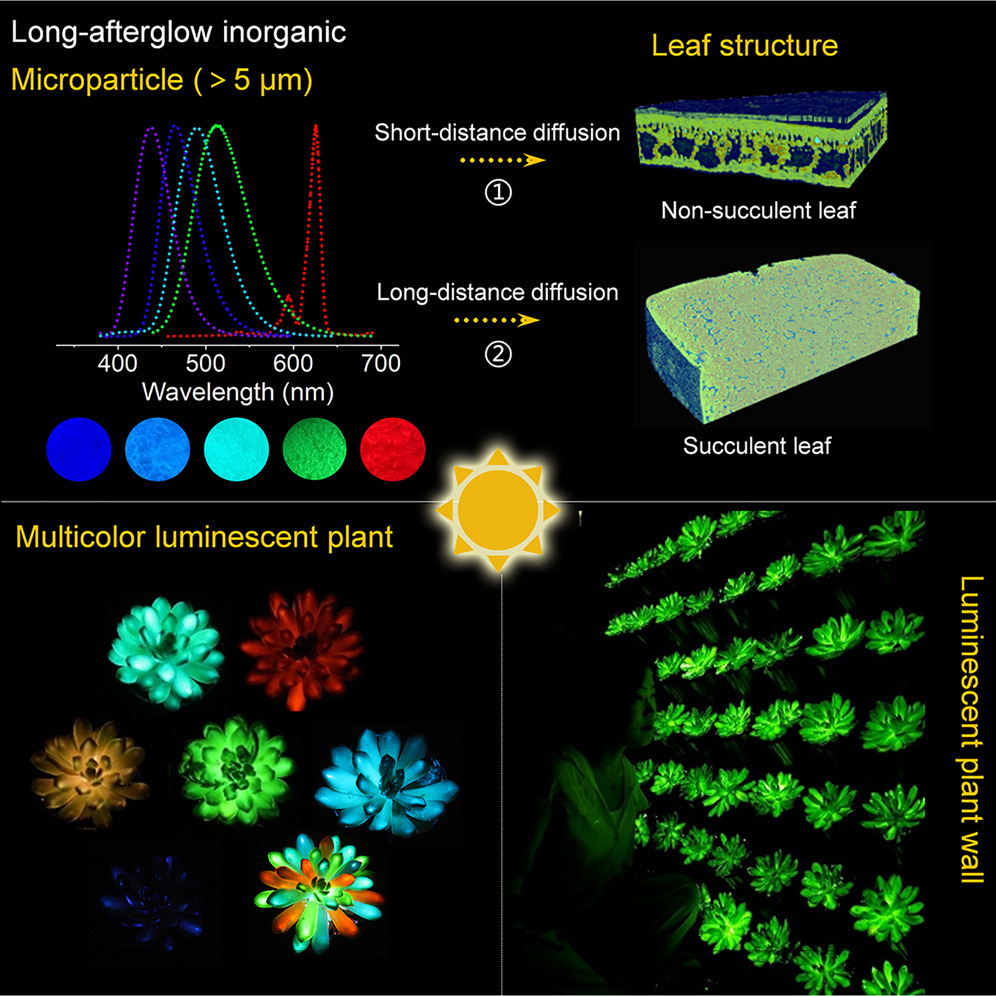
Graphical abstract borrowed from Shuting Lui et al. (2025)’s scientific paper – whose work is discussed in this post.
There is a section in Jonathan Swift’s Gulliver’s travels (Bonnie J Robinson & Laura Getty) which tells of a man who “had been eight years upon a project for extracting sunbeams out of cucumbers” (near the beginning of Part III, Chapter 5).
That observation by noted satirist (and writer, essayist, and Anglican cleric) Swift (Ian Campbell Ross; Ricardo Quintana & JE Luebering) was apparently aimed at the folly of “impractical scientific endeavors, mocking the Royal Society [of the United Kingdom] and the pursuit of knowledge without utility” (quoted from here) (Rebekah Higgitt)*. However, as impractical as it may have seemed at the time, the 21st century study of Shuting Liu et al. (2025) appears to come close to realising that ambition.
Working with the succulent plant Echeveria ‘Mebina’ – rather than cucumber (Cucumis sativus) – Liu et al. (2025) have created a version of the plant that can absorb sunlight [‘sunbeams’] and re-emit [i.e., ‘self-extract’] some of that light.
Driven by the notion that “Plant-based lighting holds significant potential across various fields, including architecture and urban planning” (Liu et al., 2025), this effect was achieved by ‘injecting’** the plants with particles of phosphate-coated SrAl2O4:Eu2+,Dy3+ (SA)***.
SA is what’s known as a long-lasting afterglow (Yang Li et al., 2016) phosphorescence material****. This means that, after it has absorbed light of appropriate wavelength, it will not only emit light, but will continue to do so, after the illuminating light has been removed*****. Although SA only emits green light, Liu et al. (2025) constructed plants that glowed in a range of colours – blue, green, red, and blue-violet. The colours generated depend upon the particular chemical composition of the long-afterglow material (e.g., Sr2MgSi2O7:Eu2+,Dy3+ (SMS), for blue). Overall, the wavelengths of the palette of glowing colours “ranged from 436 nm to 625 nm, covering the major visible spectrum”. Furthermore, with a combination of three different phosphors, “warm-white luminescent plants were developed with tunable emission, transitioning from warm-white light to green light”.
Light sources that could be used included “standard indoor WLED light [(Rob Shafer)] (∼360 lx [lux]) for 120 s[econds], producing a visible luminescence that lasts up to 1 h[our]” (Liu et al., 2025). And, using “outdoor sunlight (∼10,000 lx) for 120 s, the plants exhibited a much brighter emission, sustaining visible emission for up to 2 h” (Liu et al., 2025). With such encouraging results it is not surprisingly that the researchers conclude that “This study highlights the potential of luminescent plants as sustainable and energy-efficient lighting systems, capable of harvesting sunlight during the day and emitting light at night” (Liu et al., 2025).
Just as the source of the illuminating light source can affect illumination outcome, so can the particle size of the phosphor injected. The optimum diameter was about 7 micrometres, “about the width of a red blood cell” (Laura Baisas). “Smaller, nano-sized particles move easily within the plant but are dimmer,” says Liu, “Larger particles glowed brighter but couldn’t travel far inside the plant” (quoted in Baisas). More technically, “Particle transport is constrained by the spatially resolved physics of plants” (Liu et al., 2025). Of the range of plant types examined, “succulent plants exhibit higher loading capacity and more uniform luminescence” (Liu et al., 2025) because “The dense and compact microstructure of succulent leaves facilitates particle dispersion without promoting aggregation”.
In summarising the progress and potential of their work, the paper’s authors say, “Our work introduces the first multicolored luminescent plants, excited by sunlight, featuring unprecedented brightness, long afterglow, and a low-cost, simple, and reproducible method, paving the way for sustainable, plant-based lighting solutions” (Liu et al., 2025).
At present the methodology is extremely labour-intensive and production of sufficient numbers of these ‘afterglowing units’ is a major constraint on any notions of widespread uptake of this approach. Plus, there are questions to answer regarding the longevity of the treated plants and the effects of adding these particles to the plant’s physiology, growth and development. And there will be concerns for the environment regarding disposal of the plants – and in particular their micro particles – at the end of their useful ‘shelf-life’. [Ed. – one does have images of huge numbers of these items being bought – when on sale – and gifted as ‘winter seasonal holiday’ presents only to be discarded and dumped soon after, once the novelty has worn off. Cue a “glowing echeverias are for life not just Christmas” advertising campaign..?]
Encouragingly, Liu et al. (2025) state that “This study highlights the potential of luminescent plants as sustainable and energy-efficient lighting systems, capable of harvesting sunlight during the day and emitting light at night”. However, as I understand the work, it’s not the case that the plants are emitting light at night that was initially absorbed during daylight exposure and somehow stored within the plant – which would be really useful. Rather, the interval between light-absorption and light-emission appears to be quite short, which means that an existing light source would be needed to energise the plants shortly before the time – and probably also quite close to the place – when and where this phyto-illumination is required. So, and whilst the fact that a short period of light exposure can subsequently provide up to two hours of illumination is impressive, lengthening the time between initial light-activation of the phosphors and subsequent re-emission of that stored light energy seems to be an interesting goal worth pursuing. [Ed. – how about this for a ‘bright idea’? Light emitted from a ‘glowing echeveria’ that had initially absorbed sunlight during the day is used – during the night – to illuminate another glowing echeveria. If the emitted light from such night-time irradiated plants can suitably irradiate other glowable echeverias you could effectively have continuous light throughout the dark period..?]
However, whilst succulents may be useful as lighting units within small-scale indoor settings, they are unlikely to be the living solution outdoors and in a variety of urban environments. Although Liu et al. (2025) examined several other – non-succulent – species (e.g., ‘Capsicum’, Vigna radiata, Nicotiana tabacum, and Brassica chinensis), the best results were achieved with Echeveria ‘Mebina’. Since the success of Echeveria was ascribed to its particular leaf structure, maybe similar results could be achieved with other succulents, and possibly even cacti – which are also succulents. In which case, plants that are much taller than Echeveria – e.g., a Rhodocactus, which has tree-like stature, and leaves which might be phosphor-manipulable – might go some way towards, not only looking like but, producing the light outputs of street lights or lamp posts, or standard lamps for indoor use.
But, unless and until a wider range of plant types can be exploited as ‘living lights’, the hope that this technology can be utilised more widely across the planet may be somewhat dimmed******. Nevertheless, as a proof of principle, and in shining a light on what’s possible, Shuting Liu et al. (2025)’s work******* shows promise [Ed. – and there is a pending patent application related to this work (Chinese patent application no. 202411075973.1)]
For more enlightenment on this story, see Laura Baisas, here, Jack Knudson, here, here, Issy Ronald & Amarachi Orie, Ryan Whalen, Sascha Pare, here, Prabhat Ranjan Mishra, Christian Garavaglia, James Thompson, Priyali Prakash, Bobby Bascomb, here, Mark Wales, Jennifer Ouellette, and Katherine Bourzac. A particularly interesting and insightful read is the piece by Michael Le Page in New Scientist******. [Ed. Should you be desirous of even more news stories for this work, this link should enable you to access “93 News mentions across 10 URLs”. As you’d rightly infer, this story has been big news.]
Finally, and something that could have been easily overlooked near the end of the paper is this “DECLARATION OF GENERATIVE AI AND AI-ASSISTED TECHNOLOGIES IN THE WRITING PROCESS”. In that statement we are told that “During the preparation of this work, the authors used ChatGPT to improve readability and language. After using this tool, the authors reviewed and edited the content as needed and take full responsibility for the content of the publication”. That honest acknowledgment of the contribution of ChatGPT – one of several so-called LLMs [Large Language Models (David C & Paul J, Andreas Stöffelbauer)] – is to be applauded. As the spread and reach of LLMs continues to expand we are likely to find them being used more commonly in the creation of text for scientific articles. It is to be hoped that papers where this is done will have a declaration similar to that provided by Shuting Liu et al. (2025) for theirs.
* As poking-fun-at-the-Royal-Society as this was supposed to be, knowing what we know in the 21st century about how plants work, the notion of ‘extracting sunbeams from cucumbers’ has more than the ring of truth about it. Every time we extract parts from plants, e.g., harvest cereal grains or potatoes – or even eat slices of cucumber – we are essentially extracting ‘sunbeams’ from those plants. That’s because the energy of sunlight – contained within those sunbeams – is used to drive photosynthesis, which process essentially transforms the sun’s electromagnetic energy into chemical energy within the organic compounds that plants make in that process. Therefore, whilst we may not extract sunbeams directly from plants, we do remove the energy contained in those sunbeams.
** In practice, an injection channel was created using a hypodermic syringe needle to gently puncture the abaxial (PM Eckel) leaf surface. Subsequently, a needle-free injector was used to introduce phosphor solution into the puncture site under slight pressure, which allowed the suspension to diffuse from the injection channel throughout the leaf (Liu et al. (2025).
*** For those of us – such as Mr P Cuttings – who are not familiar with this rather exotic looking compound, it is a combination of strontium (Sr), aluminium (Al), oxygen (O), europium (Eu), and dysprosium (Dy) [Ed. – yes, I am aware that this listing is beginning to look like lyrics from Tom Lehrer’s song about the periodic table…], and is more-commonly called strontium aluminate co-doped with europium and dysprosium ions (Maryam Mollazadeh-Bajestani et al., 2023).
**** For completeness – e.g., should you read about these materials elsewhere – long-lasting afterglow phosphorescence material are also known as: long afterglow luminescent (Yuxin Guo et al., 2023); long persistent phosphorescence (Yang Li et al., 2016); or long persistent luminescence (Yang Li et al., 2016) compounds. They are also commonly-called ‘glow-in-the-dark’ phosphorescence material (Dirk Poelman et al., 2020).
***** This phenomenon of persistence is known as phosphorescence. Although it may appear similar to fluorescence, phosphorescence is distinguished from that phenomenon because fluorescent emission of light ceases as soon as the illuminating light is removed. Both fluorescence and phosphorescence are examples of photoluminescence. And, for some sort of completeness, a phosphor is “a substance that exhibits the phenomenon of luminescence; it emits light when exposed to some type of radiant energy” (quoted from here) (see also here).
****** And let’s not ignore the view of one commentator that “The brightest and most colourful glowing plants yet have been created by injecting phosphorescent chemicals directly into the leaves, but it is little more than a cheap gimmick” (Michal LePage)…
******* If this sounds a little familiar, it may be that readers recall the previous interest in ‘glow-in-the-dark petunias’. For more on that story, see Rachel Ehlenberg, here, Sara Woodruff, Zoë Schlanger, Matthew Lisy. However, Shuting Liu et al. (2025) distinguish their succulent approach to “Recent advancements, such as Light Bio’s 2024 Firefly Petunia” because “its brightness remains relatively low, and the color range is limited, which restricts its use to decoration.”
For more on bioluminescent and glowing plants more generally, see Anne Trafton, Tatiana Mitiouchkina et al. (2020), Oliver Graydon, and Anna Gibbs.
REFERENCES
Yuxin Guo et al., 2023. A brief review: the application of long afterglow luminescent materials in environmental remediation. RSC Adv 13: 16145-16153; doi: 10.1039/D3RA02046K
Yang Li et al., 2016. Long persistent phosphors—from fundamentals to applications. Chem. Soc. Rev. 45: 2090-2136; https://doi.org/10.1039/C5CS00582E
Shuting Liu et al., 2025. Sunlight-powered multicolor and uniform luminescence in material-engineered living plants. Matter 102370; https://doi.org/10.1016/j.matt.2025.102370
Tatiana Mitiouchkina et al., 2020. Plants with genetically encoded autoluminescence. Nat Biotechnol 38: 944–946; https://doi.org/10.1038/s41587-020-0500-9
Maryam Mollazadeh-Bajestani et al., 2023. Reviewing the bio-applications of SrAl2O4:Eu 2+, Dy 3+ phosphor. J Biol Med 7(1): 044-052; https://dx.doi.org/10.17352/jbm.000040
Dirk Poelman et al., 2020. Persistent phosphors for the future: Fit for the right application. J. Appl. Phys. 128: 240903; https://doi.org/10.1063/5.0032972 https://doi.org/10.1063/5.0032972
 Plant Cuttings
Leave a comment