
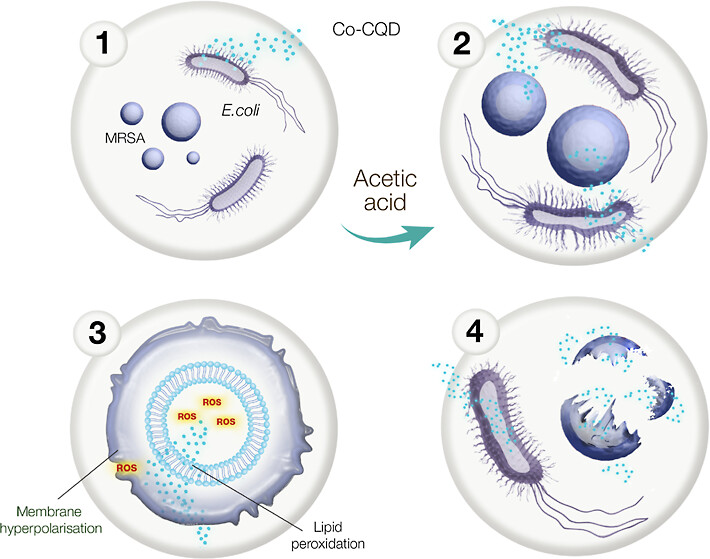
Graphic borrowed from Adam Truskewycz et al. (2025).
At Cuttings HQ we love few things more than a pleasingly tantalising, plant-linked, people-related story. This one starts with grapes and ends with infected humans (by way of quantum dots and vinegar…). So, here goes.
Where does wine (Maynard A Amerine) come from? From fermented plant products, e.g., grapes, the fruit of the grape vine (Vitis vinifera). What happens to wine if it’s not consumed, and is left exposed to the air for some time? Acetobacter bacteria might enter the wine and convert the ethanol – the principal alcoholic component of wine (Coravin, Lucy Stevenson) – into acetic acid (William H Brown) (see also here, here, and here). The common name for that watery solution of acetic acid that remains is vinegar (Martha Zepp) [Ed. – which word is apparently a corruption of the Old French term vyn egre, which means ‘sour wine’ in English]*.
Vinegar has many uses (see books highlighted in the paragraph that starts The image … below), but one of direct relevance to people who are infected is its use as a disinfecting agent (Melanie Fincher, Kirsten Nunez). In particular, “Acetic acid has been commonly used in medicine for more than 6000 years for the disinfection of wounds and especially as an antiseptic agent in the treatment and prophylaxis of the plague” (H Ryssel et al., 2009). Helpfully, the acid vinegar solution reduces the pH of the infection site so it is not as favourable for the infecting bacteria – which generate, and benefit from, an alkaline environment (Kapil S Agrawal et al., 2017).
“However, the range of bacteria that vinegar can kill is limited”, which restricts its clinical effectiveness, particularly with the number of bacteria that are resistant to chemical attack by modern medicines. And there is a pressing need to find solutions that work against such resistant microbes – as is evident in this statement by the WHO [World Health Organization] that, “Antimicrobial Resistance (AMR) is one of the most urgent global health threats and development challenges, causing over a million deaths annually. Without intensified action, it is estimated that 39 million deaths will be attributable to AMR by 2050” (quoted from WHO’s Analysis of antibacterial agents in clinical andpreclinical development: overview and analysis 2025).
Nevertheless, keen to exploit its proven effectiveness against some bacteria (“even when infection is caused by multiple antibiotic resistant strains of Pseudomonas aeruginosa (BS Nagoba et al., 2013)), and with a little 21st century chemical wizardry, vinegar can be transformed into a much more effective bactericide. Which is what Adam Truskewycz et al. (2025) have achieved.
In their work, Truskewycz et al. (2025) harnessed the pH-lowering property of acetic acid with the antimicrobial capability of nanoparticles (Suresh K Mondal et al., 2024; Hamed Salmani-Zarchi et al., 2024; Ayman Elbehiry & Adil Abalkhail, 2025), ‘carbon dots’ in particular (Xiuli Dong et al., 2017; 2020; Mattia Ghirardello et al., 2021). Accordingly, Truskewycz et al. (2025) utilised cobalt-doped carbon quantum dots (CGDs). CGDs were chosen for their “biocompatibility and potential for functional chemical modifications”; cobalt was used because of its “documented antimicrobial activity”**.
The effect of the acetic acid is to cause such severe osmotic disruption to the bacteria that swell facilitating entry of the nanoparticles inside the cell. The nanoparticles have the capacity to kill bacteria by causing severe metabolic disruption and damage to the microbes tested. In particular, “These particles generated peroxidase and superoxide ROS [Reactive Oxygen Species (Ahmed Abdal Dayem et al., 2017)], causing MRSA [methicillin- and oxacillin-resistant Staphylococcus aureus] and Enterococcus faecalis (Stephanie Watson, Emilie White) to burst and Escherichia coli [E. coli] to have their cell wall detach from the cytoplasm” (Truskewycz et al., 2025). As a result, the combined bactericidal effect of vinegar and quantum dots is considerably enhanced over that of either component on its own.
As is so often the case with such medical breakthroughs, they’re initially discovered, and found to be effective in, non-human animals – such as the black mice used here. As the team recognise in the limitations to their study “It is important to note that wound healing in mice differs fundamentally from that in humans” (Truskewycz et al., 2025). Although, according to Nils Halberg, one of the research team behind the work, “this approach is non-toxic to human cells [P Cuttings’ emphasis]” (quoted from here). Amongst the next steps for this work will be finding out if this ‘quantum elixir’ will do as effective a job on infected people. Given the past history of vinegar fighting infections the outlook is encouraging.
For more on this story, see here, Hannah Millington, here, Herman J Nord, Linda Stewart, here, Ghost, Mac Oliveau, and here.
The image at the top of this post is the cover of Vinegar: Nature’s secret weapon by Maxwell Stein. That book can be read on-line, for free at the Internet Archive. More, and freely-accessible, books on the many uses of vinegar can be found here, here, and here.
* As an interesting historical aside, a vinegary wine known as posca (Joseph Pett) was apparently “the Favorite Drink of Roman Legionaries” (Jorge Álvarez) and was the ‘vinegar’ that was given to Jesus Christ whilst on the cross. For more on this, see the fascinating article by Jorge Álvarez in LBV Magazine, “a digital magazine positioned at the intersection of history, archaeology, science, and culture with technology. It offers content that explores the roots of our civilization, the latest scientific discoveries, and the diverse cultural expressions that enrich our world, providing readers with a broad, multidisciplinary perspective on human knowledge”.
** Interestingly, cobalt’s antimicrobial credentials for this clinical application were based upon its success as an anti-biofouling agent during uranium extraction from seawater (Wenyan Sun et al., 2022).
REFERENCES
Kapil S Agrawal et al., 2017. Acetic acid dressings: Finding the Holy Grail for infected wound management. Indian J Plast Surg 50(03): 273-280; doi: 10.4103/ijps.IJPS_245_16
Ahmed Abdal Dayem et al., 2017. The role of reactive oxygen species (ROS) in the biological activities of metallic nanoparticles. Int J Mol Sci 18(1): 120; doi: 10.3390/ijms18010120
Xiuli Dong et al., 2017. Antibacterial effects of carbon dots in combination with other antimicrobial reagents. PLoS ONE 12(9): e0185324; https://doi.org/10.1371/journal.pone.0185324
Xiuli Dong et al., 2020. Carbon dots as potent antimicrobial agents. Theranostics 10(2): 671-686; doi: 10.7150/thno.39863
Ayman Elbehiry & Adil Abalkhail, 2025. Antimicrobial nanoparticles against superbugs: Mechanistic insights, biomedical applications, and translational frontiers. Pharmaceuticals 18(8): 1195; https://doi.org/10.3390/ph18081195
Mattia Ghirardello et al., 2021. Carbon dots as an emergent class of antimicrobial agents. Nanomaterials 11: 1877; https://doi.org/10.3390/nano11081877
Suresh K Mondal et al., 2024. Antimicrobial nanoparticles: current landscape and future challenges. RSC Pharm 1: 388-402; doi: 10.1039/D4PM00032C
BS Nagoba et al., 2013. Acetic acid treatment of pseudomonal wound infections – A review. Journal of Infection and Public Health 6(6): 410-415; https://doi.org/10.1016/j.jiph.2013.05.005
H Ryssel et al., 2009. The antimicrobial effect of acetic acid—An alternative to common local antiseptics? Burns 35(5): 695-700; https://doi.org/10.1016/j.burns.2008.11.009
Hamed Salmani-Zarchi et al., 2024. Antimicrobial feature of nanoparticles in the antibiotic resistance era: From mechanism to application. Adv Biomed Res 13: 113; doi: 10.4103/abr.abr_92_24
Wenyan Sun et al., 2022. Amidoxime group-anchored single cobalt atoms for anti-biofouling during uranium extraction from seawater. Advanced Science 9(10): 2105008; https://doi.org/10.1002/advs.202105008
Adam Truskewycz et al., 2025. Cobalt-doped carbon quantum dots work synergistically with weak acetic acid to eliminate antimicrobial-resistant bacterial infections. ACS Nano 19(37): 33103-33117; https://doi.org/10.1021/acsnano.5c03108
 Plant Cuttings
Leave a comment