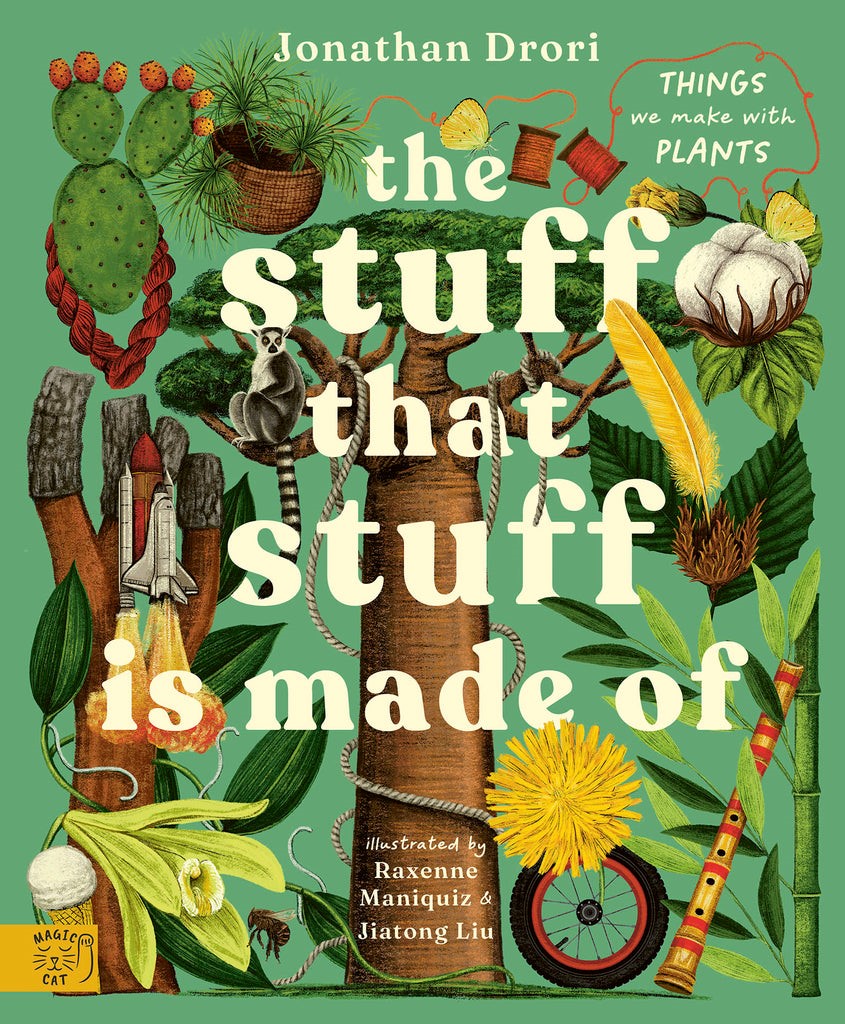
the stuff that stuff is made of: Things we make with plants by Jonathan Drori, 2025. Magic Cat Publishing.
The inability to recognise plants in the environment, or to appreciate the many important ways that plant affect our lives – the condition known as plant blindness (Carly Cowell), or plant awareness disparity [PAD] (Kathryn Parsley, 2020) – is a major problem amongst the general public [i.e., all those who don’t work with or study plants on a daily basis, which is the great majority of people on the planet]. One way of trying to reduce the prevalence of the condition is to produce books that showcase the plants and their products, and place them at the forefront of the lives of people. Without mentioning plant blindness by name, reducing that phenomenon is what Jonathan Drori attempts to do in the stuff that stuff is made of [which book is here appraised].
What you get…
A book that is very well-written, and abundantly-illustrated, and which is a celebration of plants and – in particular – the ways in which they’ve been used by humanity. At the front of the book we have a single page introduction to the book, and a single page table of contents (in English common name order, but also showing the plant’s scientific name). At the back of the book we have approx. half a page of Glossary (15 terms, from ‘Colonisation’ to ‘Superstition’, via entries such as ‘evergreen’, indigenous people’, photosynthesis’, and ‘pollination’). In between we have 60 pages devoted to the tales of 30 plants.
Within the word-constrained scope of a relatively few pages, you get some pleasingly phrased passages in the stuff that stuff is made of, for example, “Within just a few decades, Australia’s prickly pear panic was over” (p. 36). You also get several scatological and toilet-humour references, e.g., giant pandas “have to spend half their lives eating and poo up to forty times a day!” (p. 26); regarding the use of charcoal made from coconut on the International Space Station [ISS] (Elizabeth Howell), ”It purifies the air and absorbs toilet smells and astronaut’s farts” (p. 60); and “Eating too many [dandelion leaves] can make you want to pee!” (p. 35). That is definitely the sort of thing that should help the book to appeal to a younger readership [and many older ones – after all, “you’re never too old not to laugh at farts” (James Spiegel)] – and is part of the engaging (and age-appropriate…) literary style that can only help to get Drori’s message – of the utility of plants – across.
What are the plants?
The plants covered are overwhelmingly – 28 out of 30 – angiosperms, flowering plants; there is only a single gymnosperm mention (although that’s to several Pinus species). Maybe somewhat bizarrely (although it does give a shout-out for another group of photosynthetic organisms that have importance to people), an alga – the (very!) large brown seaweed giant kelp (Macrocystis pyrifera) – is also featured.
Of the angiosperms, there are eight monocots (vanilla, papyrus, giant timber bamboo, corn, sugarcane, rice, wheat, and coconut), and 20 dicots – e.g., mandrake, potato, dandelion, prickly pear, pumpkin, black pepper, and tomato – and which includes 13 trees/bushes/shrubs [tea, cacao, cotton, rubber, cork oak, blue gum, gutta-percha, nutmeg, henna, beech, olive, baobab, and peanut].
Each plant entry consists of two pages (and, pleasingly, both pages are viewable at the same time): one with common and scientific names of the plant and more-botanical information about its leaves, fruits, flowers, etc. – with pictures of the plant and its parts [think: good old-fashioned, proper, traditional, botany…]; and a 2nd page featuring short statements about the uses of the plant – which are not limited to practical ones, but also mention such aspects as folklore, and the cultural significance of the featured plant, and also numerous illustrations. Importantly, Drori is also keen to emphasise conservation and ecological messages which place the plants in the bigger planet-wide context of care for and management of the plant resource.
Throughout, the book unapologetically exudes enjoyment of, and enthusiasm for, the plants and their stories as “Best-selling author Jonathan Drori brings life to the science of plants, revealing how their worlds are entwined with our own in this one-of-a-kind family book“ [per the publisher’s site].
How were those 30 plants chosen?
Why the 30 plants were selected is unashamedly stated by the author (in a loose-leaf letter from Drori to the reader, that’s included with book), “I’ve included 30 plant species from around the world – ones I think are especially interesting and important” And why not? Drori’s book, Drori’s ‘rules’. Other authors may have made a different selection, but it’s not theirs to make. And those that Drori has selected cover the majority of ways in which people have interacted with and exploited plants over the millennia. Importantly, and as Drori acknowledges “some of the plants in this book have very sad histories” (p. 2) – especially those that are related to slavery. But, although that highlights plant-and-people associations that are most definitely not one of humanity’s proudest moments, it’s important that everybody is made aware of this much less benign side of plant-people relationships. Other stories just “make me smile” (p. 2), e.g., use of peppercorns as money, henna designs on the skin of brides-to-be, and dandelion clocks. Fortunately, there are many more of the latter than the former in the book.
With its well-chosen selection of plants and their stories, the stuff that stuff is made of should give those who aren’t that familiar with plants and plant products a pretty good introduction to that subject (and remind those who are of uses they may have forgotten about…). Drori’s charming book should therefore help to do its bit to reduce plant blindness amongst the general public. Very well done, sir!
Plenty of new ‘stuff’ here…
Although, arguably, this book treads the well-trodden path that catalogues the many uses of plants by people (and I’ve read and reviewed many of them over the years), the stuff that stuff is made of contained plenty of facts [but see What you don’t get…] that were new to me. For example, I learned the name of “a popular porridge made from lightly crushed new wheat soaked in hot water or milk” (p. 54); the identity of a tree that people in England people once believed would protect their homes from lightning; the reason why a bride and groom are showered with rice grains; that hollowing-out a particular giant fruit to be used as boats and raced against others is “possibly the most delightfully ridiculous sport in the world!” (p. 40); the name of the plant that was used to make the ropes used to shift huge stones for pyramids; and that “researchers in South Korea discovered that playing a loud high-C whistle for about six hours can delay the ripening of harvested tomatoes by nearly a week!” (p. 58)*.
What you don’t get…
The book has no index [with plenty of facts supplied it would be useful to have an index so that one could find them again amongst the text].
Neither does it provide any sources for the numerous statements of fact that it contains. Absence of sources is a shame because a fact-based book really does require the evidence to support the statements made. However, although the stuff that stuff is made of is source-free, readers interested in following-up statements made might find some help here. That is a link to “some sources for Around the World in 80 Trees and Around the World in 80 Plants”, Drori’s two previous plants-and-people books. Specifically, that site contains General Bibliography [sources used repeatedly for useful background on many trees and plants], Online Resources [“The online services I [author Drori] often consulted for Around the World in 80 Trees and Around the World in 80 Plants”], and Individual Species References [”species-specific references for each species featured in Around the World in 80 Plants, listed in alphabetical order of scientific name”]. Although Drori acknowledges that “it isn’t an exhaustive list”, he does say, “if you can’t find what you’re looking for, please contact me so I can help!”. Which, whilst it’s a nice gesture, is no substitute for having the sources to hand, in the book. But, maybe the good author could be persuaded to list the sources for the stuff that stuff is made of on his web site – as for ‘80 trees’ and ‘80 plants’..?
Author’s ambition for the book
As Drori writes – in a letter from author to reader included with the book – “I set myself the challenge to include something surprising for every reader, on every page – not just children but adults as well”. This reviewer is very happy to report that that was achieved [see Plenty of new ‘stuff’ here…]. Furthermore, the author hopes that “this book inspires an appreciation of nature and curiosity about the world” (also quoted from Drori’s letter to the reader). One can only trust that that will be the case for all who read the book.
Recognising that plant blindness is not an affliction that affects a particular age group of people, Drori’s book was written very much in mind with “readers 7 to 100” [from the publisher’s web site for the book]. Capturing the imagination of the very young may just encourage them to appreciate plants better and grow up to be more ‘plant-aware’, and phytoappreciative. And, if the book can be read jointly by adults and children, both age groups can only benefit. [Ed. – here’s an idea: maybe read a plant entry as a bed-time story for the youngsters. That way plant appreciation can be gently embedded in the general public from an early age. Surely, worth a try? And Drori’s book might just be the catalyst that brings about this change in mind-set…]
Reader’s next step?
Drori has a great track record in writing engagingly and intelligently about plants in his two previous plant books, Around the world in 80 trees, and Around the world in 80 plants. Whilst both of those are intended for older readers, younger readers of the stuff that stuff is made of should be encouraged to graduate to those to gain even more appreciation of plants and their place in the lives of people.
For completeness, it’s worth mentioning that many of the plants featured in the stuff that stuff is made of also appear in Drori’s previous plant books. From ‘80 plants’, we have giant kelp, dandelion, tomato, mandrake, papyrus, cacao (or cocoa tree), vanilla, henna, giant timber bamboo, coconut, nutmeg, potato, sugar cane [not shown as sugarcane, as here…], maize (or corn), and pumpkin. From ‘80 trees’, we have beech, olive, baobab, rubber, gutta-percha, eastern white pine, and lodgepole pine (as named examples of the genus Pinus), and jarrah (which is Eucalyptus marginata [as opposed to the blue gum – Eu. globulus – that’s featured in the stuff that stuff is made of]).
But, the stuff that stuff is made of is not just a repackaging of material about the plants that Drori has already covered elsewhere. Attention to the intended youthful audience is evident in the way material is presented here; there are lots of very short statements interspersed with numerous, small, colourful illustrations [from the talented nibs, brushes, and imaginations of artists Raxenne Maniquiz and Jiatong Liu]. That combination makes the book very undemanding to read [a bonus – whatever your age], and also provides lots of opportunities to discuss its content for adults reading with youngsters.
Summary
Jonathan Drori’s book, the stuff that stuff is made of, provides a wealth of fascinating facts about the importance of plants to the lives of every person on the planet. It ranges far-and-wide in its exploration of the plentiful ways in which plants and their products have been exploited by people. It’s an important message that’s well-told and lavishly illustrated, and deserves to be widely read by its intended audience aged from 7 to 100.
This post’s penultimate words I happily give to Drori, “Especially, let’s celebrate the plants themselves; the most intricate and beautiful chemical factories you could possibly imagine. Three cheers for each and every plant… the stuff that stuff is made of!” (p. 2). And, ultimately, let’s offer another three cheers for author Drori and his charming book.
PS [added 12th October, 2025], for more personal insights and appraisal of this book, see Alun Salt’s review on Botany One.
* This was such an intriguing statement I had to follow it up. A very quick Google turned up more about this phenomenon, which can be read in the scicomm article by MH Lee, and in the scientific papers by Joo-Yeol Kim et al., 2015, and Joo Yeol Kim et al., 2018 (which source is disclosed by Drori on-line re ‘80 plants’ ).
REFERENCES
Joo-Yeol Kim et al., 2015. Sound waves delay tomato fruit ripening by negatively regulating ethylene biosynthesis and signaling genes. Postharvest Biology and Technology 110: 43-50; https://doi.org/10.1016/j.postharvbio.2015.07.015
Joo Yeol Kim et al., 2018. Exploring the sound-modulated delay in tomato ripening through expression analysis of coding and non-coding RNAs. Annals of Botany 122(7): 1231–1244; https://doi.org/10.1093/aob/mcy134 [Ed. – yes, Kim’s name shown un-hyphenated on this occasion]
Kathryn M Parsley, 2020. Plant awareness disparity: A case for renaming plant blindness. Plants, People, Planet 2(6): 598-601; https://doi.org/10.1002/ppp3.10153

 Plant Cuttings
Leave a comment