
Funga obscura: Photo journeys among fungi, Alison Pouliot, 2025. The University of Chicago Press.
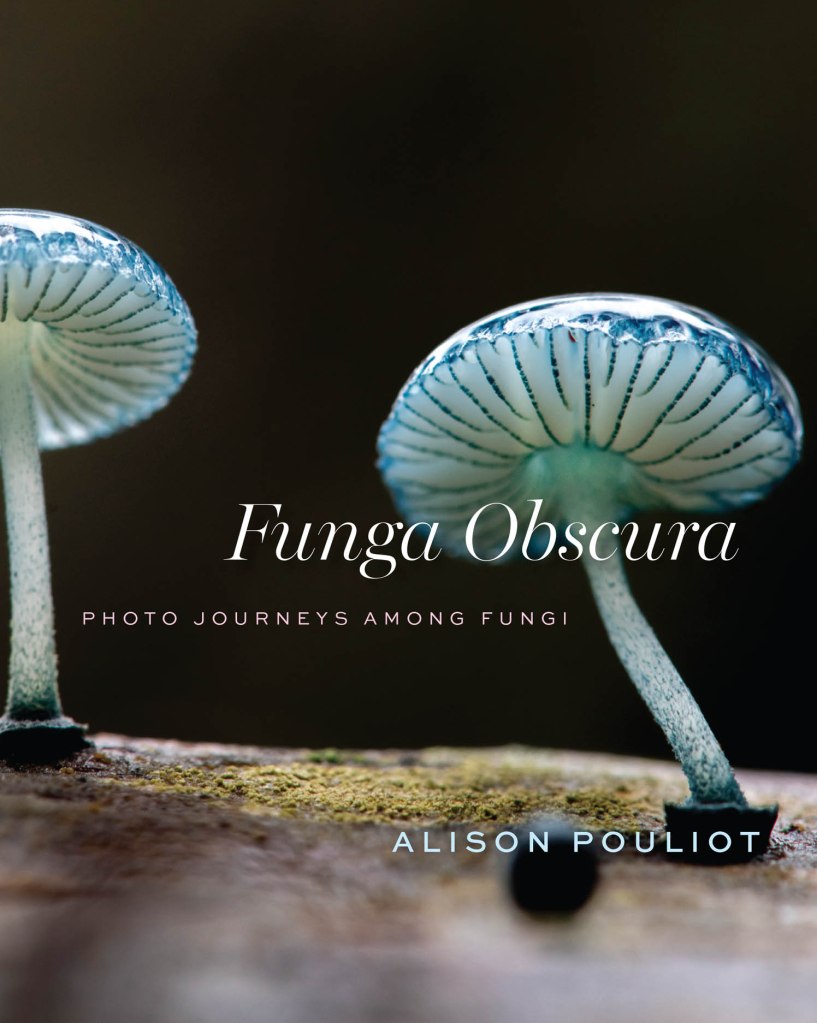
I received a copy of Funga obscura by Alison Pouliot from the publisher, University of Chicago Press. As an unsolicited book – and having already committed to appraising several other titles on my ‘books to review’ shelf, I advised the publisher that, unfortunately, I wouldn’t have time to review it, but thanked them for sending me this gratis copy. However, having recently read Mushroom day by Pouliot – and been so impressed by what she had to say, and how she said it – I have relented and here present a ‘lite’ appraisal of Funga obscura.
Overview
Funga obscura is full of wonderfully evocative text, that’s awash with Pouliot’s typical trademark trait of alliteration, e.g., “The superstitious wielded them to ward off witches or to contact the dead” (p. 4); “There’s a tantalising temporal tension between capturing fungi photographically and their ephemeral lives” (p. 5); and “monotropoid mycorrhizas, add further to the mycological mayhem by also messing with the rules” (p. 108), and with a good dose of memorable phrasing, e.g., “some mosses can slurp up nutrients through their rhizoids” (p. 15), and “Mosses and liverworts upholster the twisted limbs and reclining trunks on the forest floor” (p. 36). All-in-all, Funga obscura is beautifully written: Whilst Pouliot may observe with a naturalist’s eye, she writes with the soul of a poet.
Plus, the words are enriched and enlivened by Pouliot’s own pictures, from her fungal forays around the globe in search of myriad marvellous mycoforms. Accordingly, we have images from places such as Alder lake (Washington, USA), “the coastal hamlet of Argenton in France’s westernmost region of Brittany” (p. 155), Tallarook Bushland Reserve (Australia), the laurasilva forest of Madeira, and the glaciers of Switzerland. But, it’s not just fungi. In considering their far-reaching ecological importance, she shares with us images of some of the organisms that spread fungal spores, the crucial reliance upon fungi for their nutrition by orchids, and the habitats that fungi occupy, e.g., dead trees, abandoned cars, and headstones on graves.
As described by the author, her approach to photography is “poetic rather than diagnostic” (p. 3) – which therefore perfectly complements her writing – as she provides “a visual celebration of the remarkable lives of fungi, to capture their essence within their habitats and among other life forms” (p. 3). [Ed. – For more of the author’s photographs – of fungi and other subjects – visit her web site]
First things first, Focus on fungi is a quite philosophical section in which Pouliot sets out her stall regarding her approach to documenting fungi through the medium of photography. And, which also reminds us that this book is a fabulous fungal photofest.
The main text of the book is divided across five chapters, each of which begins with some appropriate context and scene-setting text, before displaying the pictures (with captions). Accordingly, we have…
Pioneers, which looks especially at lichens – “a world-conquering, cross-kingdom conglomerate that has stood the test of (a very long) time” (p. 13) – and their role in initiating the process of soil formation, which material they also help to stabilise providing a surface suitable for subsequent colonisation by other life forms, e.g., the “benevolent bryophytes” (p. 15) [photographs of which plants are provided by Pouliot], and more robust, vascularised horsetails and ferns – which are also illustrated in the book.
Into the forest, a big jump here from the “cryptogamic crusts” (p. 30) of the previous chapter to the majestic complete ecosystems known as forests, but an opportunity for Pouliot to present images of much more than just fungi (although one of my favourite images here are of the map fungi on leaves of Oregon grape).
Suitors & assassins, a range of intimate relationships between fungi and other lifeforms are considered here, including a pretty detailed account of the biology of the various forms of mycorrhiza, and the essential role fungi play in orchid germination and seedling survival [yes, and an opportunity to show some beautiful orchid photographs]. And the wood-wide web is here mentioned, but only fleetingly, in these words “It seems the wood wide web of the subterranean might be every bit as prone to freeloading hackers as the world wide web” (p. 108).
Parasols & oddballs, a marvellous mix of myriad mushroom morphologies on display here.
Life among Homo sapiens contains an important reminder that fungi are adept at coping with what humans have made of the planet that is largely the way it is now thanks to the pioneering terraforming work of fungi and their relationships with plants. Or, in Pouliot’s own words, “Whatever we manufacture, it seems there’s a fungus that will have a shot at colonising it” (p. 155). And which intimately and intriguingly illustrated chapter give us memorable imagery such as “the lichens create an enigmatic charm as the gravestones slowly metamorphose from lifeless entities to living ecosystems” (p. 154).
A feast of fascinating fungal facts features throughout the book, but Pouliot supplies no indications of any of their source(s) [Ed. – although six books are listed under Further Reading…]. Somewhat disappointingly therefore, we just have to take Pouliot’s word for it (or invest the time and trouble necessary to check up on sources oneself…). [Ed. – although the book’s emphasis may be upon photographs, if you are going to make statements they should be appropriately backed-up by the necessary evidence…] Anyway, some that caught my notice were: “It’s also likely that the lichen partnership developed several times in different regions” (p. 17); standing dead trees are known as ‘stags’; there is a theory of thermal melanism; “Researchers at the University of Sydney found two fungus strains with powerful enzymes that can biodegrade plastics, including polypropylene” (p. 155); “Polypropylene accounts for 16 per cent of the entire plastics industry” (p. 155); “the sobering claim that the millions of tonnes of plastics in the oceans could soon surpass the mass of fish” (p. 155). All of which I’d need to have sourced if I were to repeat them.
However, one statement did demand its immediate ‘Googling’, “only fungi can degrade lignin” (p. 17). I was sceptical of this bold assertion. It seems I was right to express doubts because reviews by Grzegorz Janusz et al. (2017), Dijana Grgas et al. (2023), and Kuan-Ting Hsin et al. (2025) all state that bacteria can also degrade lignin.
Summary
Funga obscura by Alison Pouliot is a veritable fungal photofest. Undoubtedly, 2025 has been a good year for the author with two exceptional fungus books published. It’s also been a good year for us readers, with two books about fungi from this exceptional talent.
REFERENCES
Dijana Grgas et al., 2023. The bacterial degradation of lignin—A review. Water 15: 1272; https://doi.org/10.3390/w15071272
Kuan-Ting Hsin et al., 2025. Lignocellulose degradation in bacteria and fungi: cellulosomes and industrial relevance. Front. Microbiol. 16: 1583746; doi: 10.3389/fmicb.2025.1583746
Grzegorz Janusz et al., 2017. Lignin degradation: microorganisms, enzymes involved, genomes analysis and evolution. FEMS Microbiol Rev 41(6): 941-962; doi: 10.1093/femsre/fux049

 Plant Cuttings
Leave a comment