
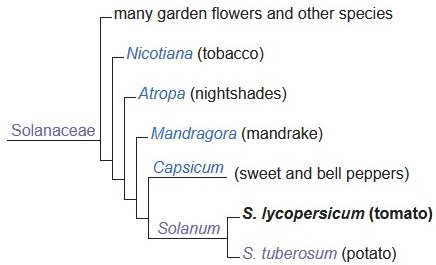
Graphic – showing the evolutionary relationship between several members of the nightshae family, the Solanaceae – borrowed from tomato’s Wikipedia page (but which can also be found on potato’s Wikipedia page, although with potato emboldened in that instance…)
Although this post is definitely a ‘plant cutting’, if I had to classify it further, it would probably be placed amongst the category of ‘things we didn’t even know were an issue’. Anyway, here goes…
A puzzling question that’s often posed is, which came first, the chicken or the egg?*
Another conundrum along similar lines, but one that I’d not been aware of before I saw the headline on PlayerFM’s popular science podcast site was, “What came first, the potato or the tomato?” It’s not something that I thought was an issue. However, having now been made aware of the ‘problem’, and one which is most pleasingly botanical, I couldn’t resist the temptation to delve into it.
Arguably, there are two ways to tackle that question. The first – and this interpretation is undeniably from my UK-based and therefore Euro-centric point of view – is to consider when those vegetables (Melissa Petruzzello) were introduced to Europe. The second takes a more evolutionary approach in considering whether the tomato or the potato evolved first.
First question first
From the European perspective, tomato and potato [both plants native to South America, i.e., they are New World crops] became known to peoples in Northern Europe as one of the consequences of the phenomenon known as the ‘Columbian Exchange’ (JR McNeill)**. The Columbian exchange “is traditionally defined as the transfer of plants, animals, and diseases between the Old World of Europe and Africa and the New World of the Americas. The exchange began in the aftermath of Christopher Columbus‘ voyages in 1492, later accelerating with the European colonization of the Americas” (John Horgan). Fair enough, but which of the two was introduced to Europe first?
In seeking to answer that question, a not unreasonable starting point these days is to use Google’s ‘AI Overview’ facility. Accordingly, using the search term “was the potato introduced to europe [Ed. – yes, sometimes Mr P Cuttings sends text before he’s edited it…] before the tomato [Ed. – and forgets to add the question mark, but the phrase seems to work as a question regardless…]”, the technology did it stuff and returned a very clear-cut, definite “Yes, the potato was introduced to Europe before the tomato”. And supplied sources that one could look at – to presumably see that they supported that affirmative reply. However, always keen to go that extra mile on behalf of my readers, I accepted Google’s invitation to “Dive deeper in AI Mode”.
Using the same search term, that deep dive displayed lots of text, culminating in this conclusion, “Therefore, it is possible that the tomato arrived in Europe slightly before the potato”. Yes, AI Mode supplied sources that – presumably – support that statement, but to have two contradictory answers to the same question was a little disappointing. Added to which is the caveat at the bottom of both sets of search results “AI responses may include mistakes. Learn more”(!) I think we can all agree with that statement. It’s just as well that this post isn’t a critical look at the question of when these two edible products of the nightshade family first came to Europe***.
Second question
The graphic [see the start of this post] used to illustrate this blog entry seems nicely clear and indicates that Solanum tuberosum (potato) (Stephen Harris) and Solanum lycopersicum (tomato) (Stephen Harris) arose at the same point in evolution from a common ancestor of both. At face value, that’s the second question answered, neither came first, both tomato and potato were ‘created’ at the same time. However, the reality is likely to be much more nuanced than indicated by that rather cut-and-dried, black-and-white representation.
The cultivated potato (Solanum tuberosum) – i.e., a proper tuber-producing potato plant [of the petota lineage (Mihai Andrei; William Whitson)] – is most likely a hybrid (Benjamin Goulet et al., 2017; Manjit S Kang) between a member of the so-called etuberosum lineage [potato plants that don’t produce underground tubers] of potatoes and a tomato****, according to the highly-detailed DNA investigative study undertaken by Zhiyang Zhang et al. (2025).
But, how do two non-tuberous parents give rise to tuber-forming offspring? Zhang et al. (2025) identify two genes of particular interest to this question from their extensive genetic analysis. One, called SP6A acts as a tuber-forming switch within potatoes, came from tomatoes; IT1, which regulates the growth of the underground stems that swell into tubers, came from etuberosum (Erik Stokstad). Through the medium of hybridization, approx. 8-9 millions of years ago, these pair helped to produce a new species of plant that was capable of producing tubers.
And it’s this development of tubers that has had a profound effect on the true potato plant ever since. First, the tubers act as a store of nutrients – for the plant [although it’s this property that’s been so beneficial to humans that potatoes are now the “third [Ed. – or fourth…] most important food crop in the world” (Daniëlle Hanse)] – that can help the plant endure tough environmental conditions (Erik Stokstad). Second, tubers help the plant reproduce vegetatively, i.e., without the need for sexual reproduction and potentially the vagaries of availability of pollinating animals (Erik Stokstad). And that’s extremely important because frequently hybrid plants have problems reproducing sexually (Haripriya Munipalli; Yidan Ouyang et al., 2010). That combination of consequences of tuberization is probably behind the tremendous diversity of the potato that’s found throughout large areas of South America.
So, to return to the question of whether the tomato or the potato came first, in an evolutionary sense, the answer has to be the tomato – because you won’t have had the potato [we know and love today] without the tomato*****.
For more on this fascinating ‘potato origins’ story (which has been very well reported in the scicomm press!), see Evrim Yazgin, Laura Baisas, Jorge Garay, Erik Stokstad, Will Dunham, Alun Salt, here, Zakaria Ahmed, here, Vanya Mileva, Eugene M Fernández Aguilar, Sara Jerez, here, Jeannette Kras, here, here, here, here, Sanjana Gajbhiye, here, Rob Beschizza, Mihai Andrei, here, here, Javier Barbuzano, Chuck Dinerstein, Josh Davis, James Woodford, Sara Hashemi, here, here, here, here, Ashley Strickland, Akshara, here, Issam Ahmed, here, Ari Daniel, Mrigakshi Dixit, Shireen Gonzaga, here, Sascha Pare, Victoria Craw, Katherine Wu, Aliza Chasan, here, here, here, Julia Musto, Rebecca Shavit, here, and Ivana Drobnjak O’Brien (!)
* Having no wish to spoil your own excitement at finding out the answer to this question, but in the spirit of sharing, for more on the chicken versus the egg question, see here, here, here, Alia Hoyt, Darren Orf, Jules Howard, Luis Villazon, and Joseph Shavit.
But I’m happy to share with you this beautiful chicken-and-egg joke [Ed. – or, yolk, even..?] I saw on social media: “I ordered a chicken and an egg from Amazon. I’ll let you know.” And that, as they say, is a ‘cracker’, and most eggcelent.
** For more on the Columbian Exchange, see here; here; here; here; Alfred W Crosby; JR McNeill & Jared Dease; here; John Horgan; Nathan Nunn & Nancy Qian, 2010; Noble David Cook, 2015.
*** Still, and for those of you keen to do their own research into this question, here’s a selection of articles to get you started (several of which were highlighted by Google in providing its two – contradictory – answers to the question…): Kimberley e.a.b; K Annabelle Smith; here; Tammana Begum; Ally North; here; Pippa Jackson; here; Diego Arguedas Ortiz; Rini; Deborah J Benoit; John G Hawkes & Javier Francisco-Ortega, 1993; Tinde van Andel et al., 2022; and here.
**** Frustratingly, Zhang et al. (2025) only talk about ‘tomato’ lineages, they don’t specify Solanum lycopersicum by name as the tomato parent of the potato. Probably because the tomato involved was a species that gave rise to the tomato, S. lycopersicum, that we know today. But, even as a ‘proto-tomato’ species it was instrumental in making the potato what it is today. So, tomato’s ‘priority’ over potato is still valid.
***** And that’s no ‘knee-jerk‘ response to the question, it’s a carefully considered one. After all, Zhang et al. (2025)’s work was carefully considered by the journal to which it was submitted for over 15 months [the manuscript was received on 25th September, 2023, and it was accepted for publication on 3rd January, 2025].
REFERENCES
Noble David Cook, 2015. The Columbian Exchange, pp. 103-134. In Jerry H Bentley et al. (eds) The Cambridge World History, Volume 6: The Construction of a Global World, 1400-1800 CE, Part 2: Patterns of Change; https://doi.org/10.1017/CBO9781139022460.006
Benjamin Goulet et al., 2017. Hybridization in plants: Old ideas, new techniques. Plant Physiol. 173(1): 65-78; doi: 10.1104/pp.16.01340
John G Hawkes & Javier Francisco-Ortega, 1993. The early history of the potato in Europe. Euphytica 70: 1–7; https://doi.org/10.1007/BF00029633
Nathan Nunn & Nancy Qian, 2010. The Columbian Exchange: A history of disease, food, and ideas. Journal of Economic Perspectives 24(2): 163–88; doi: 10.1257/jep.24.2.163
Yidan Ouyang et al., 2010. Hybrid sterility in plant: stories from rice. Current Opinion in Plant Biology 13(2): 186-192; https://doi.org/10.1016/j.pbi.2010.01.002
Tinde van Andel et al., 2022. Sixteenth-century tomatoes in Europe: who saw them, what they looked like, and where they came from. PeerJ 10: e12790; doi: 10.7717/peerj.12790
Zhiyang Zhang et al., 2025. Ancient hybridization underlies tuberization and radiation of the potato lineage. Cell 188: 1–17; doi: 10.1016/j.cell.2025.06.034

 Plant Cuttings
Leave a comment