
The sceptical botanist: Separating fact from fiction by Tim Entwisle, 2025. CSIRO Publishing.
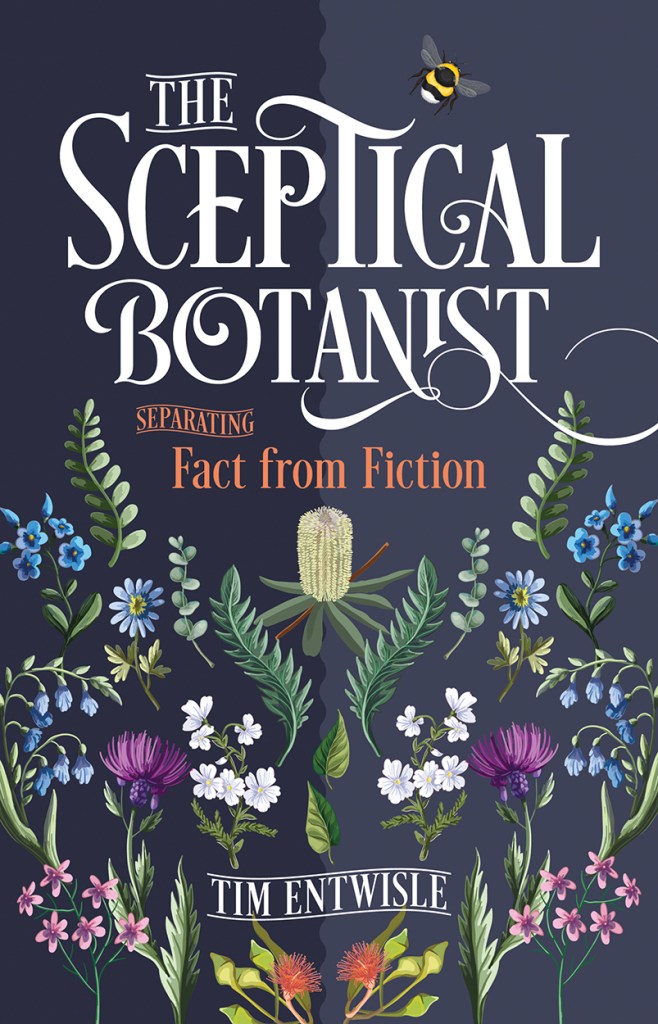
As I’ve said in previous posts I encourage people to be more sceptical about claims that are made – particularly those for which no evidence is supplied to support what is stated. I was therefore filled with considerable interest – and high hopes – when I discovered The sceptical botanist by Tim Entwisle [which book is here appraised]. That interest – and high expectation of seeing shedloads of source-supported scientific statements about plants – was further fuelled by the book’s sub-title which declares its aim of “Separating fact from fiction”. Not unsurprisingly I expected to read lots of evidence-based, factual information about plants. To find out if I did, read on…
What is the book about?
The sceptical botanist is a collection of essays by Tim Entwisle “that explore everyday questions about plants and gardens” [according to the press release enclosed within my review copy of the book]. Accordingly, the book covers such matters as, “Do trees talk to one another? Can a plant use up the oxygen in a room while you sleep? What is a native plant and what is a weed? Are some plants truly immortal?”. Although the book covers more – much more! – than that quartet of questions, they do give you a flavour of the botanical matters that exercise Entwisle’s imagination and get his creative juices flowing.
However, given that more than half of the book’s 50 essays* are previously published items [“the best of his contributions to gardening magazines and newspapers over four decades”], should you be concerned that you might have read them before – and need not therefore consider buying or reading this book? Just under half of the essays – 24 – are either previously unpublished or written new for this book. So that’s a lot of new material. Plus, for those previously published elsewhere, Entwisle usefully provides postscripts that bring those older items up-to-date. Furthermore, he has usually edited the previous versions somewhat, and sometimes combined some to produce the version published in this collection. Plus, having the older essays altogether in one handy collection makes them more readily accessible. In other words, there are plenty of reasons why this book is sufficiently novel in content to warrant closer inspection, reading, and maybe a purchase. It is however such a pity that the book doesn’t have an index. Trying to find – or refind! – particular bits of information is a challenge.
What does the author hope to achieve?
Entwistle’s declared ambition for the book is “I hope my sceptical deliberations will entertain, provoke and inform” (p. vii). This reviewer agrees that it does that.
Is it a good read?
Yes! None of the essays is overly-long – a few pages at most – and all are written in a very engaging way. Entwisle has great flair as a writer and his passages contain many stylish phrases – e.g., “Drawing on chemical stockpiles the envy of Breaking Bad’s Walter Whyte, plants can fend off hostile insect attacks…” (p. 3). All of which makes for relatively undemanding reading. And – from an educational point of view – the information that Entwisle shares with his readers seems to be transferred almost effortlessly from author to audience. It’s easy to see why the book is promoted as “a tour de force of investigative writing from one of Australia’s most thoughtful and inquisitive botanical minds”, and contains “50 beautifully crafted essays”. Certainly, Entwisle can write. Does he know what he’s writing about? What is his background, and bona fides for writing such a book about plants?
A bit about the author’s background
Author Entwisle’s botanical credentials are undeniable [largely summarised from his Wikipedia page]; after a first degree in Botany, and a PhD in the taxonomy of algae (at Australian universities), he spent many years in senior botanical leadership roles, e.g., 8 years as executive director of the Royal Botanic Gardens Sydney (Australia), and for 10 years – until July 2023 – as director and chief executive of the Royal Botanic Gardens Victoria** (Australia). He also blogs about plants on his Talking Plants site [“… every plant (alga, and even fungus) has a story to tell”]. So, there’s a solid botanical background. But, given the book’s title, …
How sceptical is Entwisle?
In addition to being steeped in a – inevitably-somewhat-Australian-biased – botanical tradition, he is “stubbornly sceptical about implausible and outrageous assertions” (p. vi). However, he tries to admit an unlikely idea “if the proponent is willing to expose it to scientific scrutiny or at least admit the possibility that it may be false” (p. vi). That is the approach he employs throughout the book, which is especially in evidence when Entwisle examines several aspects of plant biology and our assumptions about plants, e.g., the notion of ‘plant inteligence’ (Krishna Ramanujan) and the more outlandish claims about the wood-wide web (Sophie Yeo). And we see the ‘proof is in the pudding’ (Pascal Tréguer) at work in his essay about the value of adding seaweed supplements to soil in which he admits to changing his mind on that topic, and tells us why.
So, and in as much as “These essays are my attempt to make sense of things, initially to satisfy my own curiosity” (p. vi), his witty and wise writing(s) will help all those who read The sceptical botanist to become more knowledgeable about plants, and have their botanical literacy enhanced. In this way, Entwistle is also doing his bit to reduce the public’s ‘plant blindness’ (Peter) [Ed. – although that is a term he no longer uses (as explained in Note No. 48 on p. 262), and he also has reservations about use of ‘literacy’ as well…]. So, what do you get?
An overview of the 5 chapters
The 50 essays of The sceptical botanist are spread over five numbered chapters. Having no wish to give away all that the book contains, but in the interests of giving a flavour of its contents, some of my thoughts on what those chapters deliver are the following.
1, What makes plants tick [10 essays].
On page 1 of the chapter’s pre-amble we hear a great anecdote about how the author got started on his botanical journey. The first essay of the book, “Stupid plants”, is a great read – the whole of that analysis is superbly, and succinctly, summarised by the pithy one-line of text beneath the essay’s title – and is a very thoughtful dissection of the arguments around plant intelligence. The notion of flower clocks is also deliciously and wickedly dissected in this section. This was probably my favourite chapter.
2, Plants from elsewhere [10 essays]
Many of the essays here have very strong Australian botanical perspectives. Which is not too surprising since the author is Australian, studied botany in an Australian university, has been head of the Royal Botanic Gardens in both Sydney and Melbourne, and lives in Australia. Nevertheless, much of what Entwisle writes about translates very well to many other parts of the world – and will resonate with readers wherever geographically-situated they may be – e.g., his musings on the wisdom – or otherwise – of planting non-native species.
3, Garden plants and landscapes [9 essays]
Not surprisingly – given his employment history – Entwisle has a particular fondness for gardens and writes with deep knowledge and conviction about them. His “Top five ‘first’ botanic gardens” essay was a most interesting and thoughtful read, as were his thoughts on the definition of ‘garden’ more generally.
4, Gardening with convictions [9 essays]***
Here Entwisle considers “gardening techniques and principles that are not quite what they seem” (p. 145). Accordingly, topics covered here include seaweed supplements, glyphosate, ‘the moon factor’, organic farming, companion planting, GMOs, and the wood-wide web. This was my second favourite chapter.
5, Observing and cataloguing nature [12 essays]
Threaded throughout this chapter are essays on plant nomenclature [“the systematic or scientific naming of plants”; “the formal, scientific naming of plants”], which is always an interesting subject to read about. It’s also one of the author’s special interests having spent many years involved in research that has the naming of plants and algae at its heart. It’s pleasing to note that this chapter is very up-to-date with Entwisle’s consideration of the debate around the need to decolonize plant names, and with reference to the latest version of the International Code of Nomenclature for algae, fungi, and plants, The Madrid Code, published in July 2024 (Nicholas J Turland, 2025) that approved proposals to change botanical names based on racially offensive words or people (Endnote No. 40, page 261). We’ve already dealt with sceptical botanist, what about the book’s sub-title..?
How does Entwisle separate fact from fiction?
That is largely achieved by Entwisle’s analytical approach to understanding a problem and use of appropriate evidence. Which evidence is provided in the book’s Endnotes, 19.5 pages of numbered ‘notes’ [which numbers relate to the super-scripted numbers in-text] for the factual parts of the book, the five numbered chapters, Preface, and Epilogue. Included here are several links to publications of others – e.g., books such as Francis Hallé’s In praise of plants, and Daniel Chamovitz’s What a plant knows – and scientific publications, e.g., Egri et al., 2020, Rossetto et al., 2017, Barton et al., 2016 – that provide support for statements made by Entwisle elsewhere in the book. The endnotes also indicate the original places of ‘publication’ of his previously-published essays in the collection, e.g., podcasts, blogs [both with useful URLs], and – presumably – print publications (e.g., Gardening Australia) that are reproduced (albeit maybe with some editing) in this book. The numbered list also includes several references to other essays in this collection – i.e., there is useful cross-referencing within the text.
Whilst, usually, the note is to a single source, some are to multiple sources, e.g., No. 18 on p. 244 to scicomm articles at LiveScience, and National Geographic, and a scientific article in PLoS Computational Biology. And, on occasions, the exact same source has several different note numbers – e.g., the scientific article by Crisp & Cook (2023) is Numbers 17, 18 and 19 in the essay entitled “Drifting on ancient currents”. Why not just repeat No. 17 for all instances that use the same source? In other words there is some redundancy amongst the individual numbered endnotes, which reduces the number of unique sources – although this is increased somewhat by multiple sources under one note number – to less than the 255 I counted.
But, are all of the facts that Entwisle shares with his readers supported by evidence? It’s time for this reviewer to get sceptical and critical…
More sources are needed for sceptical readers…
In his defence, Entwisle acknowledges that the essays are “not referenced in full like a peer-reviewed scientific paper” (p. ix), but tells us that he’s “provided some sources where I feel a statement begs additional support or where I’ve incurred a major debt to another author” (p. ix). Where you may not think that’s sufficient, we are advised that “Generally, though, a thorough (and sceptical) trawl of internet sources or a good library will provide you with the same sources I had” (p. ix). Hmmm, yes the interested reader could do his/her own additional reading to satisfy him/herself about a particular statement, but is that really good enough? What if a reader’s own trawling unearthed sources that contradicted what Entwisle had said? That leaves us in a rather awkward and unsatisfactory situation. Having set such a high – and perfectly reasonable – bar of expectation with use of ‘sceptical’ in the book’s title, and the book’s declared goal of separating fact from fiction, shouldn’t we expect a little more by way of evidence in the book? Surely, it’s always best to provides one’s evidence? I think so.
In support of that concern – that more sources would have been very useful to support statements made (and allay any concerns of this sceptical reader) – I offer as examples these facts: “Peas have been overheard conversing in clicks…” (p. 3); London is “one of the world’s most polluted cities” (p. 17); “even plastic plants can help with healing” (p. 17); the characteristics of r- and k-selected plant species stated on p. 39; details of time, cost, and number of people required to catalogue the entirety of Earth’s biodiversity (p. 234); and that US$300 billion, “as a recent debate around tariffs has revealed, is about 60 per cent of the cost of goods imported into the United States from China each year” (p. 228). Whilst I may not exactly be sceptical about all – or any – of those statements, I would certainly like to know the sources that support them. So much for my concerns about some of the book’s factual statements. Are there any stated facts that aren’t facts? Well…
Questionable statements
Although there is much to admire – and probably agree with – in The sceptical botanist, it does contain some statements that need to be challenged – as much as for what they state in terms of factual accuracy as any concerns about absence of sources.
For instance, on p. 4 Entwisle tells us that plants “… convert carbon dioxide into sugars and oxygen using solar power…”. The suggestion that CO2 was converted into O2 had the alarm bells ringing. And that concern was further underlined by reading “carbon dioxide … a gas that plants need, turning it into more welcome oxygen through photosynthesis” (p. 16). Those statements do not look factually correct. As I understand it, the entirety of the CO2 molecule is incorporated into the organic products of photosynthesis, the oxygen that is released in the process comes from the H2O molecule that is also consumed in photosynthesis. In other words, the more welcome oxygen comes from water, not carbon dioxide. That sort of mis-statement must be pointed out – and ideally corrected in any future versions of the book – lest readers are left misinformed.
Elsewhere we are told that “All very simple: nutrients go up, sugars go down” (p. 28). Whilst one can accept the statement that nutrients dissolved within the transpiration water stream in the xylem travel up the plant, the direction of movement of sugars in the phloem is not so straightforward, or simple. The destination of products of photosynthesis is determined by something called ‘sink strength’ (Raymond), in which sugars travel from a photosynthetic source upwards or downwards, in the phloem, depending on where the greatest demand for those materials lies. For instance, from a photosynthetic source such as a leaf, they will travel up to a sink such as a carbohydrate-consuming, developing fruit, but down from that source to a non-photosynthetic, sugar-requiring source such as a root.
In another place we are told “leaving only a small fragment of cambium to deliver essential sugars to the root system” (p. 124), That is not what cambium does. It is a meristematic tissue [a sort of cell factory if you like] that’s concerned with making secondary xylem and secondary phloem. The phloem is the sugar-delivering tissue, not the cambium.
Perhaps these three instances are examples of an educator simplifying somewhat technical topics for a non-specialist, general audience. Perhaps, but any statements of simplification still need to be correct. Where they aren’t, they can mislead and undermine – they certainly detract from – any educational objective the book might hope to have. Finally, we have a number of…
Problems with names
There are a number of issues with names within the book. For example, the surname of Monica Gagliano [noted scientist and communicator on matters of plant intelligence or cognition] shouldn’t be shown as Galiano as it is on p. 6. Although it is correctly shown – as Gagliano – a few lines further down on p. 6, it is again shown as Galiano on p. 9. The surname of the so-called “Plant Messiah” (p. 109) Carlos Magdalena (Eric Wills) is shown correctly on p. 205, but stated as Magdalina on p. 109. And the title of Richard Powers’ book The Overstory is shown correctly on p. 40, but becomes The Overstorey on p. 41. In view of the importance of names and nomenclature to Entwisle, these issues are more than a little unexpected. It’s hard not to be a sceptical reader when such inconsistencies occur within the book. However, these identified items are easily fixed in any subsequent editions of the book.
After all of this doom-and-gloom, and negativity, I’d like to leave you with some positives…
What I learned
For all of my misgivings – about the need to provide more evidence, and concerns about some mis-statements of facts, or typos above – I learnt a lot that was new to me in Entwisle’s book. For example: the Japanese term for ‘thigmomorphogenesis’; that a microbe found in the soil and air has been compared to Prozac; that even plastic plants can help with healing; the notion of planting according to numbers of the Fibonacci Sequence; that the ‘scorching water droplet’ hypothesis is not accurate; rxistence of the term ‘hypaxanthic’; the concept of ‘conservation triage’; and that seaweed extracts “created” the glacé cherry. For all of which we should thank author Entwisle.
Still sceptical?
For those who are intrigued by Entwisle’s book, but not yet sure if they want to commit, there is an opportunity to ‘try before you buy’ because extracts from The sceptical botanist can be read at the author’s blog Talking Plants, e.g., here, here, and here. Each of those will give you a pretty good idea of the author’s subject matter, style, and sense of humour.
Summary
There is much to admire about The sceptical botanist by Tim Entwisle. But – as highlighted above – there’s also quite a lot to be sceptical about. That having been said Entwisle’s writing style and botanical insights make this book a pleasure to read and there’s plenty of variety amongst the topics he covers that everybody – even seasoned, sceptical botanists such as this reviewer – can get a lot out of it.
* The book’s oldest essay “Blood may flow over the wattle” is from May, 1989; the most recent “Touchy subject” is dated March 2025. Entwisle’s most productive period appears to be April 2024, when – one presumes – most of the book’s new [previously unpublished] essays were penned.
** A word to the wise, throughout the book there are several references to Victorian. I initially thought this concerned the historical period – the Victorian Age (or Period or Era) that occupied about two-thirds of the 19th century when Queen Victoria was Britain’s ruling monarch. It took me a while to realise that – in The sceptical botanist – it doesn’t. Instead, Victorian here refers to matters pertaining to the Australian state of Victoria (Duncan Bruce Waterson & John RV Prescott) [Ed. – which, and rather appropriately for Entwisle’s book, is also known as the Garden State]
*** Notwithstanding the author’s dry wit that is found throughout the book, this is not a collection of essays about horticulture in a prison setting – although one suspects that the ever-sceptical Dr Entwisle will have a view on that…
REFERENCES
Nicholas J Turland, 2025. From the Shenzhen Code to the Madrid Code: New rules and recommendations for naming algae, fungi, and plants. Am J Bot 112(4): e70026; doi: 10.1002/ajb2.70026
 Plant Cuttings
Leave a comment