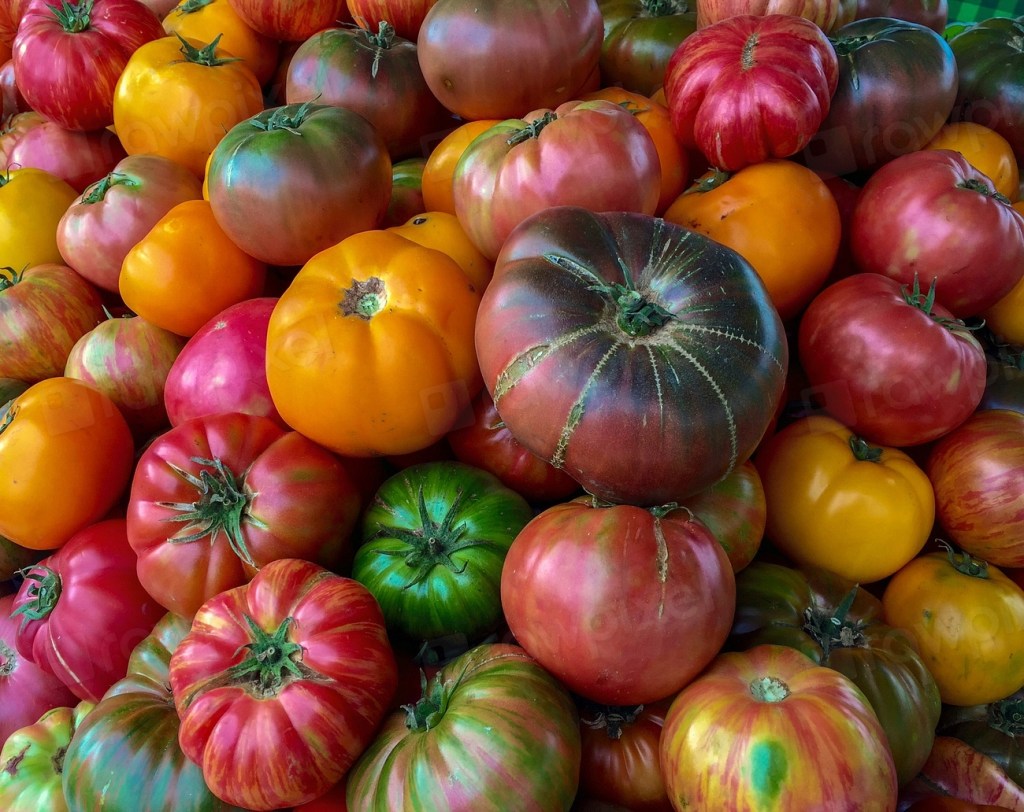

This image, by David Besa showing “a scanned red tomato, along with leaves and flowers”, is used under the Creative Commons Attribution 2.0 Generic license.
For almost as long as I’ve been interested in plants I was taught that photosynthesis uses visible light of wavelengths between 400 and 700 nm. That 300 nm [nanometre] range is known as PAR, photosynthetically-active radiation. And that is what I taught my own students back in the day. Until I came across news of a cyanobacterium – a microbe that photosynthesises in much the same way as a ‘proper’ land plant (Malihe Mehdizadeh Allaf & Hassan Peerhossaini, 2022; Hayley Dunning) – that was able to utilise light of wavelengths beyond PAR [see here] [Ed. – and which post is a reminder that Mr Cuttings appears to be aware of only one punning title for writing about this sort of work].
In brief, that post from almost 15 years ago discussed the discovery of a new type of chlorophyll – Chlorophyll [Chl] f (Stuart Gary)* – that absorbed light of wavelengths greater than 700nm, found in a cyanobacterium within stromatolites (Stuart Gary; Marian McGuinness) from Shark Bay in Australia (Min Chen et al., 2010). Although – at that time – the precise role of Chl f in photosynthesis was not understood, it did look like the definition of PAR might need to be revisited and maybe revised (e.g., Michael Kühl et al., 2020).
Happy to accept that such a trick was only available to those peculiar blue-green algae, that aren’t real plants, I was surprised to read that far-red light – of wavelengths beyond the 700 nm limit of PAR – was usable in photosynthesis by tomato (Solanum lycopersicum) – which is a real plant – as reported by Martina Lazzarin et al. (2025)**. The conclusion from their detailed study on tomato (cv. Moneymaker (Sue Fisher)) was that “These findings suggest that in young plants, the presence of FR [far-red light with wavelengths between 701 and 750 nm] in the solar irradiance increases whole-plant photosynthesis in tomato, but only at low light intensity”***. In other words, although FR can be used in photosynthesis there are a number of caveats about its role throughout the life of the plant.
Although, Lazzarin et al. (2025) question “the proposition that FR should be included universally in the (extended) PAR”, there are others who call for the revision of the definition of PAR to include FR wavelengths. For instance, Shuyang Zhen & Bruce Bugbee, 2020 concluded that “The consistent response among diverse species [14 crops including lettuce (Lactuca sativa), basil (Ocimum basilicum), spinach (Spinacia oleracea), soybean (Glycine max), tomato (Solanum lycopersicum – cv. Celebrity (Peg Aloi), which is a different one to that used by Lazzarin et al. (2025)), potato (Solanum tuberosum), wheat (Triticum aestivum), rice (Oryza sativa), and corn (Zea mays)] indicates that the mechanism is common in higher plants. These results suggest that far-red photons (701–750 nm) should be included in the definition of PAR.” [Ed. – Interestingly, Shuyang Zhen & Bruce Bugbee, 2020 also discuss genetic modification of plants with addition of Chl d and/or Chl f to enable them to make (even) better use of available FR in the light used to grow the plants, echoing the work by Stefania Viola et al., 2022 (Hayley Dunning)].
And, Shuyang Zhen et al., 2021, in their unambiguously-worded opinion piece “Why Far-Red photons should be included in the definition of photosynthetic photons and the measurement of horticultural fixture efficacy”, argue that “The definition of photosynthetic photons, and efficacy measurements of horticultural fixtures, need to include far-red photons because this extended range (referred to as ePAR) better predicts photosynthesis”. No doubt we will read more on this topic as further research uncovers the true nature of the involvement of FR in photosynthesis.
* Readers may be surprised to read that there is more than one chlorophyll (Sagar Aryal). Although used to the notion that green plants ‘contain chlorophyll’, in fact they contain two different types of that pigment – chlorophyll [Chl] a (which is also found in cyanobacteria (Elliott Walsh)) and Chl b (which a + b combination is also shared with green algae (Elliott Walsh)). Other photosynthetic organisms such as brown seaweeds, diatoms and dinoflagellates have Chl a and Chl c (Elliott Walsh), and red algae have Chls a and d (Sagar Aryal; Elliott Walsh) [Ed. – Although work by Akio Murakami et al. (2004) concludes that “Our findings show that Chl d is not a constituent of red algae”.]
Chls a and d are also found in some cyanobacteria (Murakami et al., 2004; Michael Kühl et al., 2005; Anthony Larkum & Michael Kühl, 2005; Hitoshi Tamiaki & Saki Kichishima, 2025; Nikea Ulrich et al., 2024).
Recognising that chlorophylls appear to be labelled alphabetically, and knowing that we already have Chl a, b, c, and d, and that the new chlorophyll found in some cyanobacteria was named Chl f, you might wonder about Chl e. These words from Tamiaki & Kichishima, 2025) explain the story: “After the initial detection of Chl-d, a Chl species with specific visible absorption bands measured for the faint samples from natural staffs was named as Chl-e in 1940s (Li and Chen 2015). Its molecular structure has not been determined yet due to its less availability from any phototrophs. In 2010, a new Chl pigment (not Chl-e) was discovered from a cyanobacterium, Halomicronema hongdechloris, and its molecular structure (2-formylated Chl-a) was fully characterized by obtaining its large amount via the successful FaRLiP cultivation (Chen et al., 2010). To avoid confusion, the new pigment was named Chl-f. At present, Chl-e is not still confirmed as a photosynthetically active pigment and might be an artifact of Chl-a (Sorimachi et al. 2015)”. I trust that clears that point up.
** For more on this story, see Sarah Covshoff [https://botany.one/2025/05/tomato-photosynthesis-benefits-from-far-red-light/]. For those who welcome a longer read, Martinas Lazzarin’s PhD thesis entitled “The role of far-red light in plant photosynthesis and photoprotection under artificial solar irradiance” is available here [https://library.wur.nl/WebQuery/wurpubs/614994].
*** It is important to note that Lazzarin et al. (2025) are not claiming discovery of a new type of photosynthesis for tomato. However, such a novelty has been found in Chl f-containing cyanobacteria by Dennis Nürnberg et al., 2018 (see also Hayley Dunning for more interpretation of this). The difference from normal photosynthesis here is that molecules of Chl f replace the more usual Chl a at the two photosystems, and absorb light of wavelengths beyond ‘the red limit’ (Mike McRae; Gail Overton; Martijn Tros et al., 2021) of 700 nm. In other words, energy received by the Chl f demonstrably takes part in the light-dependent stages of photosynthesis (Lára Marie McIvor). Now, that revelation does justify revision of the definition of PAR(!)
REFERENCES
Malihe Mehdizadeh Allaf & Hassan Peerhossaini, 2022. Cyanobacteria: Model microorganisms and beyond. Microorganisms 10(4): 696; doi: 10.3390/microorganisms10040696
Min Chen et al., 2010. A red-shifted chlorophyll. Science 329(5997): 1318-1319; doi: 10.1126/science.1191127
Michael Kühl et al., 2005. A niche for cyanobacteria containing chlorophyll d. Nature 433: 820; https://doi.org/10.1038/433820a
Michael Kühl et al., 2020. Substantial near-infrared radiation-driven photosynthesis of chlorophyll f-containing cyanobacteria in a natural habitat eLife 9: e50871; https://doi.org/10.7554/eLife.50871
Anthony WD Larkum & Michael Kühl, 2005. Chlorophyll d: the puzzle resolved. Trends in Plant Science 10(8): 355-357; https://doi.org/10.1016/j.tplants.2005.06.005
Martina Lazzarin et al., 2025. Far-red light effects on plant photosynthesis: from short-term enhancements to long-term effects of artificial solar light. Annals of Botany 135(3): 589–602; https://doi.org/10.1093/aob/mcae104
Akio Murakami et al., 2004. Chlorophyll d in an epiphytic cyanobacterium of red algae. Science 303(5664): 1633; doi: 10.1126/science.1095459
Dennis J Nürnberg et al., 2018. Photochemistry beyond the red limit in chlorophyll f–containing photosystems. Science 360(6394): 1210-1213; doi: 10.1126/science.aar8313
Hitoshi Tamiaki & Saki Kichishima, 2025. Chlorophyll pigments and their synthetic analogs. Plant and Cell Physiology 66(2): 153–167; https://doi.org/10.1093/pcp/pcae094
Martijn Tros et al., 2021. Breaking the red limit: Efficient trapping of long-wavelength excitations in Chlorophyll-f-containing Photosystem I. Chem 7(1): 155-173; https://doi.org/10.1016/j.chempr.2020.10.024
Nikea Ulrich et al., 2024. Ecological diversification of a cyanobacterium through divergence of its novel chlorophyll d-based light-harvesting system. Curr Biol 34(13): 2972-2979.e4; doi: 10.1016/j.cub.2024.05.022
Stefania Viola et al., 2022. Impact of energy limitations on function and resilience in long-wavelength Photosystem II. eLife 11: e79890; https://doi.org/10.7554/eLife.79890
Shuyang Zhen & Bruce Bugbee, 2020. Far-red photons have equivalent efficiency to traditional photosynthetic photons: Implications for redefining photosynthetically active radiation. Plant, Cell & Environment 43(5): 1259-1272; https://doi.org/10.1111/pce.13730
Shuyang Zhen et al., 2021. Why Far-Red photons should be included in the definition of photosynthetic photons and the measurement of horticultural fixture efficacy. Front. Plant Sci. 12: 693445; https://doi.org/10.3389/fpls.2021.693445
 Plant Cuttings
Leave a comment