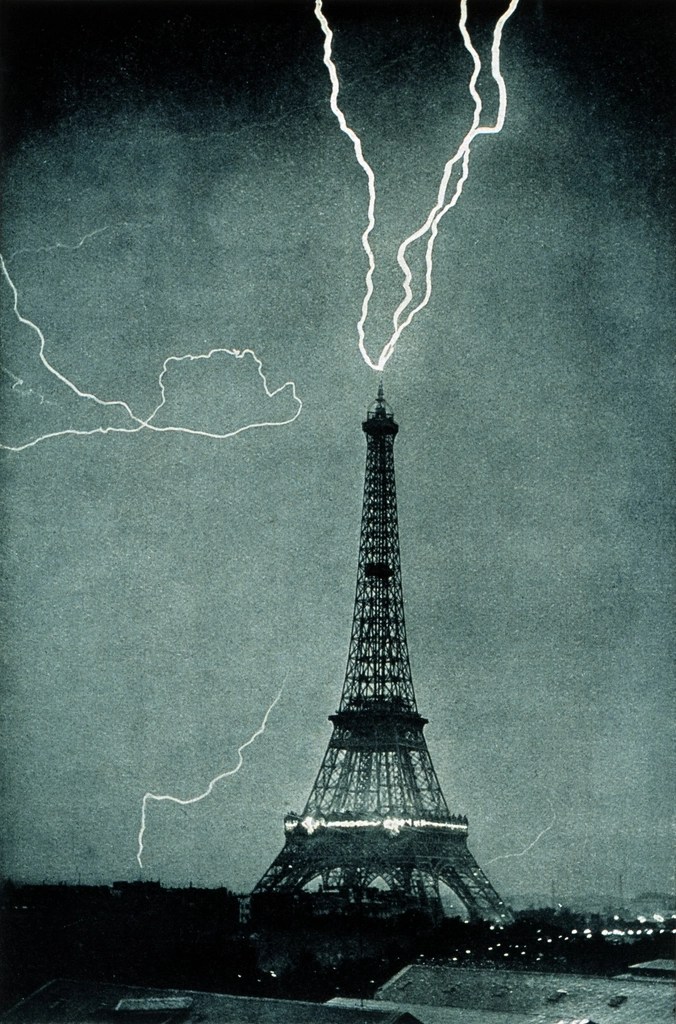
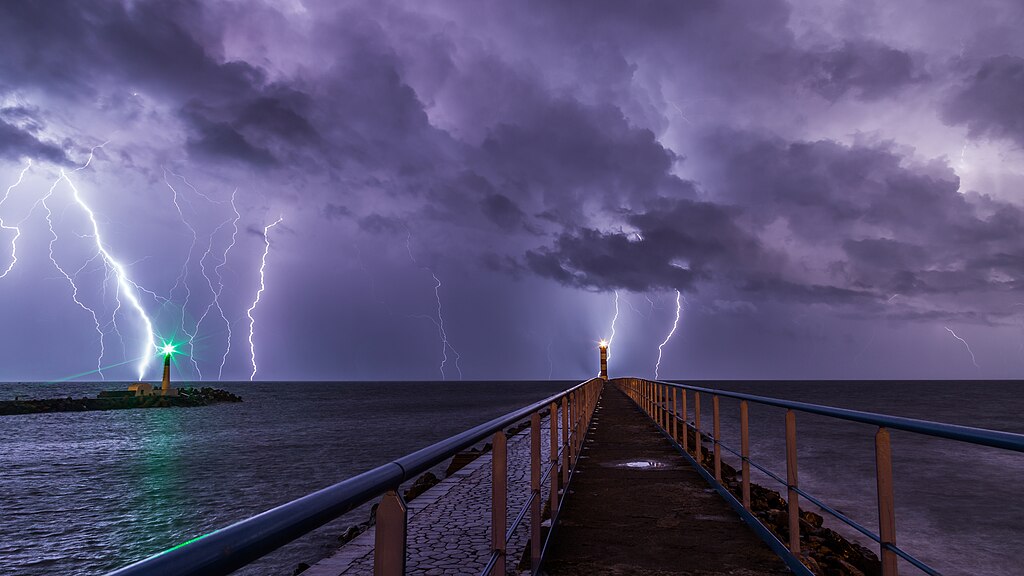
This image, captioned “Strokes of cloud-to-ground lightning strike the Mediterranean Sea off of Port-la-Nouvelle in southern France”, by Maxime Raynal is used under the Creative Commons Attribution 2.0 Generic license.
Lightning [“a giant spark of electricity in the atmosphere between clouds, the air, or the ground”* can be an awesome natural spectacle – if you can witness it at a safe distance. However, and as majestic a sight to human eyes as that can be (for example, see the image above), lightning can cause wildfires (Don Latham & Earle Williams, 2001) that devastate habitats, and can be directly injurious to plants (e.g., Scot Nelson; Evan Gora et al., 2021) and other lifeforms. And, in relation to this post, as Stephen Yanoviak et al. (2020) remind us, “Lightning is a major cause of large tree mortality in a lowland neotropical forest”.
So much for the bad news about this very high energy electrical discharge. In the spirit of ‘what doesn’t kill us makes us stronger’ [the aphorism associated with German Philosopher Friedrich Nietzsche (Kayla Driessen)], Evan Gora et al. (2025) bring news of ‘lightnophilic’ trees, tall-statured plants that appear to benefit from lightning strikes.
Investigating trees in the seasonally-moist tropical forest of central Panama, Gora et al. (2025) found that lightning killed 56% of trees that were struck directly, and caused 41% crown dieback [“the gradual death of the upper part of a tree’s canopy” (Jack Schaffer) (Ian Stone)] among those that survived the strikes. Clearly, lightning is a destructive force in that habitat. But, and rather surprisingly, they also found that direct lightning strikes caused negligible damage to Dipteryx oleifera (almendro) trees. Not only that, but those same strikes killed 78% of the lianas [long-stemmed, woody, climbing plants (Nick Rowe, 2018)]** growing on the trees, and 2.1 Mg [megagrams; one Mg is equivalent to 1000 kg, or one metric ton] of competitor tree biomass.
Whilst, generally, epiphytic plants (Barbara Gillette; Melissa Petruzzello) is assumed not to pose much of a threat to the hosting plant, the presence of epiphytic lianas “can substantially reduce tree growth, survival, and reproduction” (Gora et al., 2025). Furthermore, the proximity of neighbouring trees can have similar effects (Gora et al., 2025). In other words, Gora et al. (2025) have discovered that Dipteryx oleifera trees can not only withstand the high energy insult of lightning, but can also benefit from the event because plants that would otherwise compete with them for resources are removed by the same lightning strikes.
Because of the in-depth and highly detailed study they undertook, Gora et al. (2025) were able to “estimate that the ability to survive lightning increases lifetime fecundity 14-fold, largely because of reduced competition from lianas and neighboring trees”. That is a significant life-enhancing boost from those doses of lightning. Seemingly, working on the basis that ‘you can’t have too much of a good thing’, Dipteryx oleifera appear to have evolved so that their unusual heights and wide crowns actually “increase the probability of a direct strike by 49–68% relative to trees of the same diameter with average allometries (John Gittleman; Karl J Niklas, 2004; Alexander Shingleton, 2010]” (Gora et al., 2025).
Apparently, this ecologically – if not also an evolutionary – advantageous behaviour is not exclusive to Dipteryx oleifera. In the same study area, Gora et al. (2025) found that seven other tree species were also able to withstand lightning strikes as for D. oleifera. Those additional ‘potentially lightning-tolerant taxa’*** are: Hura crepitans (the sandbox tree); Cavanillesia platanifolia (cuipo); Platypodium elegans (graceful platypodium); Ceiba pentandra (kapok); Chrysophyllum cainito (star apple, caimito); Terminalia oblonga (yellow-wood, rosewood); and Vatairea erythrocarpa.
Whether such lightning-tolerant behaviours are found in tree species in other areas is not yet known; the region studied by Gora et al. (2025) is the “only forest globally with systematically located and field-surveyed lightning strikes”. It does seem likely that similar in-depth investigations in other areas of the world will increase the catalogue of ‘potentially lightning-tolerant taxa’. But, even if they don’t, the nicely understated conclusion that, “These patterns suggest that lightning plays an underappreciated role in tree competition, life history strategies, and species coexistence” (Gora et al. (2025) still holds [Ed. – although, if such trees were only found in that suitably-studied region of Panama, that would be a really interesting finding…].
Want to find out more?
For more on this story, in addition to reading the scientific article by Gora et al. (2025)****, see Erik Stokstad, Neha Adikane, Sara Hashemi, here, Javier Barbuzano, here, Margherita Bassi, here, here, here, Sanjana Gajbhiye, Jacklin Kwan, Alun Salt, and Bill Chappell.
The good side of lightning
Aside from the very real and present danger of direct damage to most plants – and other biota – that suffer a strike by lightning, this natural phenomenon has a more positive side. The extremely high energy associated with lightning is sufficient to promote the phenomenon of atmospheric nitrogen fixation*****. In this process, the lightning “breaks N₂ [diatomic nitrogen] molecules apart, allowing them to bond with oxygen and form nitrogen oxides (NOx)” (Anastasia M). Eventually these compounds dissolve in water present in the atmosphere to form a dilute solution of nitric acid (Laura Miller). Once this acid rain falls to earth, this adds nitrate – NO3– ions – to the soil or water where the rain lands (Sharon Ray). Nitrogen is one of the essential nutrients for plant growth (Summer Reigh Green; John David Johnson), and nitrate is one of the main chemical forms in which it is absorbed by, and useful to, plants.
So, lightning’s not all bad [Ed. – unless you’re the unfortunate tree that gets struck by a lightning bolt and whose sub-bark layer of sap and water heats up instantly, expands and blasts off the bark from the tree splits the wood…].
PS (Olivia Munson): In an article published after this post was written, it was reported that “Lianas are taking over the rainforests” and “A pandemic of lianas is sweeping through tropical forests, reducing their ability to store carbon and limiting their role in mitigating climate change”(Rianne Lindhout). In view of that rather dire warning, maybe one should be pro-active in exploiting the lethality of lightning to lianas as discussed in the post above. Perhaps a taser-like device could be invented that applies the appropriate lethal voltage directly into lianas so they can be removed from host trees. In that way, they would be unable to continue “suppressing tree growth entirely in certain locations. In such areas, forest regeneration halts, and carbon storage can decline by as much as 95%” (Rianne Lindhout).
* Here it is appropriate to mention the number of times one sees ‘lightning’ written as ‘lightening’ – which, being charitable, I assume is a problem with automatic spell-check/correction. [Ed. – Although, and somewhat ironically, when lightning occurs, its bright flash of light illuminates – lightens – the surrounding area.] Whilst annoying [the word ‘lightening’ not the enlightenment associated with lightning], that ‘typo’ isn‘t that common – except maybe in the literature about the natural phenomenon itself.
However, one typo that is much more common, and which is a constant source of annoyance to me and my ilk, is ‘lead’, as in ‘this thing lead to some consequence or other’. In that context ‘lead’ should be ‘led’, the past participle of the verb to lead (Arushi Gupta; Patricia T O’Conner & Stewart Kellerman). Again, this seems to be an over-zealous – and wrong! – attempt by spell-correction to change what one wanted to write. Maybe so, but the writer surely has some sort of duty to check what is finally published so that this sort of thing can be spotted – and corrected – to prevent its being launched on to an unsuspecting reader. Sadly, ’lead‘ where ‘led’ is intended is seen all-too-commonly in the printed word. Now you’re aware of the issue, I’m sure you’ll start to see this error ‘everywhere’. [Ed. – In researching this footnote, and having now read various article about this phenomenon, Mr Cuttings wonders if it’s not just a ‘spellcheck’ issue but may also be one of ignorance on behalf of the writer. Whatever the reason, it is annoying when one spots it…]
** For more on these fascinating plants see here, here, and here.
*** If you aren’t one of the eight named lightning-tolerant tree species, one way to avoid lightning strikes – and their associated life-threatening dangers – is not to stand out. In other words, and based on the notion that it’s the tallest structure in any given area that is likely to be hit by the lightning (Chris Opfer; LEE Lap-shun), a good strategy is to remain a suitably short-statured plant that doesn’t extend above the heights of neighbouring trees [Ed. – and is potentially one of the origins of the phrase ‘don’t poke your head above the parapet’ (Zhang Ciyun)…] Being small you’d still have to compete with neighbouring plants for other resources, etc., but at least death from lightning should be one less thing to worry about.
**** This work also gives the lie to the oft-repeated – but actually mythical (Chris Opfer) – saying that lightning never strikes the same place twice because Gora et al. (2025) state that “on average, a D. oleifera tree > 60 cm in diameter is struck by lightning at least five times during its lifetime, conferring these benefits repeatedly”.
***** In nature, atmospheric nitrogen fixation is supplemented by biological nitrogen fixation (Stephen Wagner, 2011) that takes place in the soil and aquatic environments, and within various mutualistic symbiotic relationships between plants and microbes, e.g., root nodules on the roots of legumes.
REFERENCES
Evan M Gora et al., 2021. The contributions of lightning to biomass turnover, gap formation and plant mortality in a tropical forest. Ecology 102(12): e03541; https://doi.org/10.1002/ecy.3541
Evan M Gora et al., 2025. How some tropical trees benefit from being struck by lightning: evidence for Dipteryx oleifera and other large-statured trees. New Phytologist 246(4): 1554-1566; https://doi.org/10.1111/nph.70062
Don Latham & Earle Williams, 2001. Chapter 11 – Lightning and Forest Fires, pp. 375-418. In: Edward A Johnson & Kiyoko Miyanishi (Eds), Forest Fires, Academic Press, https://doi.org/10.1016/B978-012386660-8/50013-1
Karl J Niklas, 2004. Plant allometry: is there a grand unifying theory? Biological reviews 79(4): 871-889; https://doi.org/10.1017/S1464793104006499
Nick Rowe, 2018. Lianas. Current Biology 28(6): R249-R252; doi: 10.1016/j.cub.2018.01.028
Alexander Shingleton, 2010. Allometry: The Study of Biological Scaling. Nature Education Knowledge 3(10): 2.
Stephen C Wagner, 2011. Biological Nitrogen Fixation. Nature Education Knowledge 3(10): 15.
Stephen P Yanoviak et al., 2020. Lightning is a major cause of large tree mortality in a lowland neotropical forest. New Phytologist 225: 1936–1944; doi: 10.1111/nph.16260

 Plant Cuttings
Leave a comment