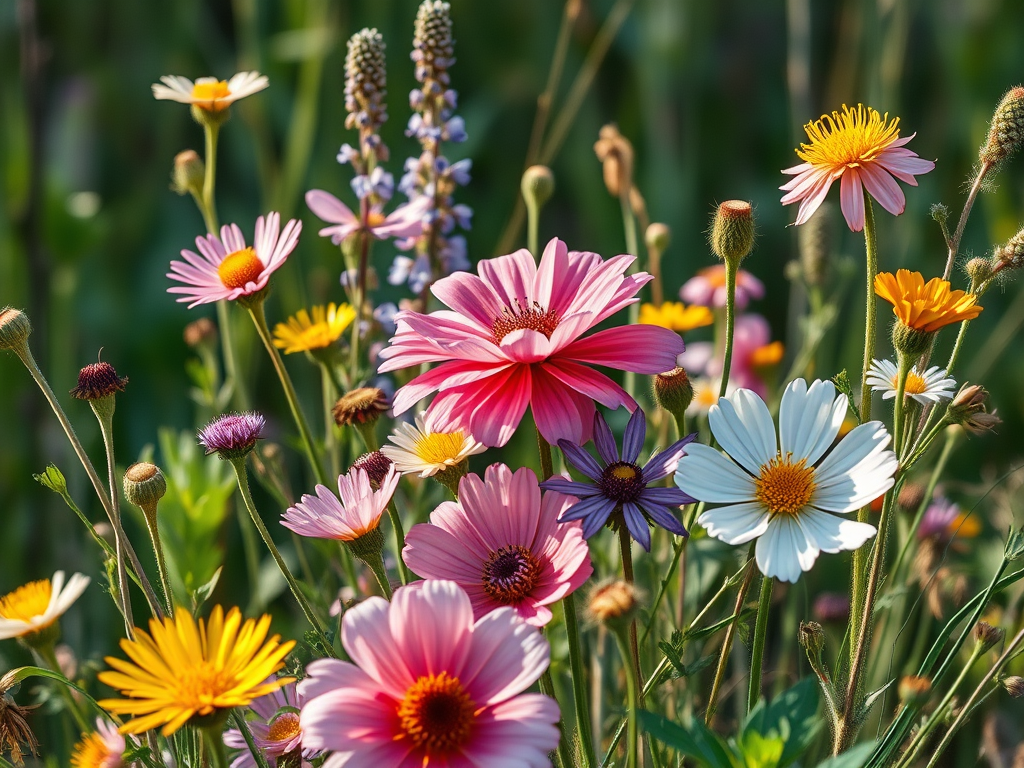
Wildflowers: Discover the science sand secrets behind the world of wildflowers by Chris Thorogood 2025. Dorling Kindersley Ltd.

When I see a book with the title ‘wildflowers’ I have in mind an identification [ID] guide to the plants of an area or location, i.e. a flora. Disabusing me of that rather fixed idea is this book’s sub-title, Discover the science and secrets behind the world of wildflowers, which tells us that Wildflowers by Chris Thorogood [which tome is here appraised] is about much more than plant ID.
Although few topics are covered in much depth – most items are only a couple of pages long – that is more than made up by the book’s considerable scope and breadth, which covers areas – ‘science and secrets’ – of plant biology such as: ecology, evolution, ethnobotany, adaptation, biodiversity, plant blindness, conservation, biomimetics, classification, physiology, reproduction, symbiosis, and ‘predator plants’.
Wildflowers is well-written [as is typical for a Thorogood publication] and with the author’s engaging style. However, in places the language used can be a little challenging, which suggests that the book’s intended audience is the intelligent reader, probably from late-teenager upwards. Wildflowers is also abundantly illustrated – as is one of the hallmarks of a Dorling Kindersley title – and as befits its wildflowers subject matter. Although, maybe somewhat curiously, there are very few photographs, the great majority of illustrations are drawings – usually in colour – of plants, habitats and plant features. Which is not a problem when the illustrations are as beautifully executed as they are; and recognition of the talents of illustrators Dan Crisp, Jessica Ip, and Stuart Jackson-Carter are very much in order. What is surprising is that there appear to be no illustrations from the pen or brush of Thorogood himself, who is a botanical artist of considerable talent and renown (John Platt).
Defining the reader’s expectations
What is wild in the book’s sense? The author usefully tells us that, “A wildflower is a plant that grows in a natural environment – rather than one that was planted intentionally” (p. 8) [but excludes cultivars (p. 8), which are produced by human agency via selective breeding]. What does the book cover? Again we turn to author Thorogood who says it covers “several hundred species of wild plant, with a focus on flowering plants*, especially those that are most conspicuous or most likely to be encountered in many parts of the world” (p. 8). Which global perspective reminds us that plants are to be found everywhere, but which – and as importantly – by providing examples from around the globe helps to ensure that the book should appeal to a global audience. In doing so, the book’s aim “is to cover as many of the major taxonomic groups as possible” (p. 8). Overall, Wildflowers is “a celebration of wildflowers: how they came to be, what they are, what they do, and how they have shaped our green planet” (p. 13). Which is fine by me, because “Plants and people have evolved together” (p. 10), and “human history is inseparable from that of plants; we have always depended upon them” (p. 10).
Because of Wildflowers’ scope and approach, there are plenty of facts to inform and educate those who know very little about wildflowers, and several snippets of information that were new even to a professional botanist**. There is truly something for everyone here – regardless of their level of plant knowledge.
The book in a bit more detail…
The main text of Wildflowers is spread over approx. 266 pages of an Introduction and nine numbered chapters. Chapter have single word titles; often active words such as ‘Discover’, ‘Interact’, ‘Classify’, ‘Walk’. The intention presumably is that such ‘instructions’ will actively encourage the reader to do something about increasing their plant knowledge, which is encouraging.
The References: section is a single 2-columned page of books and scientific papers that are the sources for facts on specified pages within the text. It is always good to see sources stated. However, the 32 pages of text specified as having sources represents approx. 12% of the total of pages that are potentially fact-filled. Which means that more than four-fifths of the book’s pages are not supported explicitly by sources. And there are numerous factual statements on those pages for which sources are needed. For example: “about 400,000 different types of wild vascular plant” (p. 7); “Chloroplasts evolved from an endosymbiotic [a term not defined here and which is not in the Glossary] cyanobacterium [which term is in the Glossary]…” (p. 7); “Two in five of the world’s wild plants are threatened with extinction today” (p. 10); “[orchid family] containing about 30,000 species” (p. 36); “Three-quarters of all flowering plants are eudicots” (p. 36); “The 300,000 species of flowering plants…” (p. 40); “Roots spread far and wide, burrowing up to 60m (200ft) beneath the soil surface…” (p. 43); “They [parasitic plants] make up more than 1 per cent of all flowering plant species” (p. 57); and “Plants are scientifically proven to clean and purify the air” (p. 270). This is quite a strange state of affairs. Yes, it’s great to see that sources are supplied for some facts. But, why only a select few, leaving many facts unsourced?
Further Reading & Resources: approx. 0.75 of a 2-columned page, comprising three categories, General reading [e.g. Jonathan Drori’s Around the world in 80 plants], Regional guides [e.g. Thorogood’s own Field guide to the wild flowers of the eastern Mediterranean, and Field guide to the wild flowers of the western Mediterranean], and Online resources [URLs provided for such entities as Société botanigue de France, Plants of the World Online, and the Australasian Plant Society].
Glossary: one and a half, 3-columned pages, “for a simple explanation of key terms” (p. 7), from ‘actinomorphic’ to ‘zygomorphic’. Helpfully, many of those terms are also explained when mentioned within the text.
Index: five and two-thirds, 3-columned pages, from ‘acacia’ to ‘zucchini’, which includes common names of plants [and Rhizopogon ellenae – which is absent from the flower index], category names, e.g. ‘beans’ [but note that different pages are cited here cf. the same term in the flower index], ‘cacti’, ‘cabbages’, and ‘eelgrasses’. Do also note a ’typo’, ‘cryptograms’ (p. 277) [but which is correctly spelt in-text].
Index of flowers: two and a third pages of 3-columned entries, from ‘Abies magnifica’ to ‘Zosterophyllum’. This list is primarily scientific names of plants, families, and genera. It contains no common names as far as I can tell, except loose category names such as ‘beans’ [interestingly, a different page cited here cf. the same entry in the general index], and ‘tree ferns’.
Some more about the main text…
Introduction – a series of short – 2-page – ‘essays’ entitled ‘wildflowers’, ‘What is wild?’, ‘Plants and people’ [with a good mention of plant blindness], and ‘Our green planet’ that help to set the scene and provide context for what follows in the chapters.
Chapters
1 DISCOVER: with sections such as plant evolution, mosses and liverworts, forest of ferns, spores to seeds, wild paleo plants, monocots and eudicots.
2 LIVE: illustrative section headings: parts of a flower, roots, how a plant grows, leaf shapes, types of fruit, pollination power, ecosystem engineers [with focus on parasitic plants], a plant within a plant: endoparasitism [quite a niche topic, but related to one of the author’s research interests…].
3 INTERACT: a great introduction to interactions between plants and other organisms, with sections such as: sensitive plants [mimosa and Venus flytrap], insect pollination, bat pollination, pollination by sexual deception [but pseudocopulation not mentioned by name, Thorogood instead preferring the term ‘pollination by sexual swindle’], nectar cheats, plants and ants, figs and fig wasps, plant talk [chemical and electrical signals, and fungal networks], fungal thieves.
4 CLASSIFY: the book’s biggest chapter at approx. 66 pages, “introduces 17 [out of “more than 600” (p. 95)] of the most important [plant families] or conspicuous, and highlights some of their key characteristics” (p. 95). For each of the families it presents half-page summary accounts. For individual species it provides: Scientific name, Common English name, Size, Habitat & ecology, Distribution, and a very brief account of the plant. This chapter more than any other is where the book is elevated about the commonplace plant book. For instance, when it includes quite well-known plant families, it doesn’t always include well-known examples, e.g. for the Asteraceae (the daisy family), although we have lawn daisy, we also have Hawaii silverweed, resurrection plant and butterbur; for the Fabaceae (the bean family) we are introduced to bladder senna, buffalo plum, black jade vine, and Sturt’s pea. So those selections provide much that is likely to be new and unfamiliar to the book’s readership – which is a good thing, and helps to expand the public’s plant literacy.
But, elsewhere in that chapter the choice of family seems a little unusual. For instance, inclusion of families such as broomrape (Orobanchaceae), fairy lantern (Thismiaceae), North American pitcher plants (Sarraceniaceae), Butterworts and bladderworts (Lentibulariaceae), and Asclepiads (Apopcyanaceae). Whilst I’m all in favour of broadening the public’s botanical knowledge, maybe these are a little ‘too interesting’ at the expense of some of the more mainstream families such as the Poaceae (grass and cereal family), which is not included?
5 WALK: encouraging readers to get out and about by including a brief tour of several different habitats: pine forests, woodland wildflowers, flowers of the desert, flowers of the mountains, flowers of the rainforest, moss forests, the Mediterranean, archipelagos, sand dunes, grasslands, gardens and lawns, seas and oceans [seagrasses…], wildflowers in the air [epiphytes], wildflowers after fire, life on the roof, life on the rails [railway plants], and volcanic landscapes.
6 CHANGE: despite its most urgent of topics, this is a rather short chapter documenting some of the threats that plants face: climate change, invasive species, habitat loss, threatened species, and pressed for time [a brief account of herbaria, and their history, and usefulness in documenting vegetation change over time].
7 IDENTIFY: An opportunity for the reader to get to grips with plant identification for themselves with sections that highlight the most important features – “from flower form to leaf surface characteristics [the latter is one of the very few instances where photographs are presented in the book]” (p. 223) – for ID of plants: dichotomous keys, recording and preserving [but doing so in a responsible way!], and identifying grasses.
8 USE: which chapter avoids – deliberately(?) – the usual list of plant uses, but, instead, dares to be different, and looks at topics such as: ancient herbal medicine, food for thought in a changing world [considers the desert hyacinth as an “important new crop in a warming world” (p. 242)], The Doctrine of Signatures, Maltese fungus [interesting uses for a parasitic plant…], the language of flowers, wildflowers in art, ethnobotany, and biomimetics [“the application of biological structures, systems, and processes in technology” (p. 261)].
9 GROW: another very short chapter – but an important one – in encouraging readers to grow their own wildflowers, do some rewilding, and appreciate the positive benefits of plants on human health in the section headed ‘flourishing‘.
Summary
All things considered, Chris Thorogood’s Wildflowers is a beautiful and informative book about flowering plants and their biology. With examples of the reasonably well-known – and some more unusual – plants, drawn from the rich flora around the world, it should have wide appeal amongst a general and global audience keen to know a little more about plants and the roles they play in terms of the planet, and people. As befits its author, Wildflowers is both thorough and good.
SPACER
* Although the book’s emphasis is upon flowering plants, for completeness, a plant per Thorogood is a member of the Plant Kingdom, i.e. “all green algae and the land plants” (p. 7).
** Some of the ‘new to me’ facts concerned: calling carnivorous plants ‘predator plants’; the ID of a moss that grows up to 60cm tall; the notion of ‘paleoherbs’, the most ancient living flowering plants; the etymology of broomrape; and that “There are a few wildflowers that are found almost exclusively on roadsides” (p. 190).
 Plant Cuttings
Leave a comment