
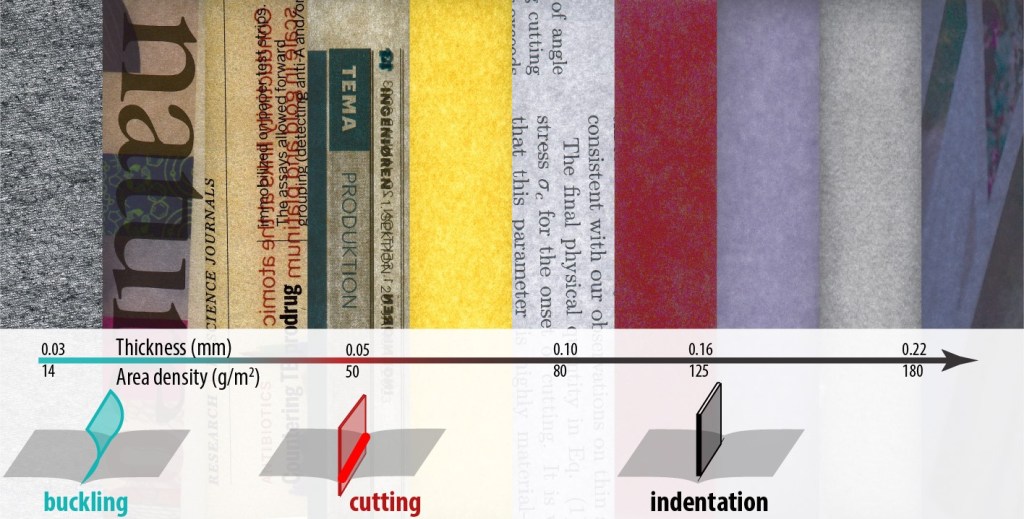
This image is from the GitHub site for supplementary information for the research paper by Sif Fink Arnbjerg-Nielsen et al. (2024).
Multiple uses of plant fibres
Plants provide people with a wealth of materials that make everyday life more tolerable. Apart from the obvious things like food, fuel, and medicines, one of the less obvious – but most multi-useful – is plant fibres. Fibres come in many forms, but some of the most notable are flax, hemp, and jute*. Although many of the objects made from plant fibres look as if they were made from fibres – e.g., linen cloths, jute bags, and hemp ropes – one of the most abundant doesn’t easily betray its fibrous origins. I’m talking here of paper.
What is paper?
Paper “is a thin material produced by pressing together moist fibres of cellulose pulp derived from wood, rags or grasses, and drying them into flexible sheets”. Prior to the industrialisation of paper production from the mid-19th century, the most common fibre source was recycled fibres from used textiles, called rags, which were made from hemp, linen and cotton (Lothar Göttsching et al., 2000).
Today, “paper is made from trees grown in sustainably managed forests and from recycled paper”. Whilst species such as spruce and fir were initially the preferred sources of wood pulp (also known as paper pulp) for paper manufacture, advances in technology “have permitted the use of practically all species of wood, greatly expanding the potential supply”. Although both softwood (Iqbal Mahmud) and hardwood (Iqbal Mahmud) trees – so-called pulpwood trees – can be used in paper manufacture, softwood species, e.g., spruce, pine, fir, larch and hemlock, are generally preferred over hardwoods such as eucalyptus, aspen and birch. The reason for this is down to fibre length; softwood fibres** range from about 2 – 4 mm (0.08 to 0.16 inch) in length, and hardwood fibres are approx. 0.5 – 1.5 mm (0.02 to 0.06 inch)[here] . Longer fibres make stronger paper, whilst shorter, hardwood, fibres “fill in the sheet and give it opacity and a smooth surface”.
For more on paper itself, its manufacture, and its history, see here, here, here, here, here, here, here, here, and here.
Paper + printing = ?
The marriage of paper with printing (Ally; Robert Lechêne), was a winning combination. The printed word allowed ideas to be recorded, reproduced, and disseminated far-and-wide – much farther and wider than the original person who had the ideas could achieve by word of mouth, on their own. The world’s most noteworthy and influential books – especially their text – could thus be broadcast around the world. That gave humanity the ability to exchange ideas, and to change hearts and minds – for good or ill, as indicated by the following short list of books that have been variously banned by governments or caused outrage amongst people (not all of whom will actually have readsthe ‘offending’ books) e.g. Adolf Hitler’s Mein Kampf, On the origin of species by Charles Darwin, Lolita by Vladimir Nabokov, The Decameron by Giovanni Boccaccio, JD Salinger’s The catcher in the rye (Katelyn Nelson), Salman Rushdie’s The satanic verses, and The Marquis de Sade’s The 120 days of Sodom.
Books, using good quality paper, can last for hundreds of years (Adam Sternbergh), giving a strong sense of permanence to the text within them – and its ability to amuse, inspire, confuse, outrage, court controversy, inform, educate, etc. long after their author(s) have departed this life.
Another mass-produced printed paper product is the newspaper. Distributed in their millions locally, nationally, and maybe internationally, newspapers recorded notable events such as births, weddings, and deaths. Immortalised somewhat in print those important moments in a life documented individuals’ hatching, matching, and dispatching (Andy Cope), marking their brief sojourn as a passenger on this planet hurtling through the void of space.
Even after their role as news-disseminators, newspapers (Bob Sampson et al.) used to have an extra lease of life as the wrapping for that most quintessential of British culinary traditions, fish and chips***. That practice – no longer practised in the UK – not only kept one’s meal warm and uncontaminated, but also provided an extra opportunity for the consumers of the ‘fish supper’ to read the printed news again, thereby nourishing both body and mind at the same time.
Made from so-called ‘newsprint’, a “low-cost, non-archival paper consisting mainly of wood pulp and most commonly used to print newspapers and other publications and advertising material”, newspapers have a maximum lifespan of about 100 years (Charles Tumosa et al., 2008).
Recording words on paper gave them some form of permanency, making them available to generations long-distant from those who originally produced them. In that way ideas, etc. could live on long past the lifetime of their originator and into the future to influence development of humanity. One way or another, paper-printed publications played a big part in people’s past, and present. But, …
The demise of paper?
… for all the wonderful things associated with paper – especially of the text-embossed variety – it seemed that the printed word was set to be overtaken by the electronic one with the advent of computers and text-recording and -sharing technology. Many years ago – at least as far back as the 1970s – I recall that one of the promises about the computerised future, that was then ‘just around the corner’, was the notion of the paperless office. That promise has not been fulfilled. Indeed, it seems that we use more and more of the stuff than ever. Not only is paper’s manufacture associated with environmental problems and issues of deforestation, its disposal presents issues as well.
But, and environmental issues aside, arguably the worst thing is that the persistent presence of paper presents one of the most dangerous hazards in the office – whether at home or at another site of work – or any place where paper is used in any amount [Ed. – and don’t get me started on ‘junk’ mail – the equally pernicious ‘manual’ or ‘analogue’ equivalent of the digital world’s eMailed ‘spam’…]. Why is this proliferation of paper in people’s lives a problem? Because of the ever-present – and increasing – danger of the paper cut. [I know paper cuts aren’t usually life-threatening, but my goodness do they ever hurt****.] [Ed. – which is one of the best arguments in favour of ‘cutting-back’ use of paper…]
What is a paper cut?*****
A useful definition is Wikipedia’s: “A paper cut occurs when a piece of paper or other thin, sharp material slices a person’s skin, most often on the upper part of the index finger. … Paper cuts can be highly painful, even though they may bleed very little, if at all” [quoted from here]****.
Paper cuts are a fact of – office – life (even for those who may work from home, and whose ‘office’ is the kitchen, living room, bedroom, understairs cupboard, garden room, table in a coffee shop, etc., and for those who don’t partake of office work but just live on this planet and who will, at one time or another, for a shorter or longer period, come into contact with paper). It seems almost impossible to avoid coming into contact with paper. Cuts therefrom are likely to be an ever-present hazard. If you can’t avoid paper entirely, what can one you do to reduce – ideally, minimise – the chances of getting cut? One tactic is to choose what type of paper you come into contact with. That is the basis of the research by Sif Fink Arnbjerg-Nielsen et al. (2024).
Research at the cutting edge…
Appropriately – i.e. here worded in a way that summarises the conclusion of the investigation undertaken – the research is entitled “Competition between slicing and buckling underlies the erratic nature of paper cuts”, Arnbjerg-Nielsen et al. (2024). In the absence of human volunteers(!) [Ed. – seemingly, although people may be prepared to ‘suffer for their art’ (Cristina Garlesteanu, Victoria Ford), they seem less keen to do so for their science…], the research team used substitute human tissues – a block of gelatin – to determine which types of paper are likely to cause paper cuts.
Their results seem quite conclusive, and are admirably summarised on the GitHub page for the work: “Thin paper can’t cut because it lacks the structural integrity to resist buckling. Thick paper, in contrast, distributes the load across a large area and is also unable to cut. This explains why only paper within a narrow thickness range can cut. The most hazardous paper thickens is 65 μm…”. That thickness corresponds to dot matrix paper [‘continuous stationery’ (UK) or ‘continuous form paper’ (USA)], i.e., paper designed for use in a dot matrix printer.
Mercifully, Emily Conover bluntly reassures us “That paper isn’t used much anymore”. [Ed. – although it is still on sale and available, e.g., here, and here]. But, printed science journals – Nature and Science – also tested by Arnbjerg-Nielsen et al. (2024) – came a close second to finger-slashing dot matrix paper, and they do still exist nowadays [Ed. – could this finding be another valid reason for switching subscription to science research journals to ‘on-line only’..?].
Although dot matrix printer paper may not be used much nowadays, a surprising outcome of Arnbjerg-Nielsen et al. (2024)’s research is the creation of a so-called Papermachete, which uses “discarded traction sections of dot-matrix paper as a blade”. Although it is only a ‘single-use’ cutting tool, it “easily cuts into most soft plant- and animal-based products”, e.g., apples, bananas, red pepper, and chicken (but “it is not suitable, for example, for wood carving and spreading butter”). Readers interested in trying this out for themselves will find instructions for 3-D printing the – recyclable – Papermachete on the paper’s GitHub site [Ed. – For some videos demonstrating what else you can cut with paper – although not employing the Papermachete, see Caroline Siede]. The scientific paper concludes with the words: “Despite its seemingly mundane nature, studying the physics of paper cuts has revealed a surprising potential use for paper in the digital age: not as a means of information dissemination and storage but rather as a tool of destruction” (Arnbjerg-Nielsen et al. (2024).
For more on this research story, see here, Andrew Paul, Bob Yirka, Gail Sherman, Alex Boese, and Emily Conover.
[And, no, it has not gone unnoticed by its author that this item is the ultimate Plant Cutting post… So, anybody dealing with paper-based greetings cards – or a hard copy priny pout of this post – on this 14th February saint’s day, do take extra care(!)]
* Although cotton is often called a fibre, it isn’t actually a fibre – an individual cell with a lignified wall, that grows at both tips (Anastasia Snegireva et al., 2015; Mateusz Majda et al., 2021), and which is a component of the sclerenchyma tissue found inside the plant – but a tubular, single-tipped, hair-like structure that extends out from the surface of the cotton seed, and whose cell wall is not lignified but almost pure cellulose. Arguably, this issue is avoided if cotton is described – and distinguished from those true fibres that come from the internal anatomy of plants – as a ‘seed fibre’. [Ed. – see also the footnote to ‘When is a fibre not a fibre?’.]
** As for cotton*, fibre in the context of softwoods is another instance where the word is used inappropriately. Softwood – wood from gymnosperms (Stephanie Conway, 2013) – largely consists of cells called tracheids (Eric Maier). Gymnosperm wood does not contain fibres. Fibres are, however, found in hardwood (Eric Maier, Rodney Savidge) – wood from angiosperms (Peter Stevens et al.).
So, when softwood pulp is used for paper-making, it mainly adds tracheids to the mix (which presumably have the same – or similar – paper-making physical attributes as hardwood fibres). When hardwood pulp is used it adds true fibres, and, one suspects, also adds longish vessel elements, fragments of xylem vessels (Harry Alden), and elongated axial parenchyma cells (Harry Alden) (and tracheids in the case of such angiosperms as oak (Marta Percolla et al., 2021)).
The word ‘fibre’ in the context of paper-making covers a wide range of cell types – only some of which this Botanist considers to be proper fibres. Which highlights the – rather important – distinction that needs to be made between fibres in the plant anatomical sense and paper-making ‘fibres’.
*** Which provides the real possibility of the introduction of salt, or – much worse? – vinegar (the traditional accompaniments to a fish and chip meal), into the wound… [Ed. – Yes, Mr Cuttings is getting ahead of himself here regarding the research item considered in this post.]
**** Quite why a paper cut hurts so much is graphically explained here: “Like a superficial cut by a razor blade, a paper cut smoothly parts the skin. But while a clean razor leaves little behind to irritate the wound, a paper cut deposits material that really stings. Paper is made of pressed wood mulch and a variety of chemicals. When paper cuts into the skin, chemical-coated fibers as well as bacteria and tiny particles remain in the wound and stimulate pain receptors in the skin. Because the cut is usually small and shallow, the skin on either side of the wound closes quickly, trapping the fibers and other particles inside. The result is a good deal of pain, and since the closed wound doesn’t allow for much bleeding, the pain seems entirely out of proportion to a cut that you can barely detect”.
For some other insightful information on why paper cuts hurts so much, see here, Jason Goldman, Christina Duffy, here, J Patrick Lewis, Gabriel Neal, and Anna Lewis.
And, should you ever need to know how to treat a paper cut, see here.
Finally, for all those out there who think paper cuts are nothing more than a minor inconvenience, here’s a cautionary tale from an Australian news outlet.
***** Alternative meanings of ‘paper cut’ include “a tiny adversary with the power to inflict a high level of unexpected pain”. In the CX [Customer eXperience] world, “a paper cut is a subtle inconvenience, a minor friction point that can transform a simple task into a time-consuming headache for customers”.
And, papercutting, “the art of paper designs. Art has evolved all over the world to adapt to different cultural styles. One traditional distinction most styles share is that the designs are cut from a single sheet of paper as opposed to multiple adjoining sheets as in collage” [quoted from here].
REFERENCES
Sif Fink Arnbjerg-Nielsen et al., 2024. Competition between slicing and buckling underlies the erratic nature of paper cuts. Physical Review E 110(2): Article 025003; https://doi.org/10.1103/PhysRevE.110.025003
Stephanie Conway, 2013. Beyond pine cones: An introduction to gymnosperms. Arnoldia 70(4): 2-14; doi: https://doi.org/10.5962/p.390719
Lothar Göttsching et al., 2000. Recycling fiber and deinking, p. 13, Technical Association of the Pulp and Paper Industry: ISBN 9525216071; OCLC 247670296.
Mateusz Majda et al., 2021. Elongation of wood fibers combines features of diffuse and tip growth. New Phytologist 232(2): 673-691; https://doi.org/10.1111/nph.17468
Marta I Percolla et al., 2021. Hydraulic function and conduit structure in the xylem of five oak species. IAWA Journal 42(3): 279–298; doi: https://doi.org/10.1163/22941932-bja10059
Anastasia Snegireva et al., 2015. Intrusive growth of primary and secondary phloem fibres in hemp stem determines fibre-bundle formation and structure. AoB PLANTS 7: plv061; https://doi.org/10.1093/aobpla/plv061
Charles Tumosa et al., 2008. The deterioration of newsprint and implications for Its preservation. WAAC Newsletter 30(3): 21-24.
 Plant Cuttings
Leave a comment