
The Psychological Appeal of Gardens by Clive R Hollin, 2024. Routledge.
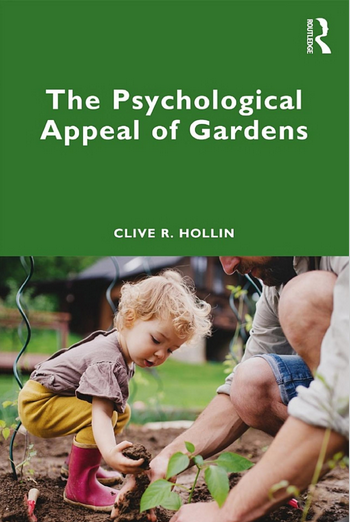
The psychological appeal of gardens by Clive R Hollin [which tome is here appraised] is one of the slimmest books I’ve reviewed. But, don’t assume that its 97 pages of main text mean that its topic is of little significance. The book’s focus on the mental health/wellbeing benefits of gardens (particularly private ones), and gardening – and with a good mention of interventions under such names as ‘green therapies’ (Kendra Wilson), ‘green care’ (Rebecca Salomon et al., 2018) or ‘green social prescribing’ – is a big subject. And one that assumed an increased importance during the recent periods of world-wide COVID-19 lockdowns [e.g. here, here, here, and here] (Dianna Keys et al.; Jonathan Kingsley et al., 2023; Alun Salt) and curtailment of the public’s usually unfettered right to roam away from home. But, first, some context.
A search on Google using the term ‘benefits of gardening’ returned many ‘hits’. The first nine of those were: “Why gardening makes us feel better – and how to make the most of it” by Lauriane Suyin Chalmin-Pui & Laura Scruby, writing for the UK’s Royal Horticultural Society [RHS], “the UK’s leading gardening charity” [with plenty of sources cited]; ”Seven health and wellbeing benefits of gardening” [with studies cited] from The Abbeyfield movement in England and Wales, which has “a rich history of providing exceptional housing and care services for older people”; “8 Surprising Health Benefits of Gardening” from Robert Hutchins for UNC Health (in the USA) [sources cited]; “Why gardening is good for your health” [sources cited], from Thrive (Registered as The Society for Horticultural Therapy, it “uses gardening to bring about positive changes in the lives of people living with disabilities or ill health, or who are isolated, disadvantaged or vulnerable”; “Dig into the benefits of gardening” by Lisa Wimmer [no sources cited], writing for Mayo Clinic Health System (USA), “a family of clinics, hospitals and other health care facilities with physical presence in 39 communities in four regions in Minnesota and Wisconsin”; “Seed, Soil, and Sun: Discovering the Many Healthful Benefits of Gardening” by Rebecca Joy Stanborough [sources cited] for Healthline, the “#1 health information platform in the US“; “The 7 Benefits of Gardening Guideline” by Caroline Picard & Amanda Hawkins for Weston Nurseries (in Massachusetts, USA whose goal is to provide “the best selection of hardy landscape-sized plant material in our area along with accurate advice on what will work best for our customers”); “Gardening for health: a regular dose of gardening”, an academic review article by Richard Thompson, 2018 [sources cited]; and “Cultivating wellbeing and mental health through gardening” by Vaithehy Shanmuganathan-Felton et al. for the British Psychological Society [sources cited].
That relatively short list should make the point that there is a lot of information [and which is readily available and accessible] that not only deal with aspects of the beneficial effects of gardens and gardening upon those who garden, both physical and mental, but also argue for the value of that activity. That’s all well and good, but, how reliable is that information?
Some of the studies named above may have vested interests in promoting a positive view of gardening. For example, one might not be too surprised that the articles by the Royal Horticultural Society, and Weston Nurseries – organisations that both benefit from gardening – strongly support the notion of gardening’s benefits, and cite sources that support that view. But, have they overlooked any sources that deliver a contrary view, that doesn’t suit their argument? The Mayo Clinic presents an item that’s strongly supportive of gardening’s benefits, but doesn’t cite any sources to support its statements. In the absence of sources might it be considered a case of ‘wishful thinking’? And, for those articles that do cite sources, how reliable are those sources? Are they sufficiently robust science that can realistically justify any claims that they make? Even for Thompson’s scientific article, how good is the study? Is the author unbiased? Under the Conflicts of interest section of the article we are advised that “The author is a trustee of the National Garden Scheme, and past trustee, now patron, of the charity Thrive. He is a member of the Royal Horticulture Society’s Health and Horticulture Forum, and he gardens in London”. What are we to make of the sources that support the claims that gardening is good for one’s health – both physical and mental, and is valuable as a ‘green therapy’ in treating patients?
Answering those questions is where The psychological appeal of gardens fits in.
Despite its title, Hollin’s book isn’t just about gardens – although a chapter looks specifically at psychological aspects of gardens (and another summarises the development of gardens since ancient times). Rather, Hollin spends considerable space considering whether gardening delivers benefits to the gardener – with particular focus on the psychological aspects, such as those around mental health and wellbeing, and its role in green therapy. In other words, Hollin looks at topics that are already well-covered – as my Google search confirms. With all the information that’s freely-available – and for free – on the internet. So, what does The psychological appeal of gardens add to the topic?
The book’s Introduction poses this question: “Given the ubiquitous presence in our everyday lives of gardens and gardening, what is their appeal?” (p. 1). Trying to answer that question, Hollin applies his psychological knowledge and training [acquired from his academic background in the field of psychology applied to understanding and reducing anti-social and criminal behaviour] by examining studies that look at aspects of the problem that have a psychological basis, or which are interpreted from a psychological point of view.
As a consequence, Hollin’s book gives us much more than we can readily get on the internet. The great strength of Hollin’s book is that the author has taken considerable trouble to access published studies [many from the last few years] that look into various aspects of ‘garden psychology’ and green therapy and examined them in detail for the readers’ benefit. It’s probably not giving that much away to say that Hollin finds considerable support for the psychologically beneficial effects of gardens and/or gardening from the studies he has examined.
But, he is also of the view that many of those studies, and therefore the conclusions that have been drawn from them [and which may widely be cited as supporting the case for the benefits of gardens and gardening] are not as robust as they should be. In particular, he draws attention to instances where the bias(es) of the researcher(s) may have led them to be overly-generous in concluding that the results favour their particular point of view, i.e. they need to be more objective. Hollin isn’t afraid to ‘call-out’ instances where sample sizes are too small for robust conclusions to be drawn. As a result of his comprehensive, in-depth, critical examination of numerous scientific studies on the subject of the benefits – psychological or otherwise – of gardens, gardening, and green therapy, Hollin makes a very strong argument that – at present – we probably don’t have enough evidence for long-term benefits of gardens-and-gardening, particularly as far as ‘green therapies’ are concerned.
Whilst it is always a little uncomfortable to hear harsh truths that may run counter to one’s own prejudices [as a gardener, I’m convinced of the positive mental benefits that activity provides – well, that’s my subjective, biased point of view…], we should be grateful to Hollin for doing what he has done and presenting his evaluation in this book. By doing so, they can be assessed and judged by others – to see if they agree with his findings, or not. Publishing one’s analysis and interpretations for scrutiny and evaluation – as Hollin has done – is an important part of the scientific process: A process which Hollin wishes had been carried out more robustly by some of those whose published work he has carefully analysed.
A comment about sources…
As a decidedly academic piece of work, a comment about sources is particularly relevant. In some respects, The psychological appeal of gardens is a book of two – although unequal – halves. When considering the academic studies, Hollin cites their sources, and generally states other appropriate sources to substantiate the statements he makes regarding them. Elsewhere, where he is generally setting the context for the subject matter of the book, more references are needed. For example, “There is no doubt that our behaviour is influenced, for the better or the worse, by what we see, hear and read” (p. 15); “the growing disconnect of children with nature as greater amounts of time are spent with electronic entertainments” (p. 18); “It is the case that many prisoners are from a socially disadvantaged background with a myriad of personal problems and are therefore in need of change” (p. 44); “UK records include the longest leek at 1.432 metres and the heaviest field pumpkin weighing in at 121.6 kilograms” (p. 57); “The lawn may have been created in Versailles” (p. 57)*; and “The number of people in the United Kingdom with dementia is approaching one million” (p. 67). Deficiency of sources is particularly acute in Chapter 1 that documents the history and development of the garden. This patchiness of sources is always an issue, but maybe more so here in a book that has an important academic purpose.
On a more positive note about sources, the main chapters that develop Holllin’s argument – numbers 2 – 7 – contain 327 references, which is an average of 6 sources per page of main text**, and which sources are overwhelmingly to scientific articles. Furthermore, of those hundreds of references, 95 (including 4 that were ‘in press’) – approx. 30% – are dated post-2020, which tells me that Hollin’s book is probably as up-to-date as it can be.
Summary
In The psychological appeal of gardens, Clive Hollin provides a detailed, in-depth and critical appraisal of the published benefits – both psychological and physical – of gardening and other interactions with gardens (such as green therapy). It is a slim volume that should be widely read – and, no doubt, debated – by all who are interested in the relationship between gardens and people. It should be of particular interest to those involved in formulating and/or delivering green therapies.
* This verdant gardening innovation was apparently termed ‘tapis vert’, which Hollin translates on p. 57 as ‘small carpet’. That looked a little strange to me as I understood that the French word vert means green. Some internet research supports my view that tapis vert should be translated as ‘green carpet’ [here, here, and here].
** When multiples sources are cited in-text, they are presented in alphabetical order of the first author’s surname. This means that such items are not necessarily placed in chronological order of their publication dates, with the oldest listed first. Whilst I understand that alphabetical ordering is required for some citation styles, chronological ordering always seems more appropriate as it acknowledges the priority that is due to the older literature.
REFERENCES
Jonathan Kingsley et al., 2023. Pandemic gardening: A narrative review, vignettes and implications for future research. Urban Forestry & Urban Greening 87: 128062; https://doi.org/10.1016/j.ufug.2023.128062
Rebecca E Salomon et al., 2018. Green care as psychosocial intervention for depressive symptoms: What might be the key ingredients? J Am Psychiatr Nurses Assoc. 24(3): 199-208; doi: 10.1177/1078390317723710
Richard Thompson, 2018. Gardening for health: a regular dose of gardening. Clinical Medicine 18(3): 201-205; https://doi.org/10.7861/clinmedicine.18-3-201

 Plant Cuttings
Leave a comment