
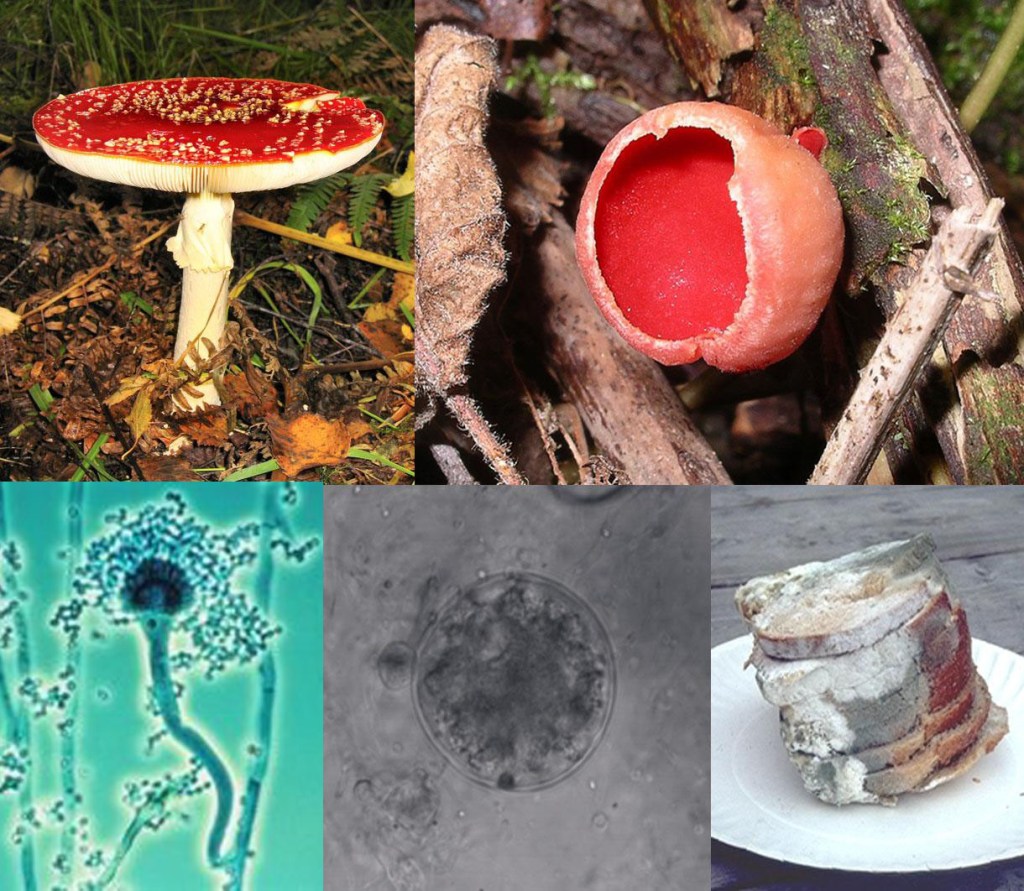
This image, entitled “A series of fungi”, by BorgQueen is used under the Creative Commons Attribution-Share Alike 2.5 Generic license.
The autumn in the northern hemisphere is traditionally the time for a fungus foray (Kriss MacDonald; Daniel Butler), when eager mycophiles traipse through the grass- and wood-lands to find fungi, particularly mushrooms and toadstools (Sue Fisher). In recognition – and celebration – of that seasonal activity, Cuttings HQ is pleased to provide a suitably fungal item for you this week. However, rather than a tale of intrepid fungal-foragers voyaging to the fungi, this item concerns fungi coming to us(!).
Much like plants, fungi are generally considered to be Earth-bound, fixed-to-one-spot lifeforms. They’re certainly not what first comes to mind when one is asked to think of mobile organisms. Well, that cherished and long-held presumption has been well and truly ‘knocked out of the park’ by the work of Xavier Rodó et al. (2024).
Sampling the atmosphere above the city of Chō fu (near Tokyo, Japan), Xavier Rodó et al. (2024) have revealed the presence of fungi and bacteria up to 10,000 feet (3,000 m) above the Earth’s surface. In total they identified “over 266 different fungal and 305 bacterial genera”. Such microbial diversity at such a height is somewhat unexpected, but hints at a wealth of lifeforms swirling over our heads. However, we don’t need to worry about mushrooms falling down to the ground – or on our heads – any time soon because the aerial fungi are presumably spores and not the mature toadstools and mushrooms we’re more familiar with as the earth-bound representatives of that kingdom.
Having revealed the presence of this atmospheric reservoir of microbes a number of questions come to mind, some of which were addressed by Rodó et al. (2024). First, where do these organisms come from? As in, what is their geographical origin? Evidence – such as the direction of the prevailing winds and probable origin of sample-associated metal content – presented in the article leads the authors to infer that their main source was the vast cereal croplands of NE China. Which, if correct, indicates a journey of over 2,000 km (and which could be even longer if the microbes remain suspended in the atmosphere rather than being removed for sampling purposes by inquisitive scientists)*.
Is this discovery important?
Yes.
As Rodó et al. (2024) emphasise, several of the bacteria identified are known pathogens of humans. For example, Bacteroides fragilis (Itzhak Brook, Hend Elsaghir et al.), which can cause severe infections (“to name a few: sepsis; peritonitis; soft tissue infections; pelvic, lung, and brain abscesses; and a toxin-associated diarrhea” (Rodó et al., 2024)), and Serratia marcescens (A Hejazi & FR Falkiner, 1997; Gianlucca Nazzaro, 2019; (Amanda Jacot), which “has the potential to induce a wide range of infections such as pneumonia, sepsis, meningitis, peritonitis, endocarditis, arthritis, osteomyelitis, keratitis, and urinary tract and skin infections” (Rodó et al., 2024).
And some of the fungi are also harmful to health. For example, Exophiala oligosperma (AD Bossler et al., 2003), which “in immunocompromised patients, it may induce soft-tissue infection, and it has been identified as a potential trigger of ocular and periocular sarcoidosis” (Rodó et al., 2024). And, Malassezia restricta (Amanda Oakley), “implicated in various diseases of the skin, including dandruff, pityriasis versicolor, seborrheic dermatitis, folliculitis, psoriasis, and atopic dermatitis” (Rodó et al., 2024).
Furthermore, some of the fungi are well-known to cause disease in crops, e.g. Sporisorium (Shamsul Bhuiyan et al., 2021; Shamsul Bhuiyan, 2024), “a known plant pathogen that causes sugarcane smut and is widespread in all the major sugarcane production areas in China” (Rodó et al., 2024). And Alternaria is a fungus of concern because, not only is it a known plant pathogen, but it also produces a variety of mycotoxins (Liliana Hogan) that can cause harm to humans (Vladimir Ostry, 2008; Chinaza Godseill Awuchi et al., 2022).
Or, in the authors’ own words, “Around 35% and 39% of bacterial and fungal species …, respectively, have the potential to pose a risk to human health since those taxa may act as opportunistic pathogens” (Rodó et al., 2024). And that potential may be realised because Rodó et al. (2024) demonstrated that several of the microbes were viable and had survived the environmental challenges of their aerial journey. Which revelation is a cause for concern. It’s bad enough to have disease-causing microbes circulating within a population or restricted area. To now know that they may be borne aloft on the wind and transported long distances into a different region, can only add to that concern.
But, and as if that news is not bad enough, there’s another side to this story: Several of the bacteria isolated from the samples exhibited multiple drug resistance [MDR]. In other words, they were resistant to a number of widely-used antibiotics – which is a major issue world-wide in humankind’s continual battle against harmful microbes (Alessia Catalano et al., 2022). Understandably, influx of any wind-borne MDR bacteria to a region is a problem. But, it’s an additional source of concern if the drug-resistance capability of these ‘immigrant microbes’ is transferred to non-MDR microbes already resident in the region. [Ed. – and this is without mentioning any of the health hazards from the various metals associated with the microbe-bearing bioaerosols (Ki-Hyun Kim et al., 2018; Wenwen Xie et al., 2021; Hazrat Zaman et al., 2023)…]. As they say, it’s an ill wind (Gary Martin)**.
It’s bad, but won’t it all just ‘blow over’?
It would be nice if all of this just went over the heads of the good citizens of Tokyo, carried aloft, and hither and yon by the wind. But, if they did, that would just pass the microbe problem on to another place. Because, eventually these particles will be removed from the atmosphere and brought back down to the ground thanks to gravity. They will either be washed out of the air with rain droplets [‘wet deposition’ (Paolo Zannetti, 1990)], or fall to earth attached to particles of dust or whatever via the phenomenon known as ‘dry deposition’ (Puja Mondal; Paolo Zannetti, 1990). So, at some time and place, what was initially an aerial problem will become a terrestrial – or aquatic – one [again, because let us not forget that the microbes commenced their journey as land-based organisms].
And there is evidence of microbial fall-out in the Japanese study area ***. “The air samples taken at 1,000 and 3,000 meters altitude yielded similar results to soil samples from the city of Chōfu“, and “microbial diversity values … up to 3,000 m a.s.l. [above sea level] were comparable to those at the near-surface level, without entrainment from surface air below” Rodó et al. (2024). All of which supports the widely-held view that long-distance dispersal [LDD (Luzie Wingen et al., 2013)] of fungi via their spores (Luzie Wingen et al., 2013; Jacob Golan & Anne Pringle, 2017) is a real – and widely-occurring – phenomenon [Ed. – which may be helped by folding of their spores during the journey (Frank Segers et al., 2023)].
Although Rodó et al. (2024) present strong evidence for the geographical origin of the microbial bioaerosls in their study, their results highlight a more general phenomenon regarding long-distance wind-borne transport of microbes and materials of health-concern to humans and crops: “The link of aerosol particles to remote agricultural areas, leaves it open the potential role of pesticides, fertilizers, or other components derived from anthropogenic activities ultimately capable of affecting human health, far from their sources” Rodó et al. (2024).
For more on this item,
see Margherita Bassi, here, here, here, Linda Stewart, Bob Yirka, Carl Zimmer, and the commentary on the scientific article by Daisuke Tanaka & Fumito Maruyama.
* This work adds to the long-distance transport of microbes, from Asia to North America, previously reported by David Smith et al. (2012).
** Although this notion was neither addressed – nor even hinted at – in Rodó et al‘. (2024)’s article, one can’t help but wonder if this knowledge could be misused. For example, it is conceivable that a rogue nation might deliberately allow release of wind-borne pathogenic microbes into the atmosphere so that they would be transported to another country. Why? In order to weaken the health of the people and crops to the point that they would be unable to resist an attempt at invasion and capture. The fact that such a scenario hasn’t yet been played out – to my knowledge – is probably largely due to the fact that, if you time things wrong, the wind might blow in the ’wrong direction’ and spread the harmful microbes back into and over the territory and population of the would-be-aggressor country. Sounds like science fiction? Or just a fictional suggestion, based on science..?
Maybe a more plausible notion is whether a country whose people or crops are harmed by microbes, etc. that originate in another jurisdiction could seek legal redress from the country that’s caused it harm. Hmmm, now that is an interesting thought – and one that’s not as farfetched as the biowarfare idea.
*** Part of the impetus for Rodó et al. (2024)’s air-sampling study was Kawasaki Disease, “a rare heart condition that causes a high fever and inflammation of the blood vessels” (Benjamin Thea Barnes). Surges in incidence of this condition in Japan and California often appeared to coincide with winds from northeast China, suggesting that something capable of causing infection might have travelled on the wind (Carl Zimmer). Although the present study hasn’t solved the question of the origin of Kawasaki Disease, it does raise new research questions, including how the microbes stay alive while being carried so high on the wind and whether winds can spread diseases (Margherita Bassi).
REFERENCES
Chinaza Godseill Awuchi et al., 2022. Mycotoxins’ Toxicological Mechanisms Involving Humans, Livestock and Their Associated Health Concerns: A Review. Toxins 14(3): 167; https://doi.org/10.3390/toxins14030167
Shamsul A. Bhuiyan et al., 2021. Sugarcane Smut, Caused by Sporisorium scitamineum, a Major Disease of Sugarcane: A Contemporary Review. Phytopathology ® 111: 1905-1917; https://doi.org/10.1094/PHYTO-05-21-0221-RVW
AD Bossler et al., 2003. Exophiala oligosperma causing olecranon bursitis. Journal of Clinical Microbiology 41(10): 4779–4782; doi: 10.1128/JCM.41.10.4779–4782.2003
Alessia Catalano et al., 2922. Multidrug Resistance (MDR): A Widespread Phenomenon in Pharmacological Therapies. Molecules 27(3): 616; doi: 10.3390/molecules27030616
Jacob J Golan & Anne Pringle, 2017. Long-Distance Dispersal of Fungi. Microbiol Spectr 5: 10.1128/microbiolspec.funk-0047-2016; https://doi.org/10.1128/microbiolspec.funk-0047-2016
A Hejazi & FR Falkiner, 1997. Serratia marcescens. J Med Microbiol. 46: 903-912; https://doi.org/10.1099/00222615-46-11-903
Ki-Hyun Kim et al., 2018. Airborne bioaerosols and their impact on human health. Journal of Environmental Sciences 67: 23-35; https://doi.org/10.1016/j.jes.2017.08.027
Gianlucca Nazzaro, 2019. Etymologia: Serratia marcescens. Emerging Infectious Diseases 25(11): 2012; https://doi.org/10.3201/eid2511.et2511
Xavier Rodó et al., 2024. Microbial richness and air chemistry in aerosols above the PBL confirm 2,000-km long-distance transport of potential human pathogens. PNAS 121(38): e2404191121; https://doi.org/10.1073/pnas.2404191121
Frank JJ Segers et al., 2023. Natural folding of airborne fungal spores: a mechanism for dispersal and long-term survival? Fungal Biology Reviews 44: 100292; https://doi.org/10.1016/j.fbr.2022.10.005
David Smith et al., 2012. Free Tropospheric Transport of Microorganisms from Asia to North America. Microb Ecol 64: 973–985; https://doi.org/10.1007/s00248-012-0088-9
Luzie Wingen et al., 2013. Long-distance dispersal and its influence on adaptation to host resistance in a heterogeneous landscape. Plant Pathology 62(1): 9-20; https://doi.org/10.1111/j.1365-3059.2012.02621.x
Wenwen Xie et al., 2021. The source and transport of bioaerosols in the air: A review. Front. Environ. Sci. Eng. 15: 44; https://doi.org/10.1007/s11783-020-1336-8
Hazrat Zaman et al., 2023. Assessment of Bioaerosols and Metal Contaminants in Car Cabin Filters Dust of Lahore, Pakistan. Pol. J. Environ. Stud. 32(2): 1919-1926; doi: https://doi.org/10.15244/pjoes/156693
Paolo Zannetti, 1990. Dry and Wet Deposition, pp. 249-262. In: Air Pollution Modeling. Springer, Boston, MA; https://doi.org/10.1007/978-1-4757-4465-1_10
 Plant Cuttings
Leave a comment