
This image, entitled “Deutonura monticola (Poduromorpha)”, by Philippe Garcelon, is used under This file is licensed under the Creative Commons Attribution 2.0 Generic license.
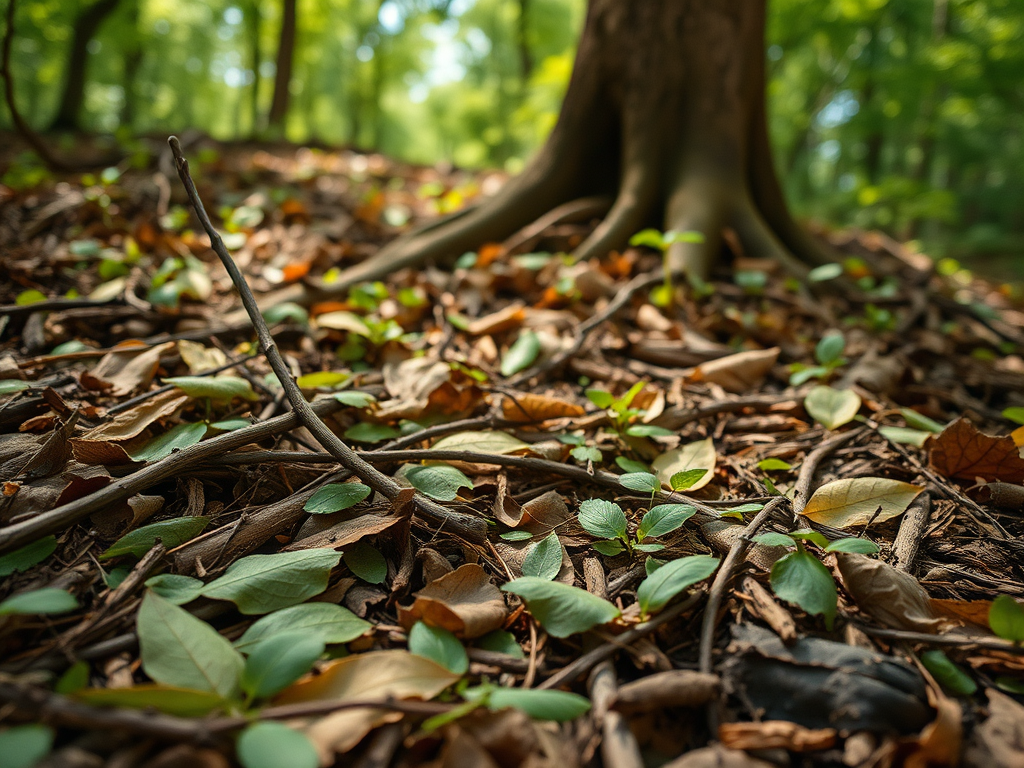
Somebody once estimated that, if dead and/or discarded or discharged plant and animal bodies and parts, wastes, and secretions were not broken down in the environment, a 12-mile thick high layer of undecayed organic matter [OM (Ron O’Hanlon)] would envelope the planet*. From the botanical perspective of this blog, that’s 12 miles of undegraded leaves, twigs, branches, tree-trunks, plant saps, petals, seeds, fruits, roots, pollen, etc. etc., i.e. plant litter or leaf litter (Marc Wilkinson, Abby Yancy). The fact that we aren’t suffocated at the bottom of such an enormous pile is down to the phenomenon of decomposition and the activity of decomposers, such as bacteria (Robert Kadner & Kara Rogers), fungi (Vernon Ahmadjian & Constantine Alexopoulos), and invertebrates.
Now, it is entirely possible that I may have misremembered that ‘statistic’*. But, the point is that without decomposition, of all dead organisms – plants, animals, fungi, bacteria, archaea, protozoa, etc. – there would be a massive pile of stuff: Decomposition is a fact of life. Not only that, it’s one of the ‘facts’ that makes life possible. If decomposition didn’t take place there would be no recycling of the nutrients that are essential to build new organisms and sustain life [more on this here, here, here, Kathiann Kowalski. Basically, life as we know it on this planet would probably be at an end. And that’s quite a scary thought. But, panic not, we’re not at that point – yet. However, anything that helps us to understand the process of decomposition better is to be applauded. Hence, this blog ‘bigging-up’ the work of Hannah Muelbaier et al. (2024).
One of the major components of OM – arguably, the major component – in nature is plant material. Although plants contain many compounds, two of the most difficult to break down are lignin and cellulose. Lignin is a complex chemical that is used as a strengthening material in plant cell walls – notably in cells of the xylem (Bruce Alberts et al., 2002; Nan Crystal Arens et al.) that constitutes the long-distance water transport pathway of plants and comprises woody material. Cellulose is famously the major strengthening component of all plant cell walls (Bruce Alberts et al., 2002).
Breakdown of lignin in the environment is largely undertaken by specialist fungi because they have the chemical inventory that enables them to do this (Amy Austin & Carlos Ballaré, 2010; Shannon Brescher Shea). Cellulose is broken down both by fungi (Shannon Brescher Shea, Kathleen Treseder), and bacteria (Rubén López-Mondéjar et al., 2016). Although cellulose and lignin are found separately, in nature – particularly in so-called secondary plant cell walls (Thomas Lankiewicz et al. , 2023; Ruiqin Zhong & Zheng-Hua Ye, 2015; Ruiqin Zhong et al., 2018) – they are more commonly encountered when chemically combined as lignocellulose (Elise Phillips, Katharine Sanderson, 2011) – “a composite of cellulose, hemicelluloses, lignin and pectin” (Muelbaier et al., 2024), which entity constitutes considerable challenges to its degradation**.
It has been estimated that lignocellulose biomass represents more than 90% of all plant biomass (Xuejiao Wu et al., 2018). As such it is the most abundant organic compound on Earth, with an estimated 181.5 billion tonnes produced annually (Nicolaus Dahmen et al., 2019). Decomposition of lignocellulose requires the activity of a number of enzymes, and the co-operation – whether co-ordinated or not – of several different organisms, chiefly fungi and bacteria (and mainly wood-degrading fungi (Martina Andlar et al., 2018).
Even though some animals, such as termites (Kumar Krishna), and grazing animals (Chris Sandom) feed on plant material – which requires them to digest lignocellulose – that complex chemical composite compound is broken down within their digestive systems thanks to the presence of microbes that have the chemical ability to do that. [Ed. – which phenomenon has been more interestingly described as being “‘outsourced’ to the gut microbiome” (Muelbaier et al. (2024)].
Apart from a few suggestions that invertebrates may possess their own enzymes that could enable them to digest cellulose – in a terrestrial termite (Hirofumi Watanabe et al., 1998), and a marine isopod (Andrew King et al., 2010) [both of which reports are cited by Muelbaier et al., 2024], as far as was known it was just microbes that produced lignocellulose-degrading enzymes (Uroosa Ejaz et al., 2021; Anupama Sapkota). Well, guess what? Yes, that’s right, Muelbaier et al. (2024) have discovered the presence of the genes for cellulose-degrading enzymes within the genomes of numerous soil invertebrates.
Specifically, after analysing the DNA of 232 animal species***, Muelbaier et al. (2024) found that genes for cellulose-degrading enzymes were present in numerous springtails [collembola] (Andy Murray) (in >70% of the 78 analysed species), and in several horn-mites [oribatid mites] (Carlos Barreto & Zoë Lindo, 2020) (in 61% of the 54 species analysed). Furthermore, Muelbaier et al. (2024) also found the cellulase in Coleoptera [‘beetles’] and Thysanoptera [‘thrips’] (in both species analysed). And, it was also present in three out of nine nematode (Amanda Bennett) species they examined. Taken at face value , the work suggests that some animals have the capacity to digest cellulose without the need for help from microbes; the seemingly widespread presence of a cellulose-degrading gene in springtails and oribatid mites is probably the stand-out result of the work, from an ecological point of view.
As Muelbaier et al. (2024]) remind us, several enzymes are involved in enzymic breakdown of cellulose, but they only investigated one, so-called GH45 cellulases (which are “endo-β-1,4-glucanases which hydrolyse cellulose”). Whether presence of just this enzyme is sufficient to break-down cellulose fully is not stated in their article. But, even if the inverts can only partially decompose cellulose – for later completion by microbial action – it’s still potentially a major contribution to decomposition of this plant-derived material in the environment, and can help to speed-up the rate of its breakdown, and recycling of its component elements. [Ed. – and helps to keep this planet from being a member of the ’12 mile high club’…]
But, and importantly – as Muelbaier et al. (2024) acknowledge – presence of a cellulase gene in an organism’s DNA does not prove that the enzyme that the gene codes for is also present in the organism and that it can function. The identification of the gene is at best suggestive that mites and springtails may have the ability to digest lignocellulose. More work will be needed to determine if the enzyme is made and functions as expected, and to quantify the role that these invertebrates contribute to lignocellulose breakdown in nature. Although Muelbaier et al. (2024) believe that they have “strong indications that GH45 cellulases in springtails and oribatids perform cellulose decomposition”, they are careful to “emphasize that the widespread presence of cellulase genes in soil invertebrates does not exclude that many species also rely on cellulolytic enzymes from microorganisms”.
In other circumstances, the finding of genes for cellulose-degrading enzymes in soil invertebrates might be called a ‘game-changer’ were it not for the fact that the game – of decomposition – hasn’t actually been changed. Any invertebrate contribution to lignocellulose breakdown was probably happening long before humans starting looking in more depth at the genetic repertoire of soil-inhabiting animals. Indeed, as Muelbaier et al. (2024) suggest, citing the work of Nicky Wybouw et al. (2016), “horizontal acquisition of cellulases and of other plant cell wall-degrading enzymes [(Patrick Keeling & Jeffrey Palmer, 2008; Kara Rogers)] likely was a key event driving the evolutionary emergence of herbivory [(Alison Stephens, 2010)] in arthropods [(Robert Barnes)]”. And, “Taken together, our data suggest an early acquisition of a GH45 cellulase during the diversifications of both springtails and oribatids” (Muelbaier et al. (2024).
What is changed, however, is our understanding of the process of plant decomposition in terrestrial environments. Extending the catalogue of organisms that can breakdown cellulose is a major contribution to ecology, particularly the carbon cycle (Melissa Ha & Rachel Schleiger), and underlines the increasing importance of the ‘FBI’ [fungi, bacteria and invertebrates] in the decomposition of OM.
Since mites and springtails are the most numerous arthropods on land (Rosenberg et al., 2023), and springtails are abundant across the globe (Potapov et al., 2023), and OM from plants is found planet-wide [and there’s an awful lot of it made anew each year], a lignocellulose-degrading role by these invertebrates would be a welcome thing. And any help that bacteria and fungi might get from other groups of organisms is presumably welcome. Anything that keeps those essential nutrient (Katharina Conradin) or biogeochemical cycles (Melissa Ha & Rachel Schleiger) turning is of benefit to all living things.
For a long time, soil invertebrates have had a well-recognised physical role in decomposition, e.g. shredding plant material into smaller pieces that facilitate entry of, and chemical breakdown by, microbes. But, it now looks like they may play a more direct – chemical – role in enzymic degradation of plant organic matter/material. Or, as Muelbaier et al. (2024) put it, “The widespread presence of GH45 cellulases in springtails and oribatid mites suggests that such endogenous cellulolytic abilities are substantially more common in invertebrates than it is generally appreciated. In addition to bacteria and fungi, invertebrates should, therefore, be considered a third evolutionarily and ecologically distinct group with such capability”****.
And who know what other groups of organisms may similarly harbour lignocellulose-digesting capabilities? For instance, although Muelbaier et al. (2024)’s work has highlighted the situation in terrestrial invertebrates, it would be interesting to know if genes for similar cellulose-degrading enzymes exist in invertebrates in aquatic environments. And what other genes relating to lignocellulose-degrading enzymes they may possess…
* If anybody can supply the source for this, I’d be most grateful. I’m a little embarrassed to say that I’d been repeating it in my lectures on fungi and decomposition for almost 20 years without appropriately attributing it – which is something I am usually so hot on, and have criticised others for doing (or, rather, not doing).
** “While cellulose and hemicellulose are polysaccharides that act as a primary structural component of the cell wall of green plants, lignin is the component that binds these sugars together and makes the entire structure more hydrophobic and resistant to degradation in so-called woody plants” (Elise Phillips).
*** For some sort of taxonomic completeness – and as a courtesy to our zoophytic readers, the range of invertebrates analysed by Muelbaier et al. (2024) was Collembola, Enchytraeidae, Gamasina, Myriapoda, Nematoda, Oribatida, and Tardigrada.
**** For more on this work, see here, here, and Stephanie Mayer-Bömoser. And, for a broad assessment of mechanisms of lignocellulose degradation from across the ‘tree of life’, see Simon Cragg et al. (2015).
REFERENCES
Bruce Alberts et al., 2002. The plant cell wall. Molecular biology of the cell, 4th edition. New York: Garland Science. Available from: https://www.ncbi.nlm.nih.gov/books/NBK26928/
Martina Andlar et al., 2018. Lignocellulose degradation: An overview of fungi and fungal enzymes involved in lignocellulose degradation. Eng Life Sci. 18(11): 768-778; doi: 10.1002/elsc.201800039
Amy Austin & Carlos Ballaré, 2010. Dual role of lignin in plant litter decomposition in terrestrial ecosystems. PNAS 107(10): 4618-4622; https://doi.org/10.1073/pnas.0909396107
Carlos Barreto & Zoë Lindo, 2020. Armored Mites, Beetle Mites, or Moss Mites: The Fantastic World of Oribatida. Front. Young Minds 8: 545263; doi: 10.3389/frym.2020.545263
Simon M Cragg et al., 2015. Lignocellulose degradation mechanisms across the Tree of Life. Current Opinion in Chemical Biology 29: 108-119; https://doi.org/10.1016/j.cbpa.2015.10.018
Nicolaus Dahmen et al., 2019. Integrated lignocellulosic value chains in a growing bioeconomy: Status quo and perspectives. GCB Bioenergy 11: 107–117; https://doi.org/10.1111/gcbb.12586
Uroosa Ejaz et al., 2021. Cellulases: From Bioactivity to a Variety of Industrial Applications. Biomimetics (Basel) 6(3): 44; doi: 10.3390/biomimetics6030044
Patrick J. Keeling & Jeffrey D. Palmer, 2008. Horizontal gene transfer in eukaryotic evolution. Nat Rev Genet 9: 605–618; https://doi.org/10.1038/nrg2386
Andrew King et al., 2010. Molecular insight into lignocellulose digestion by a marine isopod in the absence of gut microbes. PNAS 107(12): 5345-5350; https://doi.org/10.1073/pnas.0914228107
Thomas Lankiewicz et al., 2023. Lignin deconstruction by anaerobic fungi. Nat Microbiol 8: 596–610; https://doi.org/10.1038/s41564-023-01336-8
Rubén López-Mondéjar et al., 2016. Cellulose and hemicellulose decomposition by forest soil bacteria proceeds by the action of structurally variable enzymatic systems. Sci Rep 6: 25279; https://doi.org/10.1038/srep25279
Hannah Muelbaier et al., 2024. Genomic evidence for the widespread presence of GH45 cellulases among soil invertebrates. Molecular Ecology, Early View: e17351; https://doi.org/10.1111/mec.17351
Katharine Sanderson, 2011. Lignocellulose: A chewy problem. Nature 474: S12–S14; https://doi.org/10.1038/474S012a
Alison N P Stevens, 2010. Predation, Herbivory, and Parasitism. Nature Education Knowledge 3(10): 36.
Hirofumi Watanabe et al., 1998. A cellulase gene of termite origin. Nature 394: 330–331; https://doi.org/10.1038/28527
Xuejiao Wu et al., 2018. Solar energy-driven lignin-first approach to full utilization of lignocellulosic biomass under mild conditions. Nat Catal 1: 772–780; https://doi.org/10.1038/s41929-018-0148-8
Nicky Wybouw et al., 2016. Horizontal Gene Transfer Contributes to the Evolution of Arthropod Herbivory. Genome Biology and Evolution 8(6): 1785–1801; https://doi.org/10.1093/gbe/evw119
Ruiqin Zhong & Zheng-Hua Ye, 2015. Secondary Cell Walls: Biosynthesis, Patterned Deposition and Transcriptional Regulation. Plant and Cell Physiology 56(2): 195–214; https://doi.org/10.1093/pcp/pcu140
Ruiqin Zhong et al., 2018. Secondary cell wall biosynthesis. New Phytologist 221(4): 1703-1723; https://doi.org/10.1111/nph.15537
Tags: science communication, plants, decomposition, cellulose, lignin, bacteria, fungi, cellulases, enzymes, soil invertebrates, ecology, plant science, plant biochemistry, lignocellulose, nutrient cycles, biogeochemical cycles, carbon cycle, springtails, oribatid mites, botany, plant science, ecology, horizontal gene transfer,
 Plant Cuttings

Leave a comment