
This image of Liriodendron tulipifera (American Tulip-tree) foliage and flower by Bruce Marlin is used under the Creative Commons Attribution-Share Alike 3.0 Unported license.
Living in a world of binary choices – e.g. of up/down, in/out, hot/cold, 1/0 – we get used to, and can cope with, an either/or situation. A good botanical dichotomous example is the classification of the wood of trees into ‘hard’ or soft’.
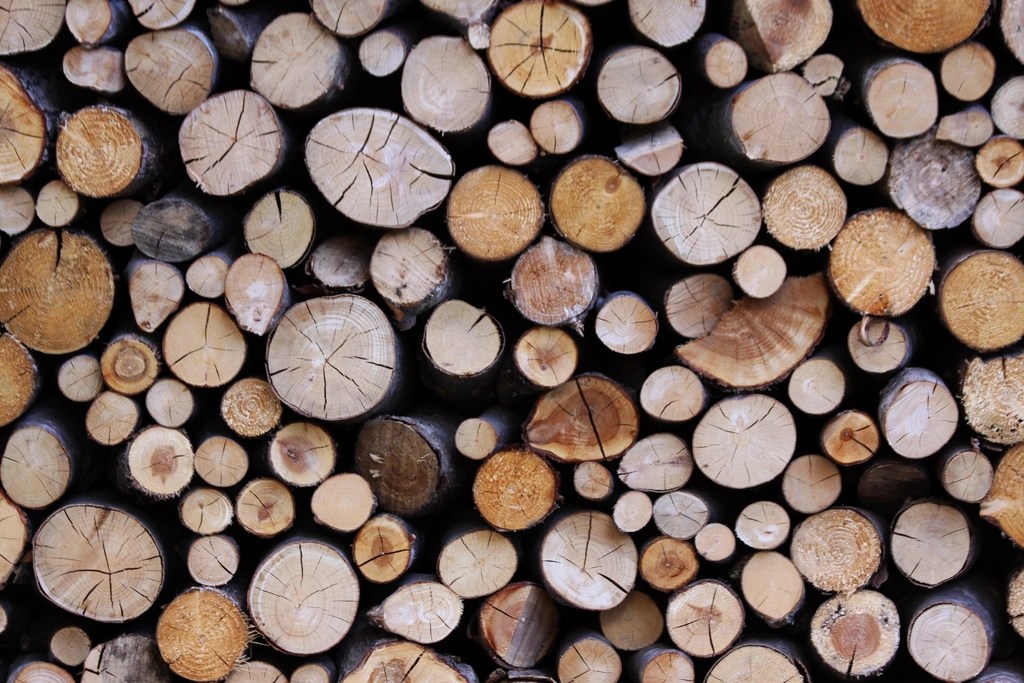
For as long as people have been studying trees and categorising their wood, two types have been recognised: Hardwood and softwood. Traditionally, softwood (Anne Weymouth) is the name given to the secondary xylem (Maria Morrow) (aka wood (Daniela Dutra Elliott & Paula Mejia Velasquez)) produced by evergreen gymnosperms (Anne Weymouth) such as eastern white pine, red pine, and balsam fir (Scott Weikert). Hardwood (Anne Weymouth) is found in deciduous angiosperm trees (Anne Weymouth), specifically dicots (Janet Grabowski) such as oak, iroko, and cherry, not monocots (Janet Grabowski).
However, as seemingly straightforward as this appears, we must acknowledge that those names aren’t foolproof; some gymnosperm wood can be rather hard (e.g. shortleaf pine, and Douglas fir (Scott Weikert). And some angiosperms produce wood that is famously soft (e.g. quaking aspen, and basswood (Scott Weikert), and balsa (Lew Feldman). In other words, hardwood is not necessarily hard wood, nor is softwood always soft wood. And larch (Larix decidua), a gymnosperm (more specifically a conifer (Christopher Earle; James Emory Eckenwalder; Aljos Farjon), and therefore a softwood tree, isn’t evergreen but deciduous (Dennis Parent et al.). But, by and large, this binary categorisation of the two types of wood that trees have works, and has been the situation for hundreds of years. Well, that’s just been challenged by Jan Lyczakowski & Raymond Wightman (New Phytologist Early view: https://doi.org/10.1111/nph.19983).
Now, it is undoubtedly the case that botanists in recent times find new species (e.g. here, here, here, and here – or even a new genus (e.g. here, (Gabriel Blanca et al., 2024, Rachael Funnell, James Woodford) – of plants quite often* – and we even occasionally discover a new plant organ (Shi En Kim). But, what has not happened for a very long time is the discovery of a completely new type of wood. Which is probably all the more surprising since we’ve been studying wood anatomy for hundreds of years – e.g. since the pioneering, trail-blazing days of microscopy by such notables as the 17th century trio of Marcello Malpighi (Flora Murray Scott, 1927; Alfredo Riva & Ettore Toffoletto) as revealed in his Anatome plantarum (Marius-Nicusor Grigore, 2016), Nehemiah Grew (Pamela Mackenzie, 2024) in The anatomy of plants begun as a philosophical history of plants (Kathryn Briggs; Brian Garret), and The comparative anatomy of trunks, and Antoni van Leeuwenhoek (Pieter Baas, 1982; Lesley Robertson, 2023).
But, although ground-breaking, those studies used light microscopes, and there’s a limit to the fine details of wood-cells that can be revealed by such equipment. In their 21st century study, Lyczakowski & Wightman (2024) investigated wood from trees growing in the Cambridge University Botanic Garden with a cryo-SEM . This instrument is a type of scanning electron microscope (Héctor Zamora Carreras, 2023) that can investigate and image the fine-detail of cells under low-temperature conditions, which correspond to their state in living trees.
Using the cryo-SEM, Lyczakowski & Wightman (2024) were able to distinguish differences in structural features of wood-cells that supported the categorisation of softwood in gymnosperms and hardwood in angiosperms. Specifically, they found that the macrofibrils (Jan Lyczakowski et al., 2019) (features largely composed of cellulose molecules) within the secondary cell walls (Bruce Alberts et al.; Daniel Cosgrove & Michael Jarvis, 2012) of wood-cells were larger – on average 27.9 nm [nanometres, each unit of which is a billionth of a metre] in diameter – in gymnosperms, and smaller – approx. 16.6 nm diameter – in angiosperm trees (Lyczakowski & Wightman, 2024)**.
But, and somewhat unexpectedly, the diameter of the macrofibrils in wood-cells of Liriodendron spp. (which are angiosperm trees) were intermediate in diameter between those of gymnosperms and angiosperms; Liriodendron tulipifera (tulip tree) averaged 22.4 nm, and Liriodendron chinense (Chinese tulip tree) averaged 20.7 nm. Although not named as such in their paper, this intermediate tulip tree wood-type has been christened ‘midwood’ (Adam Kovac)***. As unexpected as this finding was, it’s not just of academic interest. Whilst the scientific article goes on to discuss the evolutionary significance of this discovery [which are beyond the scope of this blog item], a potential practical application of this discovery – in acting as a ‘carbon-sink’ – is also considered.
Recognising that the genus Liriodendron appears in the fossil record very early in the course of evolution of the angiosperms, and at a time when the atmospheric concentration of CO2 was considerably lower than the present day, Lyczakowski & Wightman (2024) suggest that tulip-trees’ intermediate wood – which has microfibrils larger than more typical angiosperms –may be an “adaptation to more readily lock in larger quantities of carbon to the angiosperm SCW [secondary cell walls] and may have been advantageous when the availability of this resource [CO2] was being reduced”. In support of that view, Lyczakowski & Wightman (2024) cite sources which demonstrate that “both species of the Liriodendron genus are exceptionally efficient at locking it [CO2] in”. This finding has given rise to another alternative name of this newly-recognised wood type as “accumulator-wood” [another nickname for tulip-tree wood not used in Lyczakowski & Wightman (2024)], and may boost interest in use of these trees as a natural way to draw-down some of the excess CO2 in the atmosphere, and help to mitigate global warming, etc.
Although the wood of tulip trees has an intermediate macrofibril diameter, this is a fine-structural distinction and may not affect its categorisation as hardwood. Sites on the interweb state that the wood of Liriodendron is a hardwood (e.g. here, here, here, here, and Eric Meier). However, the wood’s hardness, at 2,400 N [Newton, units of force used to measure this attribute of wood] (Eric Meier), is at the lower end of hardwood hardnesses (Eric Meier), and a long way short of such woods as those from the angiosperm trees Schinopsis spp., with a hardness of 20,340 N (Eric Meier), and Quercus virginiana at 12,900 N. Nevertheless, it is intriguing to think that there might be a correlation between different categories of macrofibril diameter and (hard)wood hardness that could be investigated. In which case it will be interesting to know the diameter of the macrofibrils of balsa, which produces the softest hardwood at approx. 300 N****.
Having opened this particular can of worms (Matt Soniak), upset the applecart (Gary Martin), and set the cat amongst the pigeons (Jaehyeong Lee ), it is now only right that the wood of every tree species [and there are estimated to be 73,300 of them (Will Dunham; Roberto Gatti et al., 2022; Phoebe Weston) [which appears to include both angiosperm and gymnosperm trees per the images in Fig. 1 in Gatti et al. (2022)] be examined as thoroughly as that of Liriodendron tulipifera and L. chinense – and 31 other tree species – by Lyczakowski & Wightman (2024) to see if any more different types of wood exist…
* As comparatively commonplace as it is to discover new species, it is rare to find a new genus. Even rarer – but it does happen – is to come across a new family – e.g. the newly-described bryophyte (Wilfred Schofield), “Kahakuloa operculispora, a new Hawaiian simple thalloid liverwort in a new genus and family, Kahakuloaceae (Fossombroniales)” (A Virginia Friere et al., 2023).
** For more scicomm items about this work, see here, here,
Adam Kovac, and Steven Luntz.
*** Whilst on the topic of increasing number of types of wood, it’s worth mentioning the ‘wood’ of the arborescent monocot angiosperms known as palms (Harold Moore et al.). The so-called wood of such plants is made in a different way to that in gymnosperms and dicot angiosperms (Janet Grabowski; Peter MacSween; Alexandra Moreno). Since palms are not true trees (e.g. Sara Edelman), their ‘wood’ falls outside the scope of the soft vs hardwood categorisation, i.e. palm wood is “neither a softwood nor a hardwood” [nor a ‘midwood’ presumably]. Nevertheless, particular parts of the palm stem have uses similar to true wood, e.g. in construction (Becky Decker).
**** Adding further complexity to the story, wood in two species of Gnetum,which are non-coniferous gymnosperms, and which would be expected to have the large-diameter macrofibrils typical of softwood, actually had macrofibrils with a diameter of approx. 16.7 nm, which places them firmly in the size range observed for the hardwoods (Lyczakowski & Wightman, 2024). Who ever said botany was straightforward? Or, maybe gnetophytes (Christopher Earle; Melissa Ha et al.) are the exception that prove the rule (Nicholas Clairmont), of softwood = gymnosperm, hardwood = angiosperm..?
Finally, because I suspect you’ll be interested to know – I certainly was! – that the three softest hardwoods [according to the wonderful site, The wood database] are all angiosperms: balsam poplar (Populus balsamifera) [1,330 N], paulownia (Paulownia spp.) [1,160 N], and balsa (Ochroma pyramidale) [390 N](!) AND, the softwooded gymnosperm yew (Taxus baccata) weighs in at a most impressive 6,760 N (Eric Meier).
REFERENCES
Pieter Baas, 1982. Systematic, phylogenetic, and ecological wood anatomy — History and perspectives, pp. 23-58. In: Baas, P. (eds) New Perspectives in Wood Anatomy. Forestry Sciences, vol 1. Springer, Dordrecht; https://doi.org/10.1007/978-94-017-2418-0_2
Gabriel Blanca et al., 2024. A new plant genus and species from south-eastern Spain: Castrila latens (Rubieae, Rubiaceae). TAXON https://doi.org/10.1002/tax.13181
Héctor Zamora Carreras, 2023. Technology Networks [https://www.technologynetworks.com/analysis/articles/cryo-electron-microscopy-principle-strengths-limitations-and-applications-377080]
Daniel Cosgrove & Michael Jarvis, 2012. Comparative structure and biomechanics of plant primary and secondary cell walls. Front. Plant Sci. 3:204; doi: 10.3389/fpls.2012.00204
A Virginia Freire et al., 2023. Kahakuloa operculispora, a new Hawaiian simple thalloid liverwort in a new genus and family, Kahakuloaceae (Fossombroniales). Bry. Div. Evo. 46(1): 010–034; https://doi.org/10.11646/bde.46.1.4
Roberto Cazzolla Gatti et al., 2022. The number of tree species on Earth. PNAS 119 (6) e2115329119; https://doi.org/10.1073/pnas.2115329119
Marius-Nicusor Grigore, 2016. Rediscovering the first monograph on plant anatomy – Anatome Plantarum (1675) by Marcello Malpighi. The Biologist (Lima) 14(2): 155–170; https://doi.org/10.24039/rtb201614295
Jan Lyczakowski et al., 2019. Structural Imaging of Native Cryo-Preserved Secondary Cell Walls Reveals the Presence of Macrofibrils and Their Formation Requires Normal Cellulose, Lignin and Xylan Biosynthesis, Front. Plant Sci. 10:1398; doi: 10.3389/fpls.2019.01398
Pamela Mackenzie, 2024. Nehemiah Grew, the illustrator. Notes Rec. 78: 81–114; http://doi.org/10.1098/rsnr.2022.0020
Lesley Robertson, 2023. Antoni van Leeuwenhoek 1723-2023: a review to commemorate Van Leeuwenhoek’s death, 300 years ago. Antonie Van Leeuwenhoek 116(10): 919-935. doi: 10.1007/s10482-023-01859-4
Flora Murray Scott, 1927. The Botany of Marcello Malpighi, Doctor of Medicine. The Scientific Monthly 25(6): 546-553.

 Plant Cuttings

Leave a comment