
This is the follow-up post to last week’s [Part 1 REF] which looked at the real diet of a supposedly carnivorous animal. This item concerns the famously carnivorous snow leopard – and its title [think of it as a ‘TL;DR’ summary?] does rather ‘gives the game away’…
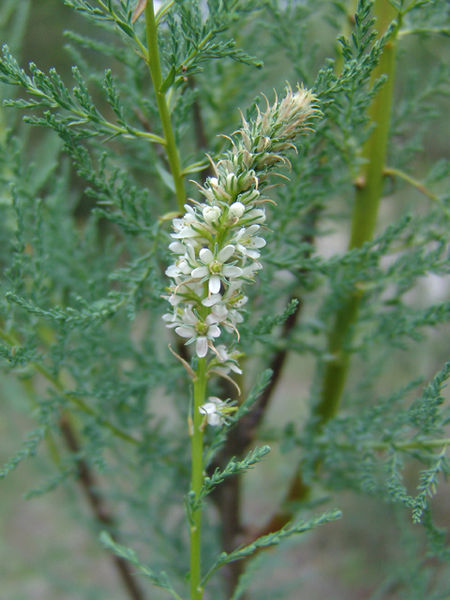
This image of “Flowers of Myricaria germanica” by Mnolf [http://www.thinkoholic.com/] is used under the Creative Commons Attribution-Share Alike 3.0 Unported license.
Confounding another of ‘those animals are definitely carnivores’ ‘facts’ we all think we know is work by Hiroto Yoshimura et al. (2024). Examining the faeces/feces of the snow leopard (Panthera uncia) (Scott Elder) in the Sarychat-Ertash Reserve in Kyrgyzstan (Edward Allworth et al.), Yoshimura et al. (2024) weren’t surprised to identify animal prey – such as Siberian ibex (Capra sibirica) and argali sheep (Ovis ammon) (Brent Huffman) – amongst the samples.
What did surprise them, however, was the quantity of plant material they also found within the cat’s scat, particularly in those samples with little or no animal material. The most frequently encountered plant was an unidentified species of Myricaria, a genus of shrubs in the flowering plant tamarix family, the Tamaricaceae.
Why are the leopards doing this??
Besides Myricaria, Yoshimura et al. (2024) found evidence of a wide range of plants in snow leopard poop* Quite often plant material was found in scat that also contained the DNA of prey animals. For example, DNA from Festuca (a grass), Rosaceae [the rose family (Melissa Petruzzello)], and Ephedra was found in snow leopard faeces along with ibex DNA. Such ‘co-occurrences’ – of plant and prey material together – led the researchers to err on the side of caution and treat such instances as indicating the possibility of secondary consumption of plant material by the leopard from the gut content of their herbivorous prey. Which seems reasonable. But, finding Myricaria DNA in cat scat which was devoid of animal prey led Yoshimura et al. (2024) to conclude that this plant was actively sought and ingested by the snow leopard. The big question then is: Why is vegetation present in the snow leopard’s diet at all? Particularly, since the genus Myricaria is not a dominant plant in the study area and is sporadically distributed along rivers (Yoshimura et al., 2024).
Possible reasons for leopard eating plants were mentioned by Yoshimura et al. (2024) in the paper’s Introduction: “Some posit plants as supplementary food or moisture sources, as indicated by the presence of fruit seeds in felid faecal samples [References cited in their paper]. Others suggest that plants serve medicinal purposes, aiding in parasite excretion [References cited] or digestion [Reference cited]. A commonly held notion also suggests plants assist in the evacuation of hair and undigested material [References cited]”.
Although all of these suggestion still remain to be examined specifically, in their Discussion (Rowan Dunton), Yoshumura et al. (2024) did consider that there might be a potential medicinal role for the Myricaria in the snow leopard’s diet. In support of which notion they cite the work of Jia-Bao Liu et al. (2015) on Myricaria bracteata, which “has been used in traditional Tibetan medicine and contains anti-inflammatory compounds” (Yoshimura et al., 2024).
However, Yoshimura et al. (2024) were careful to say that M. bracteata’s medicinal effects have not been specifically tested on snow leopards. Nevertheless, they did make the connection that intake of Myricaria sp. and the failure to acquire prey [recall instances of faeces containing plant but not prey DNA] may be related to the individual health condition of the snow leopards. So, a medicinal interpretation to this dietary discovery is not out of the question.
Sticking with that pharmacological possibility, it is noteworthy that some of the co-occurring plants found in snow leopard faces were unidentified species** of: Ephedra (‘joint firs’), Artemesia (wormwoods), and Valeriana (valerian). All of those genera contain species that have medicinal value to humans or pharmacological activity – e.g. Ephedra, Artemesia (Axelle Septembre-Malaterre et al., 2020), and Valeriana (Jillian Kubala & Franziska Spritzler). Although co-occurrence of plants with prey tends to suggest the cats aren’t seeking those plants deliberately, maybe the cats are more intelligent than we give them credit. What if they are targeting the prey – for food as a carnivore – but are also doing so knowing that the prey consumes plants that may be beneficial to the leopard? Something to consider***, and certainly relevant with the knowledge that disease is an important cause of concern for snow leopard decline in the wild (e.g. here, here, here, and Stéphane Ostrowski & Martin Gilbert)…
Acknowledging the authors’ antecedents…
An important part of any scientific paper is its Introduction, in which the authors set out the problem that they are investigating, and provide some sort of summary of the information that already exists in relation to it. In respect of plant-consumption by snow leopards, accumulated evidence prior to Yoshimura et al. (2024)’s study**** – and which they acknowledge in their article – certainly points in the direction of ingestion of vegetation being an important component of the snow leopard’s feeding behaviour.
Equally important in a scientific paper is to demonstrate how the new work differs from, and therefore adds value to, that which has gone before. Having considered the existing knowledge of plant-feeding by snow leopards from other workers, Yoshimura et al. distinguish their work from those previous studies in terms of the much more in-depth information about the range of plant material eaten and the prevalence of Myricaria sp. in the diet, and what this adds to our understanding of snow leopard behaviour and ecology. Yoshimura et al. (2024) believe that “investigating the plant repertoire consumed by wild snow leopards in alpine environments will deepen our understanding of the plant-eating behaviour, including which plants they consume despite limited plant resources”. Seemingly, this elusive and threatened ‘big cat’ still has lot more to tells us about its biology and ecology. All of which is relevant to management and conservation of this majestic feline whose status in the wild is assessed as ‘vulnerable’ (T McCarthy et al.), i.e. it is “considered to be at high risk of unnatural (human-caused) extinction without further human intervention” [quoted from here, and here]. To which unnatural extinction events can also be added natural causes from infection (Mihai Andrei).
For more on this story, see the scicomm articles by Mihai Andrei, and Sanjana Gajbhiye*****.
* For completeness, the full list of plant material identified by Yoshimura et al. (2024) in snow leopard scat, per their Fig. 6, is: Genera – Myricaria, Artemisia, Poa, Festuca, Caragana, Stipa, Papaver, Saussurea, Valeriana, Geranium, Ephedra, Caragana, Potentilla, Helictotrichon, Salix, Ribes, Cucumis, Carex, Digitaria, Bupleurum, Lonicera, Elymus, Juniperus, Allium, Bistorta; Families – Unknown Asteraceae, Unknown Cupressaceae, Unknown Papaveraceae, Unknown Plumbaginaceae, Unknown Fabaceae, Unknown Tamaricaceae, Unknown Poales, Unknown Rosaceae, Rhodiola, Unknown Crassulaceae; and Unknown Magnoliopsida**.
** If you’re wondering why the plant identifications are not to species level that is a consequence of the method used to determine what plants were present in the scat/faeces. Yoshimura et al. (2024) used the technique known as DNA metabarcoding. DNA metabarcoding “allows for simultaneous identification of many taxa [different species] within the same sample”, such as snow leopard faeces. Whilst the DNA of each species is unique, it contains within it particular short sequences of DNA – known as ‘barcodes’ – that characterise that species. So, rather than having to extract and analyse the full length of an organism’s DNA to identify the species, those short lengths can be searched for and do the job instead. In that way, the technique “enables detection of highly digested plant items”.
Although this sort of analysis reduces a species to its essence, its DNA sequence, the particular DNA sequences used in the study don’t appear able to get the identification of plant material to the level of individual species. Which is why the results of Yoshimura et al’s investigation are expressed in terms of genera, such as Myricaria, and not species, e.g. Myricaria bracteata. On that taxonomically-constrained basis, it’s reasonable to ask, is metabarcoding real plant identification? Or, is it just going through the motions? Matching the DNA metabarcode data to actual plant species is an obvious next step to generate even greater insight into snow leopard ecology – and the medicinal value – or otherwise – of vegetation in the cat’s diet.
Additionally, looking for identifications from DNA will stop you looking for actual plant material in the scat. Thus, there is nothing in Yoshimura et al’. (2024)‘s paper about viability or otherwise of plant material ingested by the cats and therefore its ability to produce a new plant some distance from the parent. In other words, this research is silent on the matter of whether vegetation-ingesting snow leopards engage in any form of endozoochory, unlike the situation that is presumed for the herbivorous piranha-like pacu in last week’s post [Part 1 REF]. In fairness, determining such matters was not one of the objectives of the work. But, scientific enquiry never ends. Whilst a study may answer the initial question that prompted the original investigation, it usually turns up other questions to pursue, such as seed viability after digestive transit through a snow leopard. Exploring that can be important in determining of Myricaria – and other – plants can be increased in number, and geographical spread within the snow leopard’s habitat.
*** Potentially, therefore, a self-medicatory role of at least some of the plants found in the snow leopard’s diet could be proposed. And turning this around, identification of such plants in the cat’s scat may assist human attempts to identify plants suitable for more intensive study as potentially of pharmaceutical value for people. [Those of you who’ve been following this blog for some time – for which I thank you – may notice relevance of this work to the earlier self-medicating orangutan item]
**** Although one of the ways in which this work was reported in the science news media, “Snow leopards: The carnivores that eat plants” (Sanjana Gajbhiye), would lead you to think that Yoshimura et al. (2024) were the first to report this phytoforaging feline behaviour, it is important to state – as do Yoshimura et al. (2024) – that theirs isn’t the first study to conclude that snow leopards have been eating/ingesting/consuming Myricaria. Previous accounts documenting this behaviour include the following:
Kubanychbek Jumabay-Uulu et al. (2014) report that remains of Myricaria bracteata “were found in 45% of the snow leopard scats” (p. 533) [although the paper appears silent on how the plant was identified, and they make no further mention of this finding in the paper].
Analysing 213 published articles (which included Jumabay-Uulu et al., 2014) to investigate factors influencing the frequency of plant occurrence in obligate carnivores, Hiroto Yoshimura et al. (2021) found that snow leopards have been reported to eat Myricaria shrubs, and that plants in the Tamaricaceae (which includes the Myricaria genus) have been “detected in 4.1%–16.9% of scat and constituted the bulk of hairballs” (p. 10983, Appendix 1). They also concluded that “the relatively high frequency of plant occurrence reported in snow leopards that live in alpine environments where plants are scarce … support the possibility that plant consumption has some advantage for carnivores” (p. 10983, Appendix 1).
The chapter on “Snow Leopard Prey and Diet” by David Mallon et al. (2016) catalogues many examples of snow leopards with vegetation in their faeces. This quote will give some idea of the prevalence of this behaviour – and the range of plants encountered – by other researchers, “In northern Nepal, grass, twigs, or leaves occurred in 19.3% of 213 scats, with six mainly composed of plant material (Oli et al., 1993) and similar plant material was also found in their sample by Devkota et al. (2013). Plant material occurred in 62% of scats sampled from Phu Valley, Manang, in Nepal, and often dominated the contents (Wegge et al., 2012). Scats containing twigs of tamarisk (Myricaria spp.) have been reported in Ladakh: 29 of 50 scats, 4 wholly composed of twigs (Mallon 1984, 1991); and 41% of 173 scats, 25 wholly composed of twigs (Chundawat and Rawat, 1994) … Schaller (1998) said that vegetation made up 2.2–11% of scats from four sites in Qing-hai, China, and included twigs of Tamarix, Salsola arbuscula, and Sibiraea angustata. Chundawat and Rawat (1994) actually observed one snow leopard feeding on a Myricaria bush after it had fed on a kill and reported further signs of feeding on these bushes, especially during the mating season”. Mallon et al. also speculate on the significance of vegetation in the snow leopard’s diet “Since Myricaria is clearly sought out or preferred, at least in Ladakh, perhaps the most likely explanation is that it contains secondary compounds that possess some dietary value; it may perhaps act as a vermifuge”. They also note that “Other potential reasons include acting as a scour, to bind material to be expelled, or help to keep the digestive system functioning in some way”. All of which is quite the catalogue of phyto-foraging behaviour by the snow leopard.
***** PS: Regardless of how ‘cool’ (David Skinner; Mike Vuolo) is this fact about the diet of the snow leopard, it’s probably not as cool as having a snow leopard as a pet, as seen in this image below entitled “A Mongolian shepherd with an AK47 and a pet snow leopard” [Image sourced from here.

Although identification of the gun as an Avtomat Kalashnikova AK-47 (Blake Stilwell; Stephan Wilkinson) has been questioned (by ‘rocky8u’ here), the black horse may have been borrowed from a television advert for Lloyds Bank, and the snow leopard might not actually be a ‘pet’ but may just have wandered into shot as the picture of the gentleman and horse was being taken [AND the whole thing may have been ‘photoshopped’ – per ‘smb_samba’ – anyway], it’s still an arresting ensemble image. For an interpretation of what the picture might be telling us, see the imaginative story by ‘Matt’.
REFERENCES
Jia-Bao Liu et al., J. Nat. Prod. 78: 1015–1025, 2015; doi: 10.1021/np500953e
Kubanychbek Jumabay-Uulu et al., Oryx 48(4): 529-535, 2014; doi:10.1017/S0030605313000306
David Mallon et al., pages 43-55 in Snow leopards, Academic Press, 2016, edited by Thomas McCarthy & David Mallon; https://doi.org/10.1016/B978-0-12-802213-9.00004-3
Axelle Septembre-Malaterre et al., Int J Mol Sci. 2020 Jul 15; 21(14):4986; doi: 10.3390/ijms21144986
Hiroto Yoshimura et al., Ecology and Evolution 11: 10968–10983, 2021; https://doi.org/10.1002/ece3.7885
Hiroto Yoshimura et al. 2024 R Soc Open Sci. 11240132; http://doi.org/10.1098/rsos.240132
 Plant Cuttings

Leave a comment