
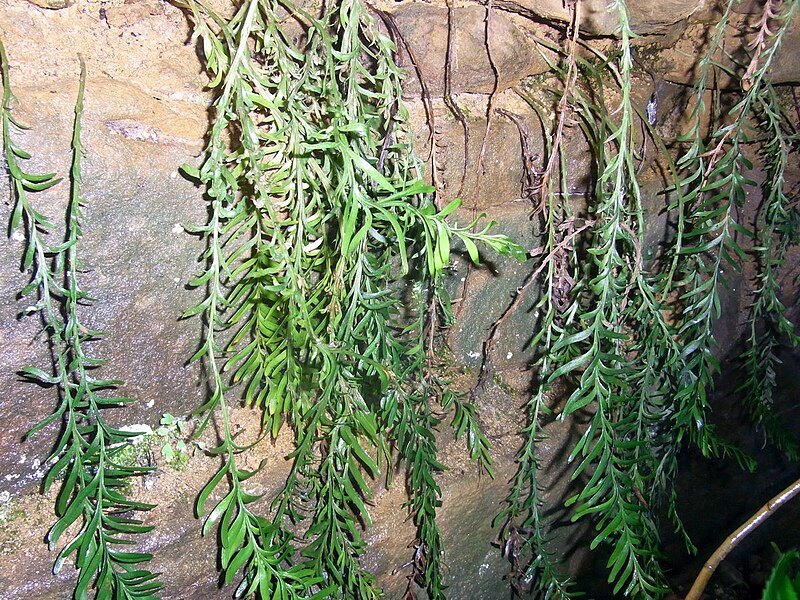
This image of Tmesipteris truncata by Peter Woodard is used under the Creative Commons Attribution-Share Alike 3.0 Unported license.
There are record breakers in the natural world for every category of ‘achievement’, and for every group of living things, e.g., longest, tallest, shortest, oldest, etc.. As you should expect, here at Cuttings HQ our focus is upon plants (plus algae photosynthetic protistans, and cyanobacteria (and fungi). So, that’s what we’ll stick to in this post. And in particular the genome.
What is the genome?
The genome* is the technical name for “all the genetic information of an organism”**, or simply “an organism’s complete set of genetic material”. As something that can be measured, genome size can be compared between organisms, e.g. to find out which lifeform has the biggest (or smallest). Well, not that us Botanists would ever wish to brag, or gloat, or do anything so impolite, but we have BIG news to share on the genome size front.
Record-breaking fork fern genome
In a scientific article, Pol Fernández et al. (2024) announce their finding of the largest known genome for a eukaryotic (Nicole Gleichmann) organism***. Rightly proud of their finding, the paper is entitled, “A 160 Gbp fork fern genome shatters size record for eukaryotes”. Even if a little ‘sensationalist’ in tone, that title actually understates the true genome size of 160.45 Gbp [Gbp is the abbreviation for a billion base pairs, and is one of the units in which genome size is recorded and reported]****, *****, ******. Putting that into some sort of context, the fork fern contains “more than 100 metres of unravelled DNA”, which is “over 50 times more DNA than humans”.
The fork fern concerned is the ‘hanging fork fern’, Tmesipteris oblanceolata ssp. linearifolia (aka T. truncata),from New Caledonia, a “French unique collectivity in the southwestern Pacific Ocean, about 900 miles (1,500 km) east of Australia” (DL Shineberg & Sophie Foster).
Whilst this finding is a cause for celebration amongst plant-lovers, it’s another – and major – blow to the esteem with which the Animal kingdom is held by those animal lovers out there. Why? Because not only is Tmesipteris oblanceolata’s genome the biggest plant genome, it’s the biggest so far found for any eukaryotic organisms – which category includes algae, protozoa, fungi and animals. For good measure, it’s worth stating that this fork fern – currently(!) – holds three official World Records – as recognised by Guinness World Records Ltd: largest genome; largest plant genome*******; and largest fern genome********. [So, Plants 1: Animals 0, methinks…]
Record-breaking fern genome is even bigger(!)
Although most sites I looked at for this piece define the genome in terms of the DNA within the nucleus [see *], that is not the only location within a eukaryotic cell that contains DNA. Mitochondria have their own complement of DNA (Ed Miller). Some sources recognise this – quite rightly and correctly – in their definition of the genome, e.g., in animals, the genome has two distinct parts, nuclear plus mitochondrial. Chloroplasts also have their own DNA (as do other members of the plastid family of organelles (Bruce Alberts et al.)).
Therefore, by analogy to animals, the full plant genome consists of nuclear, mitochondrial, and plastid DNA. The genome value explicitly stated in the fork fern scientific paper is shown as 160.45 Gbp/1C (Fernández et al., 2024). Expressed in this way, the genome relates specifically to the DNA in the cell’s nucleus-residing chromosome component because “1C = nuclear DNA content in a gametic nucleus” (Fernández et al., 2024) (Natasha Ramroop Singh; Ross Hardson; Todd Nickle & Isabelle Barrette-Ng).
If the totality of the fork fern cell’s genome – i.e. the DNA within the nucleus, mitochondria, and plastid(s) – were considered together, it would be bigger than 160.45 Gbp (although, admittedly, probably not by much more…). But, …
… is bigger better..?
More DNA doesn’t necessarily mean a better organism. As stated by Ilya Leitch (one of the hanging fork fern paper’s co-authors) here, “We know that genome size impacts several processes. For example, plants with large genomes take longer to replicate their DNA and divide their cells, and are restricted to having bigger cells which result in lower rates of photosynthesis and altered patterns of water use efficiency. This means that plants with big genomes are slow growing and are long lived. They may also be less efficient in putting on biomass or responding to water stress than species with smaller genomes. Thus, it might not be surprising that species with giant genomes are frequently found among critically endangered plants, in part due to their more limited ability to adapt to changing environments compared with species with smaller genomes”. So, seemingly, the largest genome comes with some down-sides (or, ‘every silver-lining has a cloud’ (Gary Martin)..?).
What’s next?
Well, a new fern has just been announced by Cheng-Wei Chen et al. (2024), Haplopteris palustris, from Western Malesia. One wonders what will its genome size be? But, before that, why not stick with the tried-and-tested genus Tmesipteris, “an understudied group of plants consisting of about 15 species”? The genomes of two other Tmesipteris species that have been studied – T. tannensis and T. obliqua (the long fork-fern) – also contain gigantic genomes, at 73.19 and 147.29 gigabase pairs (Gbp), respectively [although T. obliqua‘s was reported as 150.61 Gbp in Oriane Hidalgo et al. (2017).] Surely, you’d now want to examine the other 12 Tmesipteris species to see if the genome size of one of those is even greater than T. oblanceolata ssp. linearifolia (T. truncata)’s..?
* Naïvely, I assumed that getting a definition for ‘genome’ would be quite straightforward, just a few keystrokes on the interweb. But, no! Researching this post I’ve realised there are several – and occasionally – contradictory definitions of genome in hyperspace/existence. For example, this from the scitable section of the Nature science journal site, “A genome is the complete set of genetic information in an organism”. Which seems fine, until you then read that “the genome is stored in long molecules of DNA called chromosomes”, which implies just the DNA that’s within the nucleus. That interpretation is confirmed with further elaboration from the same source that “In eukaryotes, each cell’s genome is contained within a membrane-bound structure called the nucleus”. Nowhere in that ‘scitable’ definition does it mention that there is also DNA within mitochondria and plastids, which omission somewhat undermines the ‘citability’ of that source.
The BBC is quite explicit – and clear [NB, I didn’t say correct] – in telling us that “The genome is the entire genetic material of an organism. It is found in the nucleus of a cell, and is composed of a chemical called DNA”. It provides further clarification with “Genetic material for eukaryotes is in their nucleus”. But, it then rather spoils that neat definition by further defining the term genome within that definition as “the complete set of DNA found in an organism“, which will therefore include the DNA within the mitochondria, and the plastids if the cell has any.
Gabrielle Beer for Cancer Research UK defines a genome as “an organism’s complete set of DNA”. Whilst being clear that it’s the totality of the organism’s DNA that’s considered, it isn’t explicit as to whether that ‘totality’ does or doesn’t include mitochondrial DNA. And that ambiguity is maintained when Beer goes on to talk about the DNA being organised into chromosomes, without mentioning the nucleus or mitochondria. Always nice to see consistency – even if it perpetuates a certain ‘vagueness’. Interestingly, a hyperlink on the word ‘genome’ in Beer’s item takes us to the human genome chapter of the 2nd edition of Genomes by TA Brown which defines genome in its key words section as “The entire genetic complement of a living organism”.
A much better – although human animal-biased – definition is that provided by the Director of the USA’s National Human Genome Research Institute (NHGRI), “The genome is the entire set of DNA instructions found in a cell. In humans, the genome consists of 23 pairs of chromosomes located in the cell’s nucleus, as well as a small chromosome in the cell’s mitochondria” (Eric Green). This definition is also to be found in the article by Ed Miller for NHS England’s National genomics education Programme, but which you need to piece together from separate statements: “A genome is an organism’s complete set of genetic material”, “In organisms known as eukaryotes (which includes humans, other mammals, plants and fungi), most of the genome is found in the nucleus of the cell”, and “These structures [mitochondria] also contain a small amount of DNA, which forms less than 0.0005% of the total genome, about 16 thousand base pairs. Although it is only a small part of the genome, it is essential: without a functional mitochondrial genome, the cell will die”. Or, and nicely succinct (and from another source), “The human genome, like all other cellular life forms, consists of DNA and includes both the nuclear and mitochondrial DNA“.
Well, we got there in the end (if rather animal-biased), why is it seemingly so difficult to get a clear, unambiguous, definition of ‘genome’?
** Although, and somewhat inconsistently, in the ‘introduction to genetics’ page at that same source – Wikipedia – genome is defined as “The complete set of genes in a particular organism”. The DNA within the genome – however it’s defined in* – contains a lot more than just the DNA in the genes, e.g., “The genome contains both genes that provide the instructions for producing proteins (about 2% of the genome) and sequences that do not directly code for proteins (about 98% of the genome), often termed ‘non-coding’” (Ed Miller). And, see Leitch here on the ‘mysterious DNA’ in a plant genome.
*** Unsurprisingly, this news has been widely covered in both the ‘normal’ press and amongst the science news reporting community. For more articles about this discovery, see here, here, Andy Corbley, Carmen Leitch, Rox Middleton et al., Amanda Schupak, Vishwam Sankaram, Helen Briggs, Max Kozlov, Michael LePage, Eleanor Higgs, Daniel Lawler, here, here, and here. And for a video about the discovery, featuring commentary by Ilia Leitch, see here.
**** Gbp is ‘case-sensitive’, and shouldn’t be shown as GBP, which is the abbreviation for Great British Pounds, i.e. the currency of pounds sterling used in the United Kingdom/Great Britain (Will Kenton).
***** NB, this is just the mass of DNA, it’s not the assembled DNA sequence, i.e. the identity and order of all of the bases along the full length of the DNA that comprise the genome. The accolade for the largest assembled plant genome goes to Viscum album (European mistletoe) and its 94 Gbp [which comfortably beats the largest animal genome assembled, the puny-in-comparison 43 Gbp of the Australian lungfish (Neoceratodus forsteri)]. [I now make that Plants 2: Animals 0, not that I’m keeping any kind of score(!).]
****** Helpfully, and interestingly, on video [here], Ilya Leitch (one of the forked fern genome paper’s co-authors) takes pains to tell us that the unravelled fork fern’s DNA would be over 100 metres long, which exceeds the height of the tower that houses the bell known as Big Ben, or “when unravelled, the DNA from each cell of this fern would stand taller than the Elizabeth Tower in Westminster, London, which is 96m tall and home to the world-famous Big Ben bell” as stated on-line. Mr P Cuttings wonders if this more careful wording is in response to comments raised when Leitch previously said that the unravelled DNA of Paris japonica is “so large that when stretched out it would be taller than Big Ben”. Unfortunately, in common usage, the name Big Ben is usually used when people actually mean the Elizabeth Tower, the iconic clock tower that houses Big Ben. In fairness, 100 m of DNA would still be taller than Big Ben because the bell with that name is only 2.2 m high, but that’s not such an impressive ‘statistic’.
Another useful ‘metric’ – for those who are familiar with iconic structures within the grounds of Kew Royal Botanic Gardens – is that the unwound DNA from one cell of P. japonica, “would be 100 m long, twice the height of the Pagoda at Kew” (Leitch) (as would that from one cell of the fork fern…). And, for the benefit of North American readers, I’m told that 100 m (328 ft) is greater than the height of the Statue of Liberty.
******* The previous largest plant genome record holder was Paris japonica (canopy plant), whose genome weighed in at a still-impressive 152.23 pg (pg is the abbreviation for the unit of mass known as a picogram, each of which is one-trillionth of a gram – 10-14 kilogram, i.e., a vanishingly-small amount – and is another way in which genomes are measured) (Jaume Pellicer et al., 2010).
Converting that pg value to base-pairs – another genome size unit, and the one used for the forked fern in the main part of the post above, that mass of DNA equates to “about 150 billion base pairs”, or 148.8 billion base pairs (Alison Cranage), or 148.89 Gbp (Gbp is the abbreviation for a billion base pairs) (Pol Fernández et al., 2024).
For those of you who like a conversion factor, there are 978 Mbp [or, 0.978 Gbp] in a picogram.
******** Whilst on the subject of largest genomes, some readers may recall the enormous genome size attributed to the amazingly-named amoeba (Aparna Vidyasagar & Scott Dutfield, Polychaos dubium. At a reported value of 670 Gbp (Kat Arney), or 640 Gbp (Anna Perman), it was hailed as the largest genome known at the time of its announcement in 1968 based on data by Carl Friz (1968).
However, serious concerns have now been raised about the accuracy of that measurement because of the methodology used: “The method uses whole cells rather than isolated nuclei and will therefore also include not only DNA from other parts of the cell outside the nucleus (i.e. the mitochondria) but also any DNA in engulfed food organisms which the Amoeba eat. Also some of the species are multinucleate (i.e. they have more than one nucleus per cell)”. Taking that uncertainty into account, it is suggested that the true value of that organism’s genome is more likely to be 67 Gbp.
But, a higher-numbered entry – No. 117342 (cf. No. 104470, which gives the value at 67Gbp) – and which is presumably therefore a more recently-added item (and which you’d expect to be more up-to-date), on the database at the Bionumbers site, shows a genome size of 1369 Gbp for the amoeba. Mr P Cuttings is therefore left wondering what the true genome size of Polychaos dubium/Amoeba dubia is. It’s all a little dubious and chaotic. Could somebody just measure the organism’s genome using 21st century methodology and resolve the issue? Please…
REFERENCES
[In an attempt to improve narrative flow, fuller citations for scientific articles have been removed from the text above to this new section [thank you, Chris!] – do let me know if this move helps readability.]
Cheng-Wei Chen et al., Systematic Botany 49: 227-235, 2024; doi: https://doi.org/10.1600/036364424X17110457048659
Pol Fernández et al., iScience (2024), https://doi.org/10.1016/j.isci.2024.109889
Carl Friz, Comp Biochem Physiol. 26(1): 81-90, 1968; doi: 10.1016/0010-406x(68)90314-9
Oriane Hidalgo et al., Botanical Journal of the Linnean Society 183: 509–514, 2017; https://doi.org/10.1093/botlinnean/box003
Jaume Pellicer et al., Botanical Journal of the Linnean Society 164: 10–15, 2010; https://doi.org/10.1111/j.1095-8339.2010.01072.x
 Plant Cuttings

Leave a comment