
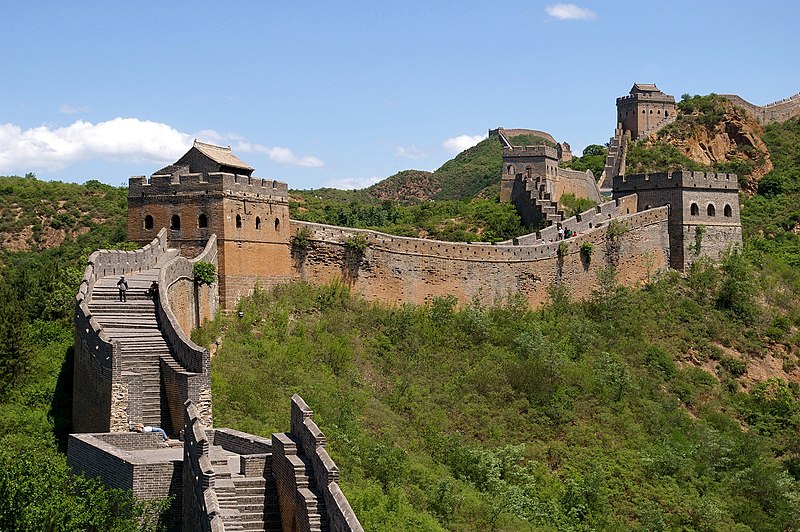
This image, entitled “Great Wall of China near Jinshanling” by Jakub Hałun is used under the Creative Commons Attribution-Share Alike 3.0 Unported license.
There is a saying in English, “a rolling stone gathers no moss” (Anna Matteo]). That may be true. What is definitely true is that a standing stone [not a standing stone (Ben Johnson), but one that is stationary (Katie Leamon) – i.e. standing still – as part of a larger stone-built structure] does. And that truism has been demonstrated on a big scale at the Great Wall of China [GWC](Kelly Pang).
Or, so I thought, given my presumption – from pictures I’d seen of the GWC [e.g. the image above] – which looked like it was a solid, stone-built structure, and the headline “From China’s Great Wall to ancient Maya, how moss protects structures” from Holly Chik’s article]. Reading in more depth – i.e. looking beyond the attention-grabbing headline of a story about a piece of scientific work – the situation becomes a little more complicated. Chik’s scicomm piece reports on the work of Yousong Cao et al. (Science Advances 9, eadk5892 (2023); https://doi.org/10.1126/sciadv.adk5892)*. The title of Cao et al’s scientific paper is “Biocrusts protect the Great Wall of China from erosion”. So, no ‘bigging-up‘ (Jim Pettiward) of moss from that, but a mention of ‘biocrusts’. And, when one reads the article it becomes clear that Cao et al‘s study examines specifically stretches of the GWC that are made not from stone, but from ‘rammed earth’. Both of which revelations – biological and constructional – not only rather ruin my opening words to this blog piece (and undermine the first foot-note), but also require some explanation.
The rammed earth construction method “involves mixing wet soil, gravel, clay, and organic material and ramming this mixture into a frame or mold. Once it hardens, the compressed aggregate forms solid structures” (Isabella Thornton). A biocrust (Bettina Weber et al., Biol. Rev. 97: 1768–1785, 2022; doi: 10.1111/brv.12862) – shorthand for ‘biological soil crust’ – is a soil surface-located biological community which can consist of mosses, cyanobacteria, lichens, algae, and microfungi, and strongly interacts with the soil. So, despite the amount of soil compaction that presumably accompanied its ‘ramming’, the material was still sufficiently soil-like for biocrusts to develop on appropriate parts of the GWC.
Cao et al. report that cyanobacteria and moss biocrusts covered over 67% of surface of the >600 km stretch of the GWC that they studied. Tychonema was the dominant genus in the cyanobacterial biocrusts. The moss-dominated biocrusts were dominated by genera such as Didymodon and Barbula. Lichen biocrusts – with Cladonia phyllophora and an Ochrolechia sp. – were also found occasionally.
Although it’s a common, and widely-held, belief that plants attached to the outside of buildings and walls damage the structure to which they adhere**, the opposite appeared to be the case with the GWC biocrusts. When comparing biocrust-covered wall with bare rammed earth, the team found that biocrusts enhanced the mechanical stability of the GWC and reduced its tendency to be eroded. The protective effect of biocrusts*** differed in different parts of the wall because of such factors as differences in composition of the biocrust, and climatic conditions, e.g. cyanobacterial biocrusts were dominant in arid climates, and moss biocrusts throve (Gemma Stoyle) in wetter semiarid climates.
Overall, the work “highlights the fundamental importance of biocrusts as a nature-based intervention to the conservation of the Great Wall, protecting this monumental heritage from erosion” (Cao et al., 2023). Learning that some of the smallest photosynthetic organisms on the planet can help to protect one of the biggest man-made structures on Earth is somewhat reassuring. Plus, I’ve also learnt not to believe everything I read in a headline – and definitely not to frame a blog item just around it(!)
* For scicomm takes on Cao et al’s GWC work, see articles by James Woodford, Sarah Kuta, Ayurella Horn-Muller, Isabella Thornton, Mike McRae, and here.
** For more on wall-damaging vegetation, see here, here, here, here, here, and AK Mishra et al. (Science of The Total Environment 167: 375-392, 1995; https://doi.org/10.1016/0048-9697(95)04597-T).
*** If biocrusts aren’t enough plant biology for you [and why should they be?!?], there’s another botanical dimension to the GWC. Robert Patalano et al. (Sci Rep 12, 22517 (2022);. https://doi.org/10.1038/s41598-022-27071-4) report the incorporation of fascines of an unspecified common reed (Phragmites sp.), and wood bundles interbedded with gravel-mixed rammed earth into some of the more ancient sections of the GWC. Plants potentially protecting this structure both internally and externally.

 Plant Cuttings

Leave a comment