
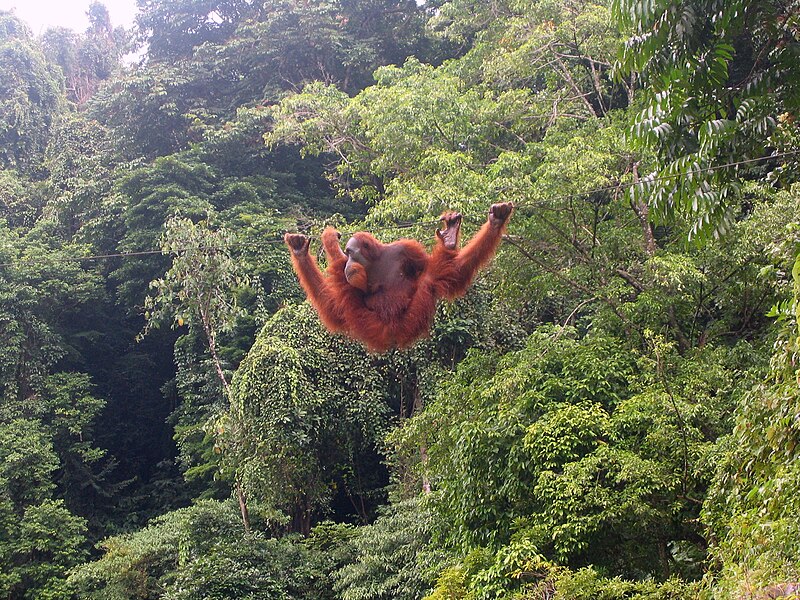
This image of an orangutan In Bukit Lawang, Nord Sumatra, by Thorsten Bachner is in the public domain.
It’s a long-established principle of ethnobotany that if you want to know how forest resources are used you work with the people who live in those environments and who use those resources. For example, if you are interested in understanding the medical potential of tropical rainforest plants, your best course of action is to interview the indigenous human population who have intimate experience of the local flora. And that approach has been [very] successful in identifying such medicinally-important plants as curare/turbocuarine (Jackie Holland), vinblastine, and quinine (Jackie Holland). In addition to human forest-dwellers, we may now need to add another primate (Beth Blaxland) as a source of insights into plants with pharmaceutical potential.
Work by Isabelle Laumer et al.(Sci Rep 14, 8932 (2024); https://doi.org/10.1038/s41598-024-58988-7)* documents use of a plant to treat a face wound by an orangutan. What they observed was a male Sumatran orangutan (Pongo abelii) (Kelle Urban) chewing leaves of a liana, Fibraurea tinctoria), and repeatedly applying the resulting juice onto a facial wound. As a final step, the wound was covered with the chewed leaves. The wound didn’t appear to get infected, and, within a month, “the wound appeared to have fully healed and only a faint scar remained” (Laumer et al., 2024).
The plant is used by humans in treating such conditions as dysentery, diabetes (Indah Purwaningsih et al., Molecules 2023, 28, 1294; https://doi.org/10.3390/molecules28031294), malaria (Ika Fikriah & Endang Sawitri, Systematic Review Pharmacy 11(6): 380-383, 2020; doi: 10.31838/srp.2020.6.60), and gonorrhoea, food poisoning, eye related diseases, diarrhoea, enteritis, vaginomycosis, furunculosis, burns, hepatopathy, nose ulcers, insect bites, snakebites, eye infection, joint pain, rheumatic & body pain, hypertension, sinus problems, fever, cancer and headache (Fauziah Abu Bakar et al., Malaysian Forester 86(1): 125-152, 2023). Amongst its many chemical constituents, the plant contains jatrorrhizine, which “exhibits anti-diabetic, antimicrobial, antiprotozoal, anticancer, anti-obesity and hypolipidemic properties, along with central nervous system activities and other beneficial activity” (Furong Zhong et al. (2022) Front. Pharmacol. 12:783127; doi: 10.3389/fphar.2021.783127). Furthermore, it also has anti-microbial activity (Savithri Galappathie et al., Journal of Herbal Medicine 4(2): 96-105, 2014; https://doi.org/10.1016/j.hermed.2014.03.001). Which impressive catalogue of medicinal emphasises the presence of biologically-active compounds within the plant.
Mindful of the caution that is required in claiming that non-human species deliberately engage in acts of ‘self-medication’, Laumer et al. (2024) explain their reasoning for considering the observed behaviour to be intentional. As a result of which careful consideration they conclude that “Taken together, chemical analyzes [sic., presumably this should be ‘analyses’] of the properties of the Fibraurea tinctoria and the orangutan’s particular goal-oriented behavior are consistent with the hypothesis that the process of preparing and applying herbal ointments may be a form of self-medication that reduces pain, prevents inflammation, and accelerates wound healing”. And, furthermore, “This possibly innovative behavior presents the first systematically documented case of active wound treatment with a plant species know [sic., assumed to be ‘known’] to contain biologically active substances by a wild animal and provides new insights into the origins of human wound care”.
Although the plant used in this instance is already well-known for its use in traditional medicine amongst humans, the observation of its use by an orangutan opens the possibility of identifying plants with medicinal potential – that are currently unknown to humans – by paying closer attention to the behaviour of other great apes such as gorillas, and chimpanzees. We can probably learn a lot from our evolutionarily-closest relatives. In which regard, it’s probably no coincidence that the word orangutan translates to ‘person of the forest (Alina Bachmann, Eric DePalma) or ‘human of the forest’ in English. And, there are even suggestions that another translation of the name is ‘wise men of the forest’, or ‘wise old man of the forest‘. Recognising – and learning from – the ‘wisdom’ of the orangutan in this medicinal plant instance is probably no bad thing. However, whether there is any wisdom in gifting orangutans to palm oil trading nations is quite another thing.
* For more insights into this orangutan self-medication story, see articles by Kermit Pattison, Christian Thorsberg, and Georgina Rannard. And for insights into why this self-medication story from 2024 isn’t that new – and the phenomenon known as zoopharmacognosy – see the article by Adrienne Mayor here, and here.


 Plant Cuttings

Leave a comment