
Things to do with plants: 50 ways to connect with the botanical world by Emma Crawforth, 2023. Kew Publishing.
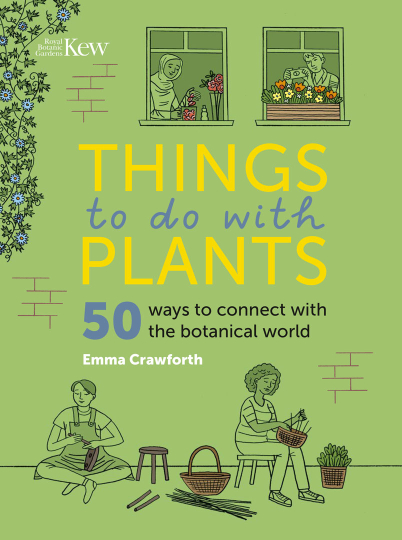
Plant blindness* is the name given to the phenomenon whereby people don’t appreciate the importance of plants to people, and/or fail to see plants in their environment (e.g. here, and here). In highlighting the issue, many words have been written (e.g. Carly Cowell, Christine Ro, and Jon Moses) – and spoken (e.g. Benedict Furness, Bethan Stagg) – about plant blindness. I’ve contributed my own thoughts on plant blindness (e.g. here, and here) – and this blog site is focused on “reducing plant blindness, one post at a time”. Writing and talking about an issue is one thing. Actually doing something about it is quite another, and many of us are happy just to wait for the necessary impetus and motivation before actually doing anything about it. Well, that wait is now over as Emma Crawforth’s book Things to do with plants [which tome is here appraised] presents 50 practical “ways to connect with the botanical world” (as the book’s sub-title usefully tells us).
What I liked about the book
The book begins with a great 1st sentence: “we all have a relationship with plants…” (p. 6). And, we do, whether we realise it or not. And, recognising that many people don’t realise – or appreciate – this fact, Crawforth mentions the problem of plant blindness almost immediately – in the book’s 2nd paragraph (p. 6). And that sets the agenda for Things to do with plants, which is filled with achievable, eco-friendly, plant-appreciative ideas.
The 50 things to do are spread over seven sections: Save the world; Build a community; Clothe and comfort; Green up a garden; Stimulate and soothe mind and body; Supply the kitchen; and Inspire creativity. Each section is divided into several, fact-filled ‘micro-essays’ with titles [which actually read like instructions] such as: Grow protein; Increase property values; Reduce noise; Dye cloth; Make compost; Build a den; Meditate; Smoke food; Wrap food; and Make rope and cordage. The layout of each of those items is similar, they start with context to the activity discussed, and then provide practical examples of things one can do to improve one’s awareness and appreciation of plants. Pleasingly, most of the suggestions are fairly easily achieved (but few as easily achievable as buying wine sealed in bottles with proper corks as opposed to metal caps(!)).
Interestingly, the Solve crimes ‘chapter’ is probably the only one of the 50 that don’t give you an activity to undertake. But, that doesn’t mean that the book contains fewer than 50 ways to connect with the botanical world (the book’s sub-title) because some of the activities have umpteen permutations and/or combinations. For example, although Make a hot drink is a single ‘chapter’ and therefore one suggestion, for the tisane-making activity it considers there’s a list of >30 plants that could be tried. Similarly, under the exhortation to Increase property values, 13 ‘easy-maintenance shrubs’ are suggested to achieve the desired value-enhancement.
Not only does Crawforth have a pleasant, and relaxed writing style, which is full of information and interesting facts [but see What I didn’t like section], she also has good credentials for writing such a book. Having trained as a gardener and worked in public gardens, Emma undertook the Horticultural Diploma at the Royal Botanic Gardens, Kew. Whilst at Kew, she developed a love of communicating about the wonders of plants, and is currently the Gardening Editor of BBC Gardeners’ World Magazine. And both her enthusiasm for her subject and communicating that interest to others come over loud and clear throughout the book. Crawforth is a great ambassador for the joy that working with plants and plant products can bring.
What I didn’t like
I have only one major problem with the book; no sources are stated for any of the book’s – numerous – statements of fact. And that’s a great shame, because Crawforth provides many fascinating facts in the text [see What I learned section], each of which cries out for evidence. For example**, there being 390,900 species in the Plant Kingdom (p. 6), what appears to be a claim of the existence of photosynthetic animals (p. 13), the identity of the world’s largest individual plant (p. 15), naming the land to which Queen Hatshepsut of Egypt sent botanists in 1495 BCE as Somalia (p. 113), and the details of cork-harvesting (p. 127). Yes, there is a list of Further Reading (12 books and 22 web sites), but there is no way of telling if any of the book’s facts come from any of those sources.
Things to do with plants is concerned with changing people’s behaviour, so that they are more appreciative of plants. Effecting change in individuals who may be resistant to do things differently is hard. Winning over sceptics to the cause of botanical enlightenment is not easy. One way you can get them to change is to provide evidence of the need for – and/or benefits of – changing what they think and do. What better way to do that than to provide the necessary sources for statements made, to back them up with the ‘proof’? If you want everybody ‘singing from the same hymn sheet’, it’s a very good idea to give them the necessary ‘chapter and verse’. When trying to change people’s attitudes, and win their hearts and minds, you need to use all tools at your disposal. So, rather than undermining the book’s important message with lack of evidence, strengthen it – and make its arguments compelling – with inclusion of sources [something else to consider as an improvement for future editions – see Some suggestions for improvement section].
What I learned
Things to do with plants is packed full of fascinating ‘facts’ (subject to the necessary ‘fact-checking’ when one tracks down the sources…). Some of those I found most interesting were: hedges used as ‘sound barriers’ should be placed close to the source of the sound, not in the area to be protected (p. 45); [n the US city of Cleveland, each street is planted with its own species of tree (p. 49), which is not only beneficial for the environment, but also helps residents locate themselves (which is another clear example of ‘appreciation of plants’…); the importance – and notion – of ‘supermarket car park’ plants when revamping a garden prior to selling one’s house; cotton bed clothes can be composted; development of the cotton gin in America “is thought to have been a cause of the American Civil War”; so-called ‘guy roots’ are formed by wind-pruned trees; a “coating of cork compound protects spacecraft from the 1000 oC temperatures they are subjected to on lift-off and return to Earth”; and hemp rope was used by arborists as recently as the 1970s in the UK.
Some suggestions for improvement
Always keen to help where I can, I offer some suggestions of ways in which a revised version of the book can be improved.
The book’s numerous illustrations largely improve it. But, there are a few instances where they raise more questions than provide answers. For example, there is an untitled picture of what looks like a carrot flower head, next to a named image of marram and a mangrove species (p. 21). What is the carrot supposed to represent in this Stabilise soil item? Similarly, there is a quartet of plant images on p. 117, and a full-size picture – of chard? – on p. 122 without captions. Another moment that made this reviewer smile was the photomicrograph on p. 57 showing a cross section of a plant stem. Since the image’s caption tells us how cross sections of plant stems under the microscope reveal features from which a species can be identified, omission of the plant’s name was a little ironic. Although the alterations required may be ‘legendary’, they are easily sorted for the next edition.
There is some inconsistency in the presentation of scientific names. More often than not they are correctly shown, with both words italicised and the first letter of the genus capitalised. However, in a few places they are shown unitalicized and all in upper case, e.g. ACER PLATANOIDES (p. 49), ACER CAMPESTRE (p. 49), GOSSYPIUM HERBACEUM (p. 71). Again, something that’s easily fixed.
I only spotted one error in the text. On p. 142 we are told that “in the newest wood (sapwood), are the vertical vessels that transport food and water to its canopy”. Whilst that statement is fine regarding water transport – in the vertically-oriented xylem vessels, food [the products of photosynthesis] is transported in the phloem, which tissue is not part of the sapwood (which is part of the xylem). A mis-statement that is easily corrected.
The book includes recipes for beetroot pudding and carrot flan, which, we are told by Crawforth, were ‘ration-book, wartime favourites‘. Presumably that’s a reference to the Second World War and the ration-book issued by the UK government. But, it might be better if that’s explicitly stated so that non-UK readers can get the full benefit of the information.
Crawforth is a little dismissive in talking about herbarium specimens, which “are not arranged to show their beauty but so that people studying them can count their plant parts and measure them” (p. 153). I’m sure there are many more uses of herbarium specimens than that, which is worth expanding upon in future.
The challenge of plant blindness
In demonstrating how individuals can help to combat plant blindness – their own, and that of others with whom they interact and maybe talk about the plant-based things they’re doing – Things to do with plants is an important book. But, there is always a danger with books such as this, that they are only read by those who are already plant-appreciative. Arguably, those members of the public don’t really need to hear the message that Crawforth provides, i.e. you are ‘preaching to the converted’ [although it never hurts to be reminded of the relevance of plants]. But, if this book inspires even plant-aware individuals to engage in more plant-related activities, the act of practising what Crawforth is preaching may act as a practical example that can be followed by those who haven’t – and maybe wouldn’t normally – read the book. All plant-appreciative individuals can be – should be – evangelists for the cause. Crawforth has provided the book and the ideas. It’s up to use the spread the word by deeds. So, unless this book is widely circulated and read – or, rather, the 50+ activities it showcases are promoted and undertaken, then it won’t make the change in the public’s appreciation of plants that is necessary. I’m hoping I’m doing my little bit to make the book more widely known in this blog piece.
Summary
Despite its lack of sources, Emma Crawforth’s Things to do with plants: 50 ways to connect with the botanical world is a valuable book in providing excellent suggestions of ways in which people can engage more directly with plants. By doing as many – or just any – of the 50 things as possible, this can only enhance one’s appreciation of plants, which will reduce plant blindness amongst those who engage with the book’s suggestions. Plus, undertaking any of the activities covered by Crawforth will help plants, which will benefit the planet, and therefore people. The next step – and the real challenge – is to get Crawforth’s ideas to those who don’t read the book. So, what are you waiting for? Go forth and spread the word.
* Or plant awareness disparity (PAD) as it has been renamed by Kathryn Parsley (Plants People Planet 2(6): 598-601, 2020; https://doi.org/10.1002/ppp3.10153).
** The palo verde tree – whose DNA famously features in convicting the perpetrator of a notorious murder in USA – is confidently named as Parkinsonia florida by Crawforth on p. 56. Recalling the problems I had in trying to pin down its scientific name in my blog piece about this forensic botany case, I’m particularly keen to know Crawforth’s source for her statement.
Tags: botany, plants, plant blindness, plant awareness disparity (PAD), Kathryn Parsley, Bethan Stagg, Benedict Furness, Emma Crawforth, Things to do with plants, practical botany, palo verde, Carly Cowell, Christine Ro, Jon Moses,
 Plant Cuttings
Leave a comment