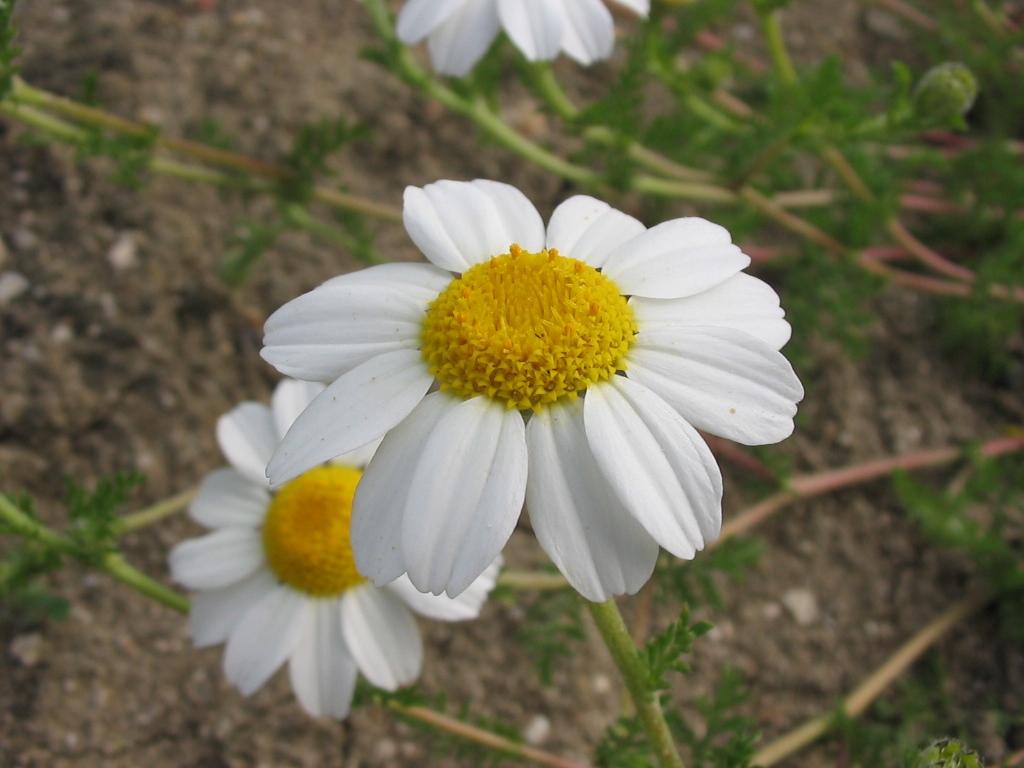
This image of Anacyclus clavatus is made available under the Creative Commons Attribution-Share Alike 3.0 Unported license.
Plants – like any other lifeforms – are vulnerable at many stages of their life cycle. Arguably, one of the most dangerous times is germination (Melissa Ha et al.; John Heslop-Harrison; Louise Placek). If a seed germinates, the plant has a chance of growing, developing and surviving to reproduce. If it doesn’t germinate, then there will be no plant (but, instead, a supply of organic materials that will nourish other living beings such as fungi, bacteria, and animals, as part of some greater cycle/circle of life).
But, back to germination. And assumptions about structure-and-function – and a cautionary tale about the need not to stop looking for true function when a plausible one has been proposed. Which brings us to Anacyclus clavatus [also known as white buttons], and the study by Rubén Torices et al. (American Journal of Botany 111 January 2024 e16272; https://doi.org/10.1002/ajb2.16272).
The fruits of white buttons – which are technically known as achenes (Lizzie Harper) – bear “lateral membranous expansions” [LMEs], otherwise known as ‘wings’ [see image below],
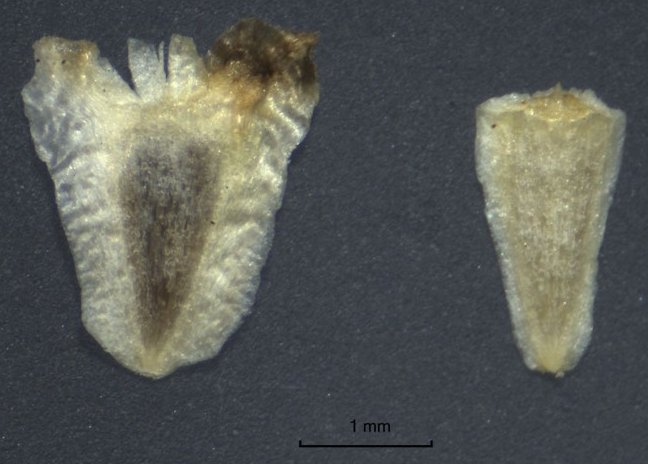
Image of ‘winged’ (on left) and unwinged fruits of white buttons borrowed from Rubén Torices et al. (American Journal of Botany 111 January 2024 e16272; https://doi.org/10.1002/ajb2.16272).
and, as for other so-called winged fruits, these structures have long been presumed to help in their dispersal by wind away from the parent plant (Steven Manchester & Elizabeth O’Leary, Bot. Rev. 76: 1–82, 2010; https://doi.org/10.1007/s12229-010-9041-0). Indeed, naming these structures ‘wings’ serves to reinforce the notion that their role is to provide lift to enable the fruits to be dispersed by air currents*. This functional interpretation is reinforced by the knowledge that white buttons produces two types of fruits – winged, and unwinged (Ana Afonso et al., American Journal of Botany 101: 892-898, 2014; https://doi.org/10.3732/ajb.1400030) [see image above]**. Being lighter than the winged variant, the unwinged achenes (Afonso et al., 2014) could be more readily blown around by the wind (or just fall and settle closer to the parent plant), whereas aerial dispersal of the heavier – winged – versions would be greatly assisted by their presence of ‘wings’.
Fortunately – because unquestioning acceptance of so-called ‘received wisdom’ closes the mind to other possibilities and is a barrier to progress and true understanding of natural phenomena [i.e. it is important to retain a degree of scepticism and to maintain an enquiring mind] – Torices et al. didn’t subscribe to the popular view of ‘wing’ function and decided to investigate. Specifically, and because winged fruits of white buttons typically have earlier seed germination than unwinged fruits (Afonso et al., 2014), Torices et al. hypothesized that the ‘wings’ could increase the contact surface with water, ultimately triggering earlier germination.
Whilst I would strongly encourage readers to access the full paper – available here at this Universidade de Coimbra site – the study showed that winged fruits absorbed more water, and at a faster rate than unwinged fruits, and the sealing of ‘wings’ with paraffin delayed germination. Which is consistent with a role in germination. However, germination time was not significantly altered by wing cutting. The intention of this surgery was to place winged fruits in the same situation as unwinged ones – which took up water and germinated slower than winged achenes. Although this wasn’t the expected outcome, this surprising result prompted further investigation of the internal structure of the fruits, and discovery of anatomical differences between the two types. Torices et al. concluded the summary of their study with appropriate caution in saying “Altogether, our results support the effect of ‘wings’ on germination and cast doubt on the unique role of ‘wings ‘in dispersal. Whether or not ‘wings’ contribute to dispersal, we propose that they also improve seed germination and seedling establishment by facilitating water absorption after the release from their mother plants”.
This charming, elegant, and unassuming study – and the way it is presented – has a number of fine features, which make it a very good example of how to report experimental studies. In particular, it sets out what was done and why in very straightforward language so readers can better understand and appreciate what was carried out. The paper’s Discussion section (Rowan Dunton]) also sets out the relevance of the results in a comprehensible way – and it’s refreshing not only to read the investigators’ surprise at the outcome of the wing-removal experiment, but also the way that unexpected result was interpreted [yes, this is a ‘teaser’, to encourage you to read the paper for yourselves…].
The authors conclude their Discussion with a note of caution about the names given to biological features: “Names for specific traits that suggest a particular function may sometimes be misleading regarding the actual roles of those traits”. Although one acknowledges that specific structures usually require specific names – to distinguish them from other features – appropriate care needs to be taken in naming them lest those names inadvertently reinforce erroneous notions of their function. Which is why ‘lateral membranous extensions’ is probably preferable to the term ‘wings’. [The proverb ‘you reap what you sow’ seems particularly apt in the case of ‘wings’ here.]
Overall, “Fruit wings accelerate germination in Anacyclus clavatus” [which is a nice, straightforward statement of a title] would make a very good example to use in teaching students how to set out a scientific paper – and how to carry out an hypothesis-driven investigation. It’s always nice to see science and its successful communication in a genuine scientific paper: Nice work, Rubén Torices et al.!
However, and as with all good investigations, it doesn’t necessarily provide the final word on the role of ‘wings’ and germination because “Despite the effect of wings in accelerating germination, the observed differences in seed germination times between winged and unwinged fruits cannot be exclusively attributed to the presence of wings [P Cuttings’ emphasis]. The delayed germination time and lower percentage of germination of seeds from unwinged fruits in our tests were likely also to be the consequence of dormancy variation between types of fruit morphologies”. In other words, the presence of ‘wings’ may be considered more a ‘marker’ of differences in other germination-relevant factors between the two fruit types than its explanation – but something that probably wouldn’t have been uncovered without the original investigation into the role of the ‘wings’. Nothing in biology is ever completely straightforward, but that’s part of the fun of finding-out(!)
Nevertheless, this appears to be a nice story about the economy of Nature, particularly its use of the ‘principle of parsimonious functionalisation of structure’ [which authentically-scientifically-sounding concept – and which shouldn’t be confused with Occam’s razor (Itamar Shatz), also known as the principle of parsimony (Alan Baker; Itamar Shatz) – may, or may not, be something that Mr P Cuttings has made up…] – possibly – in having two – or more – functions for the same structure.
* Fruit or seed dispersal by air currents or wind is an example of the phenomenon known as anemochory, which is alternatively called aerochory. For completeness, the movement of fruits or seeds from the parent simply by falling under gravity is technically termed gravichory. However, if the freed seed or fruit has a great distance to travel vertically to the ground it may be moved horizontally to some degree by air currents which would presumably be a hybrid gravi-aerochory.
** The phenomenon of possessing at least two different types of seeds is known as hererocarpy, and white buttons is therefore heterocarpic.


 Plant Cuttings

Leave a comment