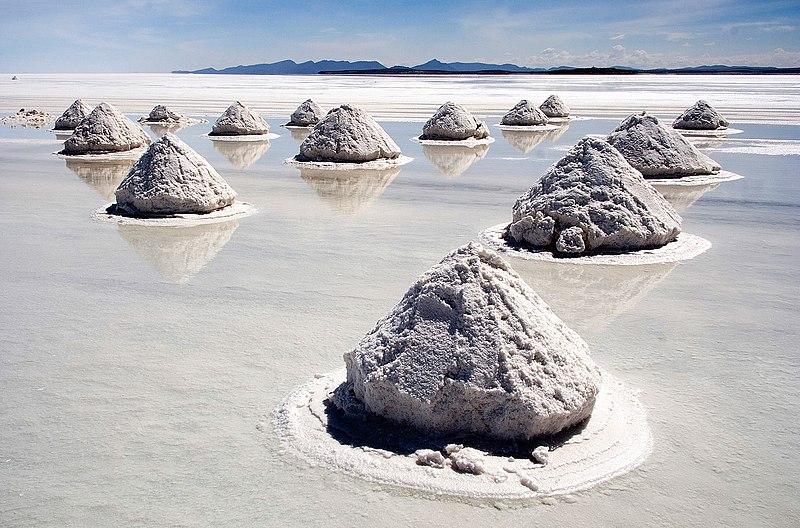
This image of salt mounds in Salar de Uyuni (Bolivia) by Luca Galuzzi is provided under the Creative Commons Attribution-Share Alike 2.5 Generic license.
It was a pretty wet end to 2023, and a very damp start to 2024 in my neck of the woods. It’s therefore not too surprising that my attention has turned to plants and water for my first Cutting of the new year. To give this post a bit of a philosophical twist, as is appropriate at this reflective time when we pause to consider the old year and the possibilities of the new one, the story covered is appropriately about re-evaluation, and re-assessment, and future opportunities. Accordingly, this post considers the exploitation potential of a plant behaviour that may have value for people in drought-stricken/water-deficient areas*.
Water is essential for plants – and all other life forms on Earth that we’re aware of. Acquiring it, using it appropriately, and not wasting it are activities that play a big part in the life of plants. Life for so-called mesic or mesophytic (MB Kirkham, 2005, Chapter 21 Leaf Anatomy and Leaf Elasticity, pp. 357-378. In: MB Kirkham (ed.), Principles of Soil and Plant Water Relations, Academic Press) plants living in areas where water is sufficiently plentiful, may seem reasonably stress-free (at least from the point of view of getting water). But, for plants living in drier areas – such as hot deserts – life can be more challenging. In such water-restrictive habitats, any behaviour or structural adaptation that plants can develop – and which gives them an edge in acquiring water over competing lifeforms – is to be welcomed. Plants living in such xeric environments – known as xerophytes** – have developed a number of adaptations that help in acquiring water, and retaining it. Such adaptations include: a thick cuticle; multiple epidermis; several layers of palisade cells between the epidermis and the spongy parenchyma; sunken stomata; and presence of hairs in stomatal pits (crypts) (e.g. here, here, and MB Kirkham, 2005).
However, if living and thriving – or merely just surviving – in such extreme places is impressive, it’s even more so for those few plants that live in areas where water is not only in (very) short supply, but where any water that’s present is salty, or saline. Whereas plants have very little difficulty in absorbing water that’s just water [‘pure’ water], they need special adaptations to enable them to take up water from a solution that contains salt(s), i.e. which is not just pure water. Plants with adaptations to that environment are called halophytes (Oliver Yorke; Timothy Flowers & Adele Muscolo, AoB PLANTS, Volume 7, 2015, plv020; https://doi.org/10.1093/aobpla/plv020)***. One strategy such specialist salt-tolerant plants have is to take up both water and the salts**** it contains. Because the salts are likely to harm the plant (Parul Parihar et al., Environ Sci Pollut Res 22: 4056–4075, 2015; https://doi.org/10.1007/s11356-014-3739-1; Mustafa Yildiz et al. (2021), Plant Responses to Salt Stress. IntechOpen; doi: 10.5772/intechopen.93920; Thuvaraki Balasubramaniam et al., Plants 2023, 12(12), 2253; https://doi.org/10.3390/plants12122253), in some cases they are expelled by the plant to leave the useful and now-safe water for its use. The surplus salts are released to the outside of the plant as a highly-concentrated salt solution. The water from that solution evaporates – loss of water during this process may be akin to water loss via transpiration (Melissa Petruzzello), and thereby probably cools the plant a little – to leave behind crystals of salts. These crystals may coat the exterior of the plant with a crust. In this way, not only have the excess salts been put somewhere where they can’t harm the inner workings of the plant, but the white salt coating may also act to reflect some of the sun’s heating wavelengths and keep the plant a little cooler than it would otherwise be (George Karabourniotis et al. (2021), Plants (Basel) 10(7): 1455; doi: 10.3390/plants10071455).
One such plant that lives in an arid, hypersaline environment, Tamarix aphylla, was the object of study by Marieh B Al-Handawi et al. (PNAS 120 (45) e2313134120; https://doi.org/10.1073/pnas.2313134120). It has been known for some time that this plant excretes a salt-rich solution (Wade Berry, American Journal of Botany 57: 1226-1230, 1970; https://doi.org/10.1002/j.1537-2197.1970.tb09928.x; WW Thomson et al., PNAS 63(2): 310-317, 1969; https://doi.org/10.1073/pnas.63.2.310; Yoav Waisel, Physiologia Plantarum 83: 506-510, 1991; https://doi.org/10.1111/j.1399-3054.1991.tb00127.x), crystals of which salts**** may coat the surface of the plant. Although Al-Handawi et al. investigated the tamarisk’s salt-coating their particular interest was in its capacity to absorb water from the atmosphere.
Analysing the salt solution on the surface of the plant, Al-Handawi et al. found it contained “at least ten common minerals”*****, with sodium chloride (common salt, NaCl) and gypsum (CaSO4·2H2O) the major components. Although silica (SiO2) and calcium carbonate (CaCO3) were also found, they were considered to be contaminants from the substrate in which the tamarisk was growing, rather than having been expelled by the plant [which view was corroborated by the observation that these minerals were “expectedly found in higher concentrations on windy days”]. Amongst the minor components in the salty solution was lithium sulphate. Whereas the larger crystals of salts, such as common salt and gypsum, readily fell off of the waxy cuticle, crystals of the lithium salt remained on the plant. And it was those crystals that exhibited the property of deliquescence (Abdel Hadrami; Anne Helmenstine)******, the ability of absorbing moisture from the surrounding atmosphere. This property was particularly evident during the night-time, when it is cooler and more humid than the daytime. And the effect was quite marked; of the 15.2 mg of water collected by a ‘crystallised’ branch in 2 hours, only 1.6 mg was due purely to condensation, i.e. deliquescence contributed the most. Is that biologically meaningful?
In the arid environment in which the plants grew, the capacity of this mineral to draw water out of the air might represent an additional mechanism – supplementing that derived from the ground via the roots – whereby the plant can obtain water. Rather than just state that as a possibility, Al-Handawi et al. (2023) tested this proposal. Accordingly, a solution containing fluorescent dye, the gloriously-named lucifer yellow (Carol Peterson et al., Canadian Journal of Botany 59: 618-625, 1981; https://doi.org/10.1139/b81-087; Menachem Hanani, Journal of Cellular and Molecular Medicine 16: 22-31, 2012; https://doi.org/10.1111/j.1582-4934.2011.01378.x; Magdalena Bederska et al., Symbiosis 58: 183–190, 2012; https://doi.org/10.1007/s13199-013-0221-7) [which is, somewhat ironically, a lithium salt ], was applied to leaves of the plant. The dye penetrated through the cuticle and into the palisade and spongy mesophyll cells of the leaf. Although foliar uptake was not observed in all cases [which is attributed to the varying leaf water potential and status…], this experiment does at least suggest that water on the outside of the leaf – from deliquescence – may be taken into the leaf, and supplement water taken up by the roots. At least one commentator, Maheshi Dassanayake at Louisiana State University is not convinced by the researchers’ evidence that the plant actually uses the water absorbed by the salt on its leaves (cited in James Dineen‘s sci-comm item about this study).
As interesting as this work is from the point of view of the plant’s water budget and issue of structure-and-function, it may also have important exploitation potential, as expressed in the last sentence of the paper’s abstract: “this natural mechanism for humidity harvesting that uses environmentally benign salts as moisture adsorbents could provide a bioinspired approach that complements the currently available water collection or cloud-seeding technologies” (Al-Handawi et al., 2023). And this possibility has been recognised by the Smithsonian Magazine which identified this study as one of seven scientific discoveries in 2023 that could lead to a new invention (Carlyn Kranking). Yet again, plants showing people the way to make this a better planet: Happy 2024!
* As the rain has persisted during the writing of this blog post, and the ground is becoming flooded, I wonder if a more appropriate topic might have been how plants cope with water-logging…
** Teaching tip: since the prefix ‘xero’ is essentially pronounced ‘zero’ it should remind students that there’s very little – not zero, but something approaching it – water in those habitats. Hopefully, that should give those who might need it a big clue to the technical term for such plants.
*** In penning this post I’ve learnt that there are three types of halophytes: “euhalophytes, pseudohalophytes, and recretohalophytes” according to Fang Yuan & Baoshan Wang (Adaptation of recretohalophytes to salinity, pp. 991-1011, 2021. In: Grigore, MN. (eds) Handbook of Halophytes. Springer, Cham. https://doi.org/10.1007/978-3-030-57635-6_32). “Recretohalophytes possesses structures for salt secretion, including salt glands and salt bladders, which actively excrete ions out of the plant and thereby avoid salt damage. These unique epidermal structures, which distinguish these plants from other halophytes and all non-halophytes, play a pivotal role in salinity resistance” (Yuan & Wang, 2021). Tamarix aphylla is a recretohalophyte.
Ever keen to improve one’s botanical literacy – in both senses of the word – some words on the derivation of the prefix ‘recreto-’ are appropriate. Waisel (1991) explains that “The term “recretion” is used to describe the removal of those ions that pass through the plant without being metabolized or changed (cf, Frey-Wyssling 1935)” [Frey-Wyssling, A, 1935, Die Stoffausscheidung der hoheren Pflanzen, Verlag von Julius Springer, Berlin]. As defined by JW Hes (Acta Botanica Neerlandica 7(2): 278–281, 1958; doi:10.1111/j.1438-8677.1958.tb00622.x), “Recretes are substances absorbed from the soil and eliminated without entering the system of assimilation”. And, “The substances entering may be given off again without change …. This we name recretion” (p. 55 in Geochemical Perspectives 11(1), April 2022, edited by Don Canfield). In other words, recretohalophytes expel the salty ions that they necessarily absorb alongside the water in the same state as they are absorbed from the soil through their salt glands. Which neatly gets us back to their characterisation in the article above by Yuan & Wang (2021). I trust that helps.
And, knowing how keen readers are to know more about blog item’s topics, I’m pleased to point you in the direction of the freely-available articles on halophytes by Fang Yuan & Bingying Wang (2016. Front. Plant Sci. 7:977; doi: 10.3389/fpls.2016.00977), and Maheshi Dassanayake & John Larkin (2017. Front. Plant Sci. 8:406; doi: 10.3389/fpls.2017.00406).
**** Teaching tip: salts plural is used because there are many types of salt (Anne Helmenstine; Kate Onissiphorou). When used without any qualification or context, salt can be assumed to mean common salt, sodium chloride (NaCl) (Chris Eboch). However, technically speaking, salt is the name given to any “electrically neutral chemical compound consisting of cations and anions connected by an ionic bond” (Anne Helmenstine). One way of making a simple salt is by chemical reaction – a neutralisation reaction – between an inorganic acid (Anne Helmenstine) and an inorganic base (or alkali). For example, when sodium hydroxide and hydrochloric acid react they produce water and the salt known as sodium chloride (Anne Helmenstine; Kate Onissiphorou). However, in the reaction between potassium hydroxide and sulphuric acid, the salt produced is potassium sulphate. I don’t know how much chemistry botany students have these days, but hope that this will help to provide them with a little, so that they will at least realise that not all salt is NaCl (and appreciate that saline habitats will usually have a mix of salts (Robert Byrne et al.; Anne Helmenstine) not just the halite that gives its name to halophytes*****). It’s also worth adding that all soils contain a mix of salts, but their concentration in soils of arid and semi-arid regions – such as the habitat for Tamarix aphylla – is a particular issue.
***** The minerals identified (and their percentage of the mix by mass) were: halite (NaCl, 81.0%), gypsum (CaSO4·2H2O, 3.5%), sylvite (KCl, 2.1%), calcite (CaCO3, 3.2%), quartz (SiO2, 2.6%), anhydrite, (CaSO4, 1.5%), syngenite (K2Ca(SO4)2·H2O, 1.5%), dolomite (CaMg(CO3)2, 2.5%), albite (AlNaSi3O8, 1.6%), and lithium sulfate (Li2SO4, 0.5%) (Al-Handawi et al., 2023). Halite, from the Ancient Greek – or Modern Latin – name for common salt, gives its name to the halophytes.
****** It should be noted that this deliquescence had previously been commented upon by Yoav Waisel (1991). He interpreted it as a mechanism that moistened the twigs thereby shortening the duration of transpiration (Todd Dawson & Gregory Goldsmith, New Phytologist 219: 1156-1169, 2018; https://doi.org/10.1111/nph.15307), which therefore reduced water loss by the plant*******. Curiously – and disappointingly because it certainly appears to be work that was worth noting – there is no mention of Waisel (1991)’s paper in the 2023 study by Al-Handawi et al. Why wasn’t it cited? Was Waisel’s work known about but deemed insufficiently noteworthy? Or, were Al-Handawi et al. not aware of that work? If the latter, one might wonder about the thoroughness with which the prior literature was searched. Although important questions are raised by this omission, their consideration is something for another place and time…
******* Amongst other proposals of a role for this salty exudate, Waisel (1991) had suggested it may act as a trap for CO2. Using radioactive carbon dioxide, he showed that atmospheric CO2 absorbed by the salty solution during the night is released during the early hours of daylight. This release of CO2 – along with that from respiration of the plant – increases the local ambient concentration of the gas enabling the plants to photosynthesize at their highest rates during the early morning hours. In this way Waisel envisaged that the salty solution acted as a carbon-concentrating mechanism (CCM). CCMs (Shailendra Singh et al. (2014). Carbon-Concentrating Mechanism, pp. 5-38. In: Photosynthetic Microorganisms. SpringerBriefs in Materials. Springer, Cham. https://doi.org/10.1007/978-3-319-09123-5_2) are better-known – and studied – in such organisms as algae and cyanobacteria (Justin Findinier & Arthur Grossman, Journal of Experimental Botany 74: 3402–3405, 2023; https://doi.org/10.1093/jxb/erad200, and CAM and C4 plants, where they are located within cells. However, and although those CCMs are arguably more biochemically-sophisticated than the phenomenon in Tamarix, its extracellular – and transitory and cyclically-present – variant seems worthy of that categorisation. By way of summary, Waisel (1991) proposed three functions for the salty exudate of Tamarix: removal of excess salts out of the twigs; provision of a cover of hygroscopic solutes that moistens the twigs and shortens the duration of transpiration; and providing the plants with an environment enriched in CO2.
Whilst on the subject of additional roles, it has not escaped Mr P Cuttings’ attention that the crystals that encrust the exterior of the plant – before they do so, for those that fall off, and particularly for those that remain attached – may act as a deterrent to would-be herbivores that might choose to nibble on the plant’s leaves or branches– if there are such plant-eaters in the area. In that way, it is suggested that these crystals – plus any sand particles that may have become stuck to the plant’s surface by entrapment within the salty solution – may act in the manner suggested for sand particles and other abrasive material in the phenomenon known as psammophory (Eric LoPresti & Richard Karban, Ecology 97: 826-833, 2016; https://doi.org/10.1890/15-1696.1; Eric LoPresti et al., Ecological Entomology 43: 154-161, 2018; https://doi.org/10.1111/een.12483; Jeff Milton; Eric LoPresti. If that role has previously been proposed for Tamarix aphylla by AN Other(s) – I’ve not done any literature-searching to see if that may be the case – then due credit must be given to whomsoever such credit is due. In any event, the number of possible roles that salty solution/salts may perform in this desert shrub continues to grow. Truly, athel tamarisk is a remarkable creature.
Ever-curious, Mr Cuttings wonders if the salt-accumulation capability of Tamarix aphylla could also be utilised as a biological method of producing lithium sulphate that might be used in the manufacture of lithium batteries, particularly of the lithium-sulphur variety (William Lockett). [The image of battery-farming Tamarix aphylla is one that Mr Cuttings cannot now get out of his head…] Apparently, “lithium sulphate solution is a precursor material for lithium hydroxide monohydrate, a raw material used in the manufacture of lithium-ion-batteries” (Haoyu Yang et al., Inorg. Chem. 62: 5576–5585, 2023; https://doi.org/10.1021/acs.inorgchem.3c00087). Just a thought…
 Plant Cuttings
Leave a comment