Darwin and the art of botany: Observations on the curious world of plants by James Costa and Bobbi Angell, 2023. Timber Press.
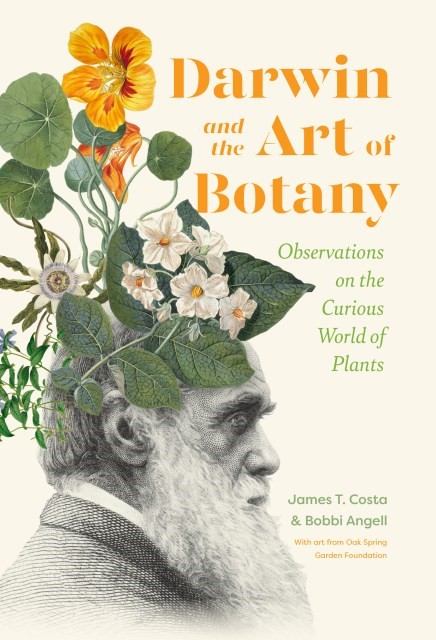
When he wasn’t musing about animals such as pigeons (Stephen Montgomery; Stephen Bodio), barnacles (Sam Kean; Ann Sylph), ‘finches’ (Heather Scoville; Arhat Abzhanov, Phil. Trans. R. Soc. B 365: 1001–1007, 2010; doi:10.1098/rstb.2009.0321), or earthworms (Jeremy Megraw), Charles Darwin (Russell McLendon; Frank Sulloway; Kerry Lotzof) spent a lot of time thinking – and writing – about plants. Indeed, six of his books were devoted specifically to aspects of their biology. And, it’s that botanical side of the esteemed biologist that is the subject of Darwin and the art of botany by James Costa & Bobbi Angell [which book is here appraised]. As its cover reminds us, this book “is an exciting new marriage of art and science, providing a fresh look at one of history’s most influential thinkers”. Grateful as we should be for that, what do we actually get?
The Introduction
Generally, this section is very well-written, although it does use some challenging words (e.g. consilient (p. 14), florilegia (p. 38), and contains some phrasing that doesn’t really work for me (e.g. “Edinburgh had not been a total bust” (p. 17), “That trip ended up fizzling” (p. 18). Whilst those phrasing issues probably reflect differences in English usage between the USA and Great Britain [the writer is American, the appraiser is British…], their presence can be a little irksome, and one has to guess at their meaning. Fortunately, such issues appear infrequent in the book. Less controversially, this section is a great – and well-referenced [which contrasts with the plant chapters – see A statement about sources] – essay providing important background on Charles Darwin and his botanical ‘legacy’.
As you’d probably expect, the Introduction sets the scene for the subsequent 45 chapters – each of which is devoted to a specific plant – admirably. If 45 plants sounds like a lot, then Costa is keen to tell the reader that “Darwin covered an astonishing diversity of plants in his far-ranging studies: 125 species of climbers, nearly 70 orchid genera, including native and tropical species, 20 carnivorous plants, more than 200 species that he experimented with for pollination and movement, and dozens of fruits and vegetables” (p. 29). With so many to choose from, selecting which species to highlight in the book must have been quite challenging.
Although a somewhat daunting task, that choice was arguably made a little easier because illustrations in Darwin’s his own works were rather few and far between, and apparently limited to black-and-white woodcuts (Emma Jones). Musing on that fact, Costa notes that the dearth of accompanying images in Darwin’s publications is particularly disappointing since the art of proper botanical illustrations was probably at its zenith during Darwin’s day. No matter, in Darwin and the art of botany, authors Coast & Angell “seek to remedy this deficiency” (p. 37). Which they most emphatically do.
However, although the colourful illustrations undoubtedly enliven the text and add interest by showing readers what the named plants look like, I’m not sure that they add much by way of additional insight into the botanical information conveyed by Darwin’s investigations. That task falls to the excerpts – supplemented in places by the original illustrations from the Darwin publications – and Costa’s commentaries thereupon.
With that caveat aside, I’m happy to concur with the author’s statement that “In this volume, we present forty-five plants studied by Darwin, representing the broad range of his extensive botanical research, with enough detail in the excerpts to give an appreciation for his working method and the remarkable depth of his investigations. Collectively, our selection covers Darwin’s major botanical research threads” (p. 30). Those threads come directly from the titles of Darwin’s six explicitly-botanical works*: The various contrivances by which orchids are fertilised by insects; On the movements and habits of climbing plants; Insectivorous plants; The effects of cross and self-fertilisation in the vegetable kingdom; The different forms of flowers on plants of the same species; and The power of movement in plants. Additionally, excerpts from On the origin of species, and The variation of animals and plants under domestication are included where appropriate, as are selections from some of Darwin’s 75 scientific papers. With that as the background, what can be said about the chapters that follow? The following…
The plant chapters
The main part of the book is the 45 ‘chapters’ – which are more like essays – that highlight a particular plant [and its relevance to the six specific aspects of Darwin’s botanical investigations]. Arranged alphabetically by genus, those chapters go from Angraecum [orchids, forms of flowers, pollination] to Vitis vinifera [climbing plants], and include plants such as Bignonia [climbing plants], Cyclamen [cross and self-fertilization [presumably a ‘typo’ since Darwin’s book title spelling is fertilisation, and that form is used elsewhere in the book, but which otherwise uses English (US) spellings, Dionaea muscipula [insectivorous plants], Lupinus [plant movement], Primula [forms of flowers, pollination], and Tropaeolum [climbing plants, movement].
Each of the separate plant entries begins with a full-page illustration (usually – always? – in colour) [additional images in black-and-white – some, if not all, from Darwin’s own works – are sometimes included within the account] of the featured plant with a legend The text has a formulaic heading showing: the featured plant’s Scientific name (e.g. Mitchella repens, Vicia faba) or – and more usually – just the genus; its English common name; the name of the Family** to which the plant belongs – as both the official ‘-aceae’ format, and the English common name of the family; and the Category (or categories) of botanical study – the ‘thread’, e.g. ‘climbing plants’ re Clematis, ‘orchids, forms of flowers, pollination‘ re Epipactis, and ‘plant movement’ re Vicia faba. – that it relates to. On average, the plant entries are 6 pages long, although there are approx. 8 pages each for plants such as Catasetum, and Trifolium.
Costa’s opening account for each plant – and text between excerpts where appropriate – gives some background to the plant highlighted and context to the excerpt(s) selected. As a useful aid to the reader, Darwin’s words are shown in different font to distinguish them from Costa’s. Although generally the excerpts are from Darwin’s books (and not just the dedicated plant titles, others, such as On the origin of species (RB Freeman; Adrian Desmond), are also used), as are his scientific articles where appropriate. Finally, for each plant showcased, there may – or may not – be a closing statement from Costa to round-off the chapter.
The excerpts from Darwin’s publications vary in length – and there may be more than one in a chapter [the account of Trifolium has excerpts from three books] – e.g. two pages’ worth in foxglove; three for Angraecum, and Arachis; approx. four for Trifolium; and over four and a half pages re Catasetum. In other words, much of the book’s text is Darwin’s own words – which are acknowledged, but which means that the book can be seen in two ways. Either as an unapologetic ‘copy-and-paste’ compilation [in which the ‘joins’ between Costa’s and Darwin’s prose are very obvious], or as a carefully-curated collection that unites Darwin’s botanical work – along with context, etc. from Costa – with illustrations of the plants he studied. I’ve opted for the latter interpretation.
Although the approx. 325 pages of Introduction and plant chapters are very much the body of the book, they don’t stand fully alone and several sections at the back of the book provide additional – and important – information that is helpful – and even indispensable – to their proper interpretation. Accordingly, a few words are necessary about the Endnotes, Bibliography, Index, and artworks consulted.
The book’s other important sections
The six and a half, 2-columned pages of Endnotes contains the notes that are included as super-scripted numbers within the text of the Introduction and plant chapters. Each of the 159 notes usually relates to a single reference, although some are multiples, e.g. two items for No. 149, and three for Nos 18 and 23; full citation details of those references are found in the Bibliography. [Additionally, footnotes, indicated by asterisks in-text, are included at the bottom of the relevant page. Unfortunately, sources are not always given for the facts presented in those items, e.g. p. 64.]
The Bibliography (but, which actually appears to be a list of sources cited – i.e. a reference list – rather than a bibliography) is approx. five, 2-columned pages. Items included are mainly books [not too surprisingly, this collection includes many works by Charles Darwin – 14 of his books (two editions of each of On the origin of species, and The variation of animals and plants under domestication)], but also a few scientific articles – including 11 of Darwin’s.
The Index, of approx. 11.5, 2-columned pages, goes from ‘162 Drawings of Plants (Hamilton)’ to ‘yellow pea’. Publications, people, places, and plants (both scientific binomial names and English common names) are prominent here. As are categories (e.g. climbing plants; cross-fertilisation; flowers, forms of; orchids) – with alphabetically-listed appropriate sub-categories (which are usually the relevant plants for that category), and topics (e.g. apheliotropism, apogeotropism, geotropism, pollination). Somewhat intriguingly, the category ‘pea’ has sub-categories that include Arachis, Mimosa, and Trifolium. Since none of those plants are ‘peas’, I infer that here ’pea’ means the pea family, the Fabaceae – of which those three genera are members. Even more intriguingly, neither Fabaceae (nor Leguminosae), nor any other plant families are listed in the Index, even though those family names are stated at the head of each plant’s entry in-text.
And, the section entitled Botanical art from the library of Oak Spring Garden Foundation catalogues the 25 publications from which images of plants were taken to illustrate Darwin and the art of botany. For each work, a mini-appraisal of the item or its author(s) is provided, as is an indication of which plants were sourced from it. Publications used include: The Orchidaceae of Mexico and Guatemala by James Bateman, Elizabeth Blackwell’s A curious herbal (Will Beharrell), The Botanical Magazine of William Curtis, 162 drawings of plants (Dame Ann Hamilton), and British flowers by Elizabeth & Margaret Wharton.
Updating Darwin for the 21st century
The publisher’s on-line catalogue tells us that Darwin and the art of botany is concerned with “situating Darwin’s words in the context of his knowledge and research of the time”. Readers should therefore know what to expect from the book – and be pleased to discover that that it is what Costa & Angell have provided. However, the book actually gives more than that because, in several places, Costa adds appropriate updates of Darwin’s own work for modern-day plant science. Here are just three examples.
The first is from the entry for Linaria. Here Costa cites the 2013 study of Anne Leonard et al. (PLoS ONE 8(2): e5591; https://doi.org/10.1371/journal.pone.0055914) when he states that “Darwin would be fascinated to learn that nectar guides may in fact reduce the nectar-robbery he often observed bumble bees engaging in, …” (p. 188). The second is in respect of “a thought-provoking “phytoneurobiological” model for understanding plant growth and physiology” (p. 316). That was referred to in the entry for Vicia faba where Costa mentions Darwin’s “root-brain hypothesis” (p. 316) and cites the modern-day articles, EricBrenner et al’s Plant neurobiology: an integrated view of plant signaling (Trends in Plant Science 11: 413-419, 2006; https://doi.org/10.1016/j.tplants.2006.06.009), and František Baluška et al’s The ‘root-brain’ hypothesis of Charles and Francis Darwin (Plant Signaling & Behavior 4(12): 1121-1127, 2009; doi: 10.4161/psb.4.12.10574). The third example relates to the conclusion of Darwin’s book on climbing plants where he states “that while all tendrils performed the same functions, they were, depending on the plant, derived from different organs, including leaves, flower-peduncles, and possibly branches and stipules” (p. 335). Costa cites the 2018 work of Mariane Sousa-Baena et al. (Front. Plant Sci. 9:403; doi: 10.3389/fpls.2018.00403) which recognises 17 tendril types, and states that tendrils are “derived from a variety of morphological structures, e.g., stems, leaves, and inflorescences, …”. Which trio underline the continuing relevance of Darwin’s 19th century work into the 21st century, and are a welcome – if largely unpublicised – feature of Darwin and the art of botany.
A statement about sources
Although the plant accounts make liberal mention of Darwin’s own works and those of his contemporaries [and clearly state the source(s) of the excerpts from Darwin’s own works], more references are needed in several places. In particular, they’re needed in the commentaries/passages by Costa that introduce each plant – for factual statements regarding the number of species in a genus, or the habitat and range of the plants considered. For example, on page 197, for Lupinus, sources are needed regarding: the belief that the plants are “ravenous as wolves”; the ability of the plants to fix nitrogen; the genus consisting of more than 200 species; and that many species are toxic. But, in adding such references – many of which are likely to be sources from the 20th or 21st century – is there a concern that inclusion of such modern-day botanical information would detract from the book’s focus on the 19th century work of Darwin and his contemporaries hence their exclusion? No. Adding sources – i.e. providing evidence for statements made – is very much in the tradition of science generally, and Darwin’s own meticulous practice in assembling evidence to support his views. Inclusion of those sources can only enhance the academic credentials of the book, and further underline the scholarship that has gone into Darwin and the art of botany.
Conspicuous by its absence…

This image of Phalaris canariensis (rightmost illustration), from Prof. Dr Otto Wilhelm Thomé’s Flora von Deutschland, Österreich und der Schweiz (1885) is in the public domain.
Whilst acknowledging that the choice of which plants to include in their book must be a privilege of the authors, one species does seem strangely absent, Phalaris canariensis (canary grass). This grass – and Avena sativa (oats (Stephen Harris) – was used by Darwin in his investigations into the effect of light and the growth movement of the coleoptile (Bob Nielsen) (which structure was known as the cotyledon in Darwin’s time) of these grasses. These studies were important to the subsequent identification of the plant hormone (Anne Marie VanDerZanden) auxin (Tom Michaels et al.) and recognition of the phenomenon known as phototropism. These experiments are described in great detail in Darwin’s book The power of movement in plants***, a publication that is clearly within the scope of the book under review. [Consistent with this omission, there’s no mention in the Index of Phalaris, Avena, coleoptile or phototropism.]
By way of underlining the importance of Darwin’s studies of Phalaris and Avena coleoptiles to plant biology, it’s worth citing the following: Nikolai Cholodny (Science 86: 468, 1937; doi: 10.1126/science.86.2238.468.a) who was of the view that Darwin’s work on coleoptiles confirms that “the basic idea of the modern theory of tropisms belongs to the great English biologist [Charles Darwin], whose merits in the physiology of plant movements seem not to be fully appreciated”; “The coleoptile later became one of the standard objects of plant physiological investigations. It is fair to say that the establishment of this system is equivalent to Thomas H. Morgan’s (1866–1945) introduction of the fruit fly Drosophila into the emerging field of animal genetics” (Ulrich Kuschera & Winslow Briggs, Plant Biology 11: 785–795, 2009; doi:10.1111/j.1438-8677.2009.00243.x); and, “Modern studies of phototropism began with experiments conducted by Charles Darwin demonstrating that light perception at the shoot apex of grass coleoptiles induces differential elongation in the lower epidermal cells” (John Christie & Angus Murphy, American Journal of Botany 100: 35-46, 2013; https://doi.org/10.3732/ajb.1200340). Quite why these iconic investigations – and therefore this plant – are not mentioned and illustrated in Darwin and the art of botany is not known; maybe that’s something to remedy in a future edition of the book.
Overview
Publisher’s Timber Press are – understandably, the clue’s in the name(!) – noted for their range of books on tree-related plant topics (e.g. Conifers of the world, and Rare trees). Darwin and the art of botany by James Costa & Bobbi Angell extends that reach to ‘non-tree plants’ (but not grasses…), and is another very worthy addition to their catalogue. All involved with its creation and production are to be congratulated. Darwin and the art of botany is not the first publication to emphasise the notion of Darwin as a botanist. For example, that idea has previously been promoted in articles by Sara Hoot and Henry Nicholls, and in Ken Thompson’s book Darwin’s most wonderful plants. But, and as Costa & Angell rightly argue, their book is probably unique in uniting plant illustrations and Darwin’s own text.
Summary
The cover**** of Darwin and the art of botany by James Costa & Bobbi Angell tells us that this “first book to present Darwin’s most important writings about plants in one accessible volume illuminates his work as never before”. I cannot dispute that statement, and the book is worth reading solely on that basis. But, dealing with such a noted plantsman, and his many investigations into the biology of plants (and placing at least some of that work in a modern-day context), it also deserves its place amongst the blossoming field of plants-and-people literature.
* Copies of Darwin’s books – and many of his other publications and correspondence – are freely-available on-line thanks to the scholarship and hard work of sites such as Darwin Online – and some of which items are referred to, and cited, in-text. Darwin’s books are also available at Project Gutenberg. The Library of Congress proudly claims to house “The complete works of Charles Darwin online”, and is accessible here. And the Biodiversity Heritage Library’s Charles Darwin’s Library is a digital edition and virtual reconstruction of the surviving books owned by Charles Darwin. Finally, Darwin’s voluminous correspondence is accessible at the appropriately-named Darwin Correspondence Project – some of which items are referred to, and cited, in-text (e.g. references for the Passiflora chapter are solely Darwin correspondence).
** A statement would be useful regarding the taxonomy used in the book. For example, Humulus is stated to be in the Cannabaceae, which is where it currently [in December 2023] resides. However, it has previously been placed in the Moraceae (e.g. on p. 96 in Vernon Heywood et al., Flowering plants of the world, Oxford University Press, 1978), and the Urticaceae (LR Chadwick et al., Phytomedicine 13(1-2): 119-131, 2006; doi: 10.1016/j.phymed.2004.07.006). I believe it would have been considered a member of the Urticaceae (stinging nettle family) in Darwin’s day – as it is classified in Bentham & Hooker’s British flora, 6th ed’n, 1892, page 400. Although it probably doesn’t matter that much what family the genera are assigned to [after all, it’s the plants themselves that are the true stars of the show], it would have been helpful to know what classification scheme is being followed in the book. Or, to put it another way, are the families stated those from the present day, or from the state of knowledge contemporaneous with the publication date of Darwin’s own books?
*** For Phalaris, see, e.g. pages 455-467 in The power of movement in plants; for Avena, see pages 466-479 of the same book.
**** Curiously, the book’s back cover provides four examples of “praise for previous works of James T Costa and Bobbi Angell”. Whilst one would hope that similarly appreciative comments could be made about Darwin and the art of botany, I’m not sure how relevant they are to the book under review here, but whose back cover they adorn. Undoubtedly, as rather glowing tributes, they clearly have marketing value from the publisher’s perspective, and could easily influence the casual browser in their decision to purchase the book. However, if you overlooked the comment about previous works, you might expect that Bobbi Angell had created the illustrations included in Darwin and the art of botany. Although this is not the case, uncritical acceptance of such ‘endorsements’ could seriously mislead the unwary. Which reminds me of the old adage that one shouldn’t judge a book by its cover. Rather, one should use appraisals of the actual book – such as this one, which will – hopefully – be more relevant and useful.

 Plant Cuttings
Leave a comment