
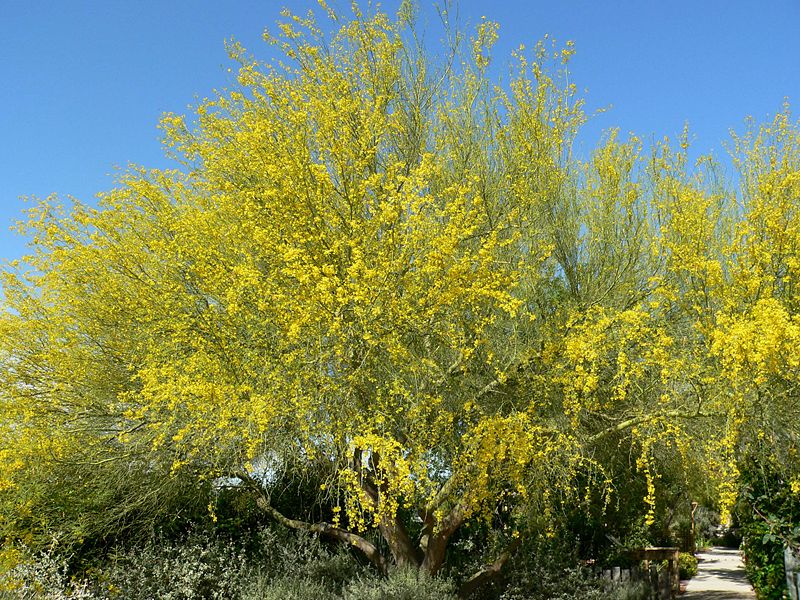
Photograph of Cercidium floridum (blue palo verde) at the Springs Preserve garden in Las Vegas, Nevada by Stan Shebs. File licensed under the Creative Commons Attribution-Share Alike 3.0 Unported license.
By way of showing what can inspire a plant cutting blog post, this item should help.
Whilst revising a lecture on forensic botany (Kate Avis-Riordan), I was also in the midst of reading Stefano Mancuso’s Tree stories. A chapter in that book considered the use of plants as evidence in criminal cases. Highlighted were the 1932 kidnapping and death of the infant son of American aviator Charles Lindbergh, and the 1992 murder and dumping of the body of Denise Johnson in the Arizona desert near some palo verde trees (Crystal Samples). Although both crimes were mentioned in my lecture, the latter case provides the starting point for this blog item.
In all the years I’d delivered my forensic botany lecture, I’d been happy to refer to the palo verde tree – DNA from whose pods “marks the first time that non-human DNA evidence has been admitted in a criminal trial” (Carol Kaesuk Yoon, Science 260(5110): 894-895, 1993; https://doi.org/10.1126/science.8493521) – as Cercidium floridum. Why? Because that is how it was named in the on-line PowerPoint lecture on forensic botany* that I originally used as the basis of content for my own talk. For many years I had neither concerns nor questions about the identification of the tree in question. However, Mancuso refers to the tree, only by a scientific name, as Parkinsonia aculeate (p. 181 of Tree stories). Although there is an issue with the specific epithet, which should probably be aculeata – and is possibly an auto-correction error by the word-processing program used to draft the book’s manuscript – I was intrigued by the name he used, because it appeared to conflict with the one I’d been happily using all that time. Because accuracy is very important to me in any tales about plants, I needed to know which name was correct. Some ‘Googling’, and searching through actual, old-fashioned, honest-to-goodness, old-school, hold-‘em-in-yer-hands, physical books, duly ensued. That bit of ‘forensic’ botany unearthed the following…
As we study plants more, our understanding of how one plant species is deemed to be evolutionarily related to others can change. Re-evaluation of the relationship can result in a change to the scientific names of plants (e.g. here, here, and here, Ken Thompson, Alan Weakley (Native Plants Journal 6(1): 52-58, 2005; 10.1353/npj.2005.0033)). That’s fine, it’s only right that the name should change in those circumstances, and is scientifically-defensible. When that first happens, the literature may alert the reader to that fact and show the older name, known as a ‘synonym’ (Alan Paton) of the plant – think, ‘such-and-such a species, formerly known as’ … – as well. And that is helpful because the former name will still persist in the older literature since there’s no facility to ‘correct’ older names that have already appeared in print [Ed. – that which has been published electronically on the internet is not so protected, and retrospective amendments to names could happen [uncomfortable echoes of George Orwell’s 1984 (Lionel Trilling) and retruthing of history here..?]]. Was this the reason for the two different names – one from a lecture written before 2002, the other from a book published over 20 years later?
Well, synonyms are listed for Parkinsonia aculeata. On Wikipedia they are Inga pyriformis, Mimosa pedunculata, Parkia harbesonii, and Parkia macropoda. The World Flora Online gives Parkinsonia inermis, Parkinsonia spinosa, and Parkinsonia thornberi as synonyms [as does RBG Kew’s Plants of the World Online [POWO] site]. But, I couldn’t find any suggestion that Parkinsonia aculeata and Cercidium floridum might be the same species.
Trying to cover all the bases, I searched for Cercidium floridum. POWO states that C. floridum is a synonym of Parkinsonia florida. As does the World Flora Online, and the University of California’s Jepson Herbarium. Wikipedia also states this, and adds that its common name is blue palo verde. It thus begins to look like there’s been a name change between Cercidium and Parkinsonia – at least as far as the ‘florida/floridum’ species is concerned**.
Support for such a name change is provided here, here, here, Georgette Kilgore, and confirmed in Table 1 in the article by Marcos Vinicius Varjão Romão & Vidal de Freitas Mansano (Rodriguésia 72 (2021); https://doi.org/10.1590/2175-7860202172119). Conclusion, Parkinsonia florida = Cercidium floridum. Although that is apparently one mystery solved, we ain’t finished quite yet…
Whilst equivalence between those two scientific names seems established, Parkinsonia aculeata isn’t the same as Cercidium floridum, and I still don’t know which is the correct scientific name of the palo verde in the case of State of Arizona vs Mark Bogan. Unfortunately, Mancuso is silent on the source for the name he used (insufficiency of sources for statements stated is probably the major deficiency in that book Bot1REF), and I can’t now recall if the original Australian slides stated their source either. So, is the tree in question Parkinsonia florida/Cercidium floridum, or P. aculeata? I’ve been unable to unearth the records from the original trial concerning the case, but have located the document relating to the appeal by Mark Bogan – to have his conviction and sentence reversed***.
Unfortunately, that document just refers to ‘palo verde trees’, which is both disappointing and surprising, Disappointing because accuracy in identifying the plant would seem to be rather important in a court of law – especially where somebody is accused of murder – and calling a tree a palo verde is nowhere need specific enough – there are several different species all with the common name of palo verde (e.g. blue, border, and Mexican, and foothills). And surprising because I thought legal types loved their Latin phrases (Jennifer Betts), and would therefore have been keen to use the plant’s Latinised scientific name.
Final attempt to solve the mystery: What was the tree called by others who have cited this case****, would that provide consensus? Somewhat presciently – maybe anticipating the taxonomic confusion that has spawned this blog post? – it’s referred to as a Cercidium sp. by David Hall & Jason Byrd (p. 102), and just a palo verde tree. The Botanical Society of America refers to ‘palo verde’ trees, which it names as Parkinsonsia microphylla – as do Chris Balouet et al. (Environmental Forensics, 2012; doi: 10.1080/15275922.2021.1940381), and thereby adds more nomenclatural confusion to the matter. Wim Koopman et al. (Forensic Science International: Genetics 6: 366-374, 2012; https://doi.org/10.1016/j.fsigen.2011.07.013) name them as Palo Verde trees (Parkinsonia florida). And David Gibson calls it a “blue palo-verde tree (Cercidium floridum, also called Parkinsonia floridum [presumably, this is a ‘typo’ and should be florida] by some taxonomists)” (p. 109).
If there’s any consensus from that, and taking into account the name used in the original slide set, it looks like the palo verde tree***** in question is Parkinsonia florida/Cercidium floridum. But, has this been established beyond a reasonable doubt? Thirty years on, it appears that the jury is still out******.
* I stumbled across this great resource, from the University of Western Australia, in searching for material for my forensic botany lecture in 2002/3. Sadly, the URL is no longer associated with any content. However, I would here like to put on the record my appreciation for the creator of that slide set – one George Stewart is named as its author, and for making it available. One of the reasons I still use several of those slides is that they have a great background. They also feature several interesting animations – the eyes that move on the ‘searching for plant clues’ slide are memorable(!). I’ve no idea how to amend the background or animations, and have no desire to because they’re great as they are. Consequently, they‘ve been shamelessly – although acknowledging their source – used for almost 20 retellings of my lecture on that topic.
** Whether this is because of re-evaluation of the relationships of the particular species to other plants, or the discovery of older legitimately described species necessitating a name change to reflect this priority in naming (Scott Mori) is not important in this instance.
*** It wasn’t, the conviction and sentence were upheld: convicted of murder in the first degree, and sentenced to life imprisonment.
**** Other commentators seem less inclined to use scientific names, thus George Sensabaugh & DH Kaye (Jurimetrics 39: 1-16, 1998; https://www.jstor.org/stable/29762581), and Heather Miller Coyle et al. (Croatian Medical Journal 42(3): 340-345, 2001) mention just palo verde trees. Jenny MacKay specifies blue palo verde trees, whilst, and somewhat curiously, they are identified as a Palo Verde vine by Tanmay Gujarathi.
***** Interestingly, the palo verde tree (Parkinsonia florida) is the state tree of Arizona. Given the associations of this species with such a notorious crime, maybe it is time for a different tree to be chosen?
****** A somewhat ironic twist to this palo verde murder case is the discovery that a Mark Bogan – a Massachusetts Certified Arborist – is the founder of Bogan Tree Services, a “full service tree care and removal company”. [Ed. – we should point out that arboricultural Mark Bogan is not the convicted murderer of the same name.]


 Plant Cuttings
Leave a comment